稀土资源可持续利用

Search documents
植物也能“造矿”?广东科学家在蕨类植物中发现稀土成矿现象
Nan Fang Du Shi Bao· 2025-11-06 10:45
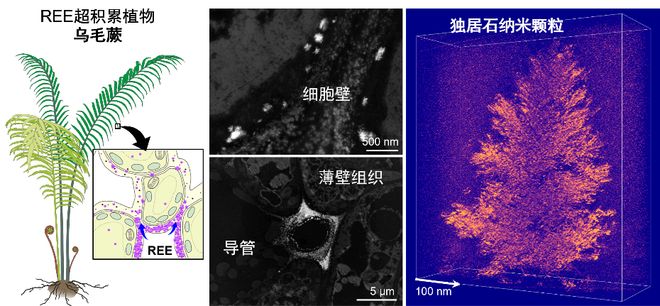
Core Insights - The research team from the Guangzhou Institute of Geochemistry has made significant progress in discovering rare earth elements within a plant called "Osmunda japonica," which has shown a unique ability to self-assemble these elements into a mineral known as "Monazite-(La)" [1][2] Group 1: Research Findings - The "Osmunda japonica" is classified as a rare earth "hyperaccumulator" plant, effectively absorbing and concentrating rare earth elements from the soil [2] - The rare earth elements are found in the vascular bundles and epidermal tissues of the leaves, precipitating as nanoparticles and crystallizing into phosphate rare earth minerals [2] - This process acts as a self-protection mechanism for the plant, encapsulating potentially harmful rare earth ions within a mineral structure, thereby detoxifying them [2] Group 2: Industrial Implications - Monazite is an important industrial rare earth ore, but natural monazite often contains radioactive elements like uranium and thorium, complicating extraction and application [6] - The "biological monazite" formed by "Osmunda japonica" under normal temperature and pressure conditions is pure and non-radioactive, presenting a promising avenue for green extraction [6] - The discovery enhances understanding of plant mineralization capabilities, previously underestimated, and opens new research opportunities for nearly a thousand known hyperaccumulating plants [6] Group 3: Environmental and Economic Benefits - The research published in the journal "Environmental Science & Technology" reveals the detoxification and mineralization mechanisms of plants regarding rare earth elements [6] - Utilizing hyperaccumulator plants like "Osmunda japonica" can facilitate soil remediation and recovery of valuable rare earth elements from contaminated sites, promoting a green recycling model of "repair and recovery" [6]

新发现:植物体内不仅有“稀土矿”还有“加工厂”
Xin Hua She· 2025-11-06 07:32
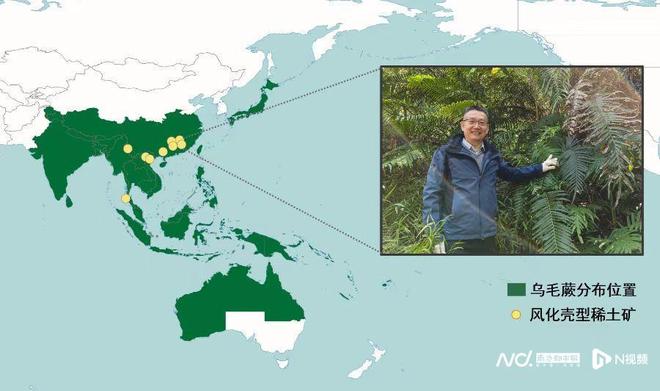
Core Insights - Researchers have discovered a significant accumulation of rare earth elements in a fern species called "U毛蕨" and observed the self-assembly of these elements into a mineral known as "lanthanite" within plant tissues, marking the first instance of biogenic mineralization of rare earth elements in natural plants [1][2] Group 1: Research Findings - The study published on November 5 in the journal "Environmental Science & Technology" highlights the potential for sustainable utilization of rare earth resources through the biogenic processes observed in U毛蕨 [1] - U毛蕨 has been identified as a "super-accumulator" plant, effectively absorbing and concentrating rare earth elements from the soil, functioning like a "vacuum cleaner" for these elements [1][2] Group 2: Implications for Industry - The biogenic lanthanite formed in U毛蕨 is free from radioactive elements like uranium and thorium, which are commonly found in natural lanthanite, presenting a cleaner alternative for rare earth extraction [3] - This discovery opens new avenues for the sustainable recovery of rare earth elements, suggesting that cultivating U毛蕨 and similar plants could facilitate soil remediation and the recovery of valuable rare earths simultaneously, promoting a green recycling model [3]