
节水灌溉

Search documents
持续完善灌排工程体系 我国耕地灌溉面积达10.86亿亩
Yang Shi Xin Wen· 2025-09-21 23:07
Core Insights - The article highlights the continuous improvement of irrigation systems in China, emphasizing the promotion of water-saving irrigation practices [1] Group 1: Irrigation Area and Water-Saving Initiatives - The total irrigated area of farmland in China has reached 108.6 million acres [1] - The area of water-saving irrigation projects has reached 63.8 million acres, representing a 12.5% increase compared to the end of the 13th Five-Year Plan [1] - The increase in irrigated area and grain production has been achieved while maintaining stable agricultural water usage [1]
新疆水利事业实现从“人逐水走”到“水为人用”的跨越——绘就人水和谐新画卷
Ren Min Ri Bao· 2025-09-18 00:41
Core Insights - The water management projects in Xinjiang have significantly improved agricultural productivity and ecological sustainability, marking a transition from traditional water usage to modern, efficient systems [1][2][3]. Group 1: Water Infrastructure Development - The construction of the Altash Water Conservancy Project began in 2011, addressing challenges such as high seismic activity and deep riverbed layers, resulting in enhanced flood control and irrigation capacity [2]. - After the project became operational in 2021, the irrigated area increased from 6.51 million acres to over 10 million acres, doubling local grain production [2]. - The Dashi Gorge Water Conservancy Project, part of a national initiative, is expected to provide ecological water for over 8 million acres of farmland upon completion in 2026 [3]. Group 2: Technological Integration in Water Management - The Uruvat Water Conservancy Project has supplied 23.9 billion cubic meters of water, increasing irrigated land to 6.0379 million acres and improving water utilization efficiency to 0.575 [4][5]. - Digital technologies have been integrated into irrigation practices, allowing farmers to manage water usage through mobile applications, significantly reducing costs and increasing crop yields [7]. Group 3: Economic and Employment Impact - The Altash project created approximately 12,000 job opportunities during its construction, with over 3,000 technical workers trained, contributing to local economic growth [2]. - The average annual income in the village is projected to reach 24,000 yuan by 2024, reflecting the positive economic impact of these water management projects [2]. Group 4: Overall Water Resource Management - Xinjiang has constructed 671 reservoirs and over 12,540 kilometers of irrigation channels, achieving a rural tap water coverage rate of 99% [8]. - The region's water management strategy emphasizes water conservation, spatial balance, and systematic governance, aiming to enhance water resource management [8].
目前我国耕地灌溉面积已超10.8亿亩—— 走灌区,算粮“账”
Ren Min Ri Bao· 2025-07-10 22:18
Core Viewpoint - The article emphasizes the importance of water management in agriculture, highlighting advancements in irrigation systems across various regions in China to ensure food security and enhance agricultural productivity [1][4]. Group 1: Water Management and Irrigation Systems - The total area for spring irrigation in China this year is approximately 43 million acres, with summer irrigation being carried out in an orderly manner [1]. - The irrigated area of arable land in China has exceeded 108 million acres, with a gradually improving irrigation and drainage engineering system [1][4]. - The modernized irrigation systems, such as the Jiaokou Pumping Station in Shaanxi, have significantly improved water delivery efficiency, achieving a maximum flow rate of 39.5 cubic meters per second [3]. Group 2: Agricultural Productivity - The Jiaokou irrigation area has cumulatively diverted 11.8 billion cubic meters of water, resulting in an increase of 15 billion kilograms of grain production [4]. - In Henan, the average yield of summer grain is reported at 1,490 pounds per acre, with irrigation practices improving water efficiency [7]. - The investment of 658 million yuan in the People's Victory Canal irrigation area is expected to reduce water usage from 90 cubic meters to 70 cubic meters per acre while increasing grain yield from 595 kilograms to over 656 kilograms per acre [8]. Group 3: Technological Advancements - The introduction of digital technologies in irrigation management, such as real-time monitoring and automated control systems, has enhanced water management efficiency in the Anhui province [9][10]. - The digital twin technology is being promoted to improve irrigation supply efficiency and effectiveness, with ongoing trials in 49 pilot areas [11][12].
蓄足“水动力” 多地抗旱保粮一线观察
Xin Hua Wang· 2025-05-28 06:49
Group 1 - The article discusses the drought situation in China, highlighting measures taken in various summer grain-producing regions to mitigate the impact of drought [1][2][3] - Jiangsu province has implemented advanced irrigation techniques, including automated monitoring systems and smart irrigation, which have significantly improved water efficiency and crop yield [1][3] - In Jiangsu, a total of 13.1 billion cubic meters of water has been diverted this year, which is double the amount compared to the same period in the last five years [1] Group 2 - In Gansu province, artificial rainmaking operations have been conducted extensively, resulting in some areas receiving over 10 millimeters of rainfall, which has allowed farmers to begin planting crops [2][4] - Efforts to enhance water efficiency include modernizing irrigation channels and maintaining water supply infrastructure, which has improved water delivery capacity by 40% in certain areas [3][5] - The Central Meteorological Observatory forecasts that the drought conditions may persist, emphasizing the need for ongoing monitoring and potential artificial rainmaking to alleviate drought impacts during the summer harvest [5]

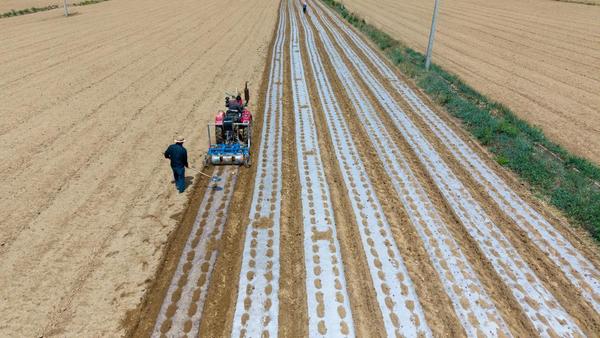
各地春灌陆续展开
Liao Ning Ri Bao· 2025-05-12 02:01
Core Points - The spring irrigation work in the province has officially commenced, with the opening of the dam at the Erfang Canal, marking a significant step in agricultural water management [1] - The provincial water resources department has organized a comprehensive irrigation supply guarantee meeting to ensure accountability and effective water management strategies [1] Group 1 - The effective irrigated area in the province is nearly 26.1 million acres, including 8.91 million acres of rice, 1.97 million acres of facility agriculture, and 15.21 million acres of irrigated land [1] - A "100-day repair campaign" has been initiated to restore seven irrigation facilities damaged last year, ensuring all repairs are completed before the spring irrigation [1] - Over 2,500 pump stations have been inspected and maintained, with timely repairs on water gates and dredging of irrigation channels to ensure efficient water delivery [1] Group 2 - As of May 1, the total water storage in 37 large reservoirs reached 15.7 billion cubic meters, which is 3.89 billion cubic meters more than the average for the same period [2] - The total water storage in 76 medium-sized reservoirs was 984 million cubic meters, exceeding the average by 223 million cubic meters [2] - By May 8, a total of 5.68 million acres of farmland had been irrigated, utilizing 225 million cubic meters of water [2] - A dynamic monitoring system for soil moisture, water conditions, and agricultural needs has been launched to ensure precise water management during the peak irrigation period [2]