
轨道交通智能化

Search documents
成都又增3条轨道交通智能化造修产线 地铁列车“大保养”在家门口就能完成
Mei Ri Jing Ji Xin Wen· 2025-08-11 08:08
Core Insights - The construction of three intelligent maintenance lines for subway train braking systems is underway in Chengdu, enhancing local capabilities for comprehensive inspection and repair of braking systems [1][2] - The establishment of the 铁科成都装备公司 aims to fill the gap in local manufacturing and repair capabilities for critical rail transit equipment in the Southwest region [2][3] - Chengdu has developed a comprehensive lifecycle maintenance capability for vehicles, covering core systems such as traction and braking, thereby promoting a complete supply chain from manufacturing to maintenance [3] Group 1 - The braking system, known as the "safety wing" of subway trains, consists of multiple complex subsystems [1] - The new maintenance lines will significantly reduce repair time and operational costs while enhancing safety and control [1][2] - The 铁科成都装备公司 has established two maintenance lines for urban rail braking systems, with plans for a third line to support higher-speed operations [2] Group 2 - The annual maintenance capacity of the new lines is projected to reach 4,800 sets, meeting the diverse needs of Chengdu's multi-type and multi-speed rail transit network [2] - The initiative is part of Chengdu's strategy to develop a national-level emerging industry cluster for rail transit equipment [2][3] - Chengdu's rail transit group has built 11 specialized maintenance lines, increasing overall vehicle maintenance capacity to 625 vehicles per year [3]
交大铁发上市募1.7亿首日涨262% 经营现金净额波动大
Zhong Guo Jing Ji Wang· 2025-06-10 07:51
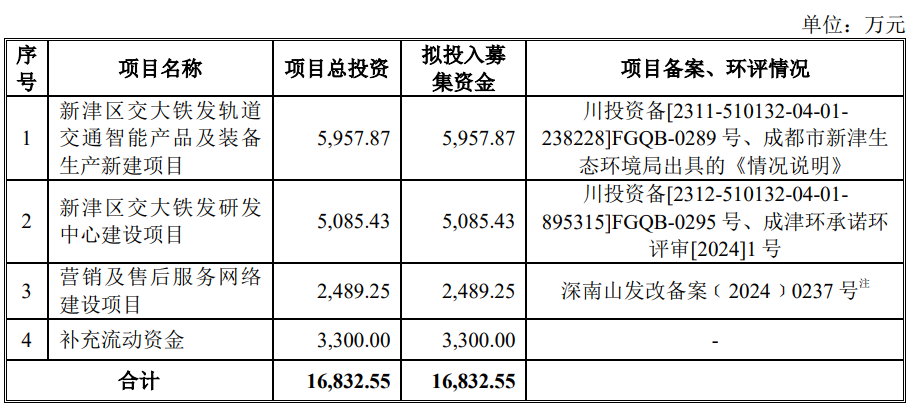
Core Viewpoint - Sichuan Southwest Jiaotong University Railway Development Co., Ltd. (referred to as "Jiaoda Tifa") has successfully listed on the Beijing Stock Exchange, with a significant opening price and trading performance, indicating strong market interest and potential for growth [1]. Company Overview - Jiaoda Tifa specializes in the research, development, production, and sales of intelligent products and equipment for rail transit, as well as providing professional technical services [1]. - The company is classified as a high-tech enterprise [1]. Shareholding Structure - The actual controller of the company is Wang Pengxiang, who holds 10.49% of the shares before the exercise of the over-allotment option and 10.11% after full exercise [2]. - Other significant shareholders include Chengdu Jingsheng (7.19% before, 6.93% after), Yangshun Enterprise Management (7.37% before, 7.10% after), and Yiguangda Enterprise Management (5.73% before, 5.52% after) [2]. - Wang Pengxiang, through various agreements, controls a total of 30.78% of the voting rights before the over-allotment option and 29.67% after [2]. Financial Performance - Jiaoda Tifa's revenue for the years 2022, 2023, and 2024 was 235 million, 273 million, and 335 million yuan respectively, with net profits of approximately 33.78 million, 48.96 million, and 56.10 million yuan [8]. - The company reported cash received from sales of 186 million, 247 million, and 241 million yuan for the same years, with net cash flow from operating activities showing fluctuations [8]. - For the first half of 2025, the company expects revenue between 11 million and 13 million yuan, with a potential net profit of 1.05 million to 1.40 million yuan, indicating a possible decline in profitability compared to the previous year [11]. Fundraising and Project Investment - Jiaoda Tifa plans to raise 16.83 million yuan through its public offering, which will be allocated to new production projects, research center construction, marketing, and working capital [6][7]. - The total investment for the new production project is approximately 59.58 million yuan, with similar amounts allocated for the research center and marketing network [7]. Market Position and Future Outlook - The company has shown a strong market debut with a closing price of 31.90 yuan, reflecting a 262.09% increase from the initial offering price of 8.81 yuan [1]. - The total market capitalization reached 2.435 billion yuan, indicating robust investor confidence [1].

香港东铁线站台门加装项目投入运作 方大集团“即装即用”技术打造轨道交通安全标杆
Zheng Quan Ri Bao Wang· 2025-06-05 12:49
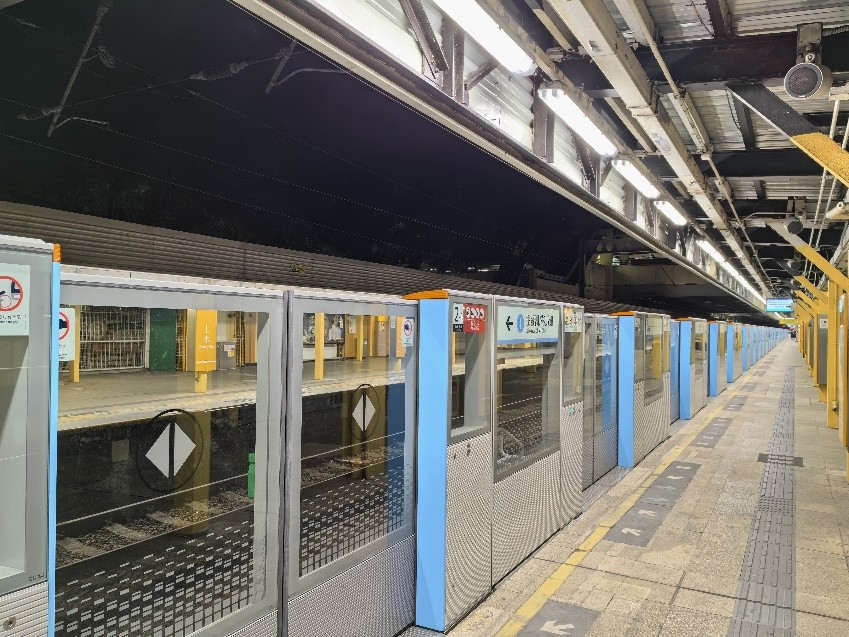
Group 1 - The Hong Kong East Rail Line platform door installation project, led by Fangda Group, was completed approximately six months ahead of schedule, marking a significant advancement in the line's safety and intelligence [1][5] - The project involved the installation of 1,575 half-height platform doors and an intelligent safety system across 13 stations and 35 platforms, enhancing passenger safety and comfort [3][4] - Fangda Group is recognized as a high-tech enterprise specializing in the development, design, manufacturing, installation, and maintenance of platform screen door systems, with a comprehensive intellectual property portfolio [3][4] Group 2 - The installation process was highly efficient, with the team completing all operations within a two-hour window during train downtime, setting a new industry benchmark for "zero interference" construction [4] - Advanced technologies such as laser radar for passenger detection and a high-reliability signal simulator were utilized to ensure safety and operational continuity during the installation [4] - The successful experience from this project is expected to provide valuable insights for the Greater Bay Area and global rail transit platform door projects, promoting technological innovation in the industry [5]

方大集团:香港东铁线站台门加装项目圆满竣工,方大“即装即用”技术打造轨道交通安全新标杆
Zheng Quan Shi Bao Wang· 2025-05-27 11:55
Core Insights - The completion of the Hong Kong East Rail Line platform door installation project marks a significant advancement in the region's rail safety and technology, being the world's first "immediate use" platform door installation on an operational railway line [1][2] - The project enhances passenger safety and comfort by installing 1,575 half-height platform doors and an intelligent safety system across 13 stations and 35 platforms, addressing historical safety gaps [1][2] Group 1 - The project took nearly ten years from exploration and design to completion, showcasing the company's ability to leverage technology to overcome complex challenges [2] - The innovative "unit sliding door center folding point design" was developed to ensure seamless operation of doors on curved platforms, demonstrating high precision in installation [2] - The use of advanced technologies such as laser radar for passenger detection and IP65 certified equipment ensures safety and reliability under adverse weather conditions [2] Group 2 - The project sets a new benchmark for global rail transit platform door installations, with record achievements in installation efficiency and zero disruption to existing services [1][2] - The successful experience from this project is expected to provide valuable insights for the Greater Bay Area and global rail transit platform door engineering, promoting technological innovation in the industry [2]
南京康尼机电股份有限公司2025年第一季度报告
Shang Hai Zheng Quan Bao· 2025-04-29 15:16
Core Viewpoint - The company, Nanjing Kanni Electromechanical Co., Ltd., reported a profit distribution plan for 2024, proposing a cash dividend of 2.5 yuan per 10 shares, amounting to approximately 212.36 million yuan, which represents 60.53% of the net profit attributable to shareholders for the year [4][23]. Group 1: Company Overview - Nanjing Kanni Electromechanical Co., Ltd. focuses on the rail transit and new energy vehicle parts industries, positioning itself as a smart transportation equipment platform [12][13]. - The company has a diversified business structure, with rail transit products as the core, new energy vehicle parts as a growth area, and smart health products as emerging business segments [12]. Group 2: Industry Context - The rail transit industry in China is experiencing growth due to national strategies and economic recovery, with significant investment in railway infrastructure, reaching 850.6 billion yuan in 2024, a year-on-year increase of 11.3% [7]. - The urban rail transit sector is stabilizing, with 58 cities operating 362 lines totaling 12,168.77 kilometers, and an expected addition of nearly 1,000 kilometers of new lines by 2025 [8]. - The new energy vehicle parts industry is supported by national policies, with production and sales of new energy vehicles reaching 12.89 million units in 2024, a year-on-year increase of 34.4% [10]. Group 3: Financial Performance - For the reporting period, the company achieved a revenue of 3.97 billion yuan, an increase of 12.64% year-on-year, primarily driven by growth in maintenance and safety door businesses [21]. - The net profit attributable to shareholders was approximately 350.83 million yuan, remaining stable compared to the previous year, impacted by provisions for investor compensation [21][23]. - The total assets of the company reached 6.92 billion yuan, reflecting a year-on-year increase of 9.69% [21].

成都运达科技股份有限公司2024年年度报告摘要
Shang Hai Zheng Quan Bao· 2025-04-18 22:14
Core Viewpoint - The company is a leading supplier of intelligent systems for rail transit, focusing on smart training, intelligent operation and maintenance, smart vehicle depot solutions, intelligent traction power supply, and intelligent freight solutions, aiming to enhance safety and efficiency in rail operations [3][20][21]. Company Overview - The company operates in the rail transit sector, providing solutions to various customer groups including national railways, urban rail, and vocational schools [3][20]. - The company has a comprehensive product line that covers multiple application scenarios in the rail transit industry, filling technological gaps and business shortcomings in the industry [20]. Business Strategy - The company follows a "3351" strategic plan, targeting three major customer groups and three main business sectors, while providing five major system solutions [7][20]. - The company integrates advanced technologies such as big data, cloud computing, IoT, 5G, AI, and digital twins into its solutions to enhance operational efficiency and passenger experience [7][20]. Key Products and Solutions - **Smart Training Solutions**: Utilizes digital twin technology and AI for comprehensive training systems covering various rail transit roles, enhancing training quality and efficiency [8][9]. - **Intelligent Operation and Maintenance Solutions**: Focuses on lifecycle health management of vehicles, utilizing IoT and big data for smart analysis and decision-making [11][12]. - **Smart Vehicle Depot Solutions**: Aims to improve operational quality and efficiency through integrated intelligent management platforms [13][14]. - **Intelligent Traction Power Supply Solutions**: Provides efficient power management and energy utilization for rail operations [14][15]. - **Intelligent Freight Solutions**: Enhances operational efficiency and reduces costs through digital transformation of traditional freight models [16][17]. Industry Position - The company has received numerous national honors and is recognized as a key player in the rail transit intelligent systems market, with a strong focus on R&D and innovation [20][25]. - The company is well-positioned to benefit from national policies promoting the development of a comprehensive transportation network and the modernization of rail systems [21][22][23]. Financial Highlights - The company has undergone accounting policy changes affecting the classification of service fees, which may impact financial reporting [26]. - The company has engaged in share buybacks to maintain value and protect shareholder interests, repurchasing approximately 6.12 million shares [28][30].

交大铁发IPO:解码轨道交通安全监测“隐形冠军”的科创底色
Zhong Guo Chan Ye Jing Ji Xin Xi Wang· 2025-03-25 10:27
Core Viewpoint - The company, Southwest Jiaotong University Railway Development Co., Ltd. (referred to as "Jiaotai Tifa"), is set to go public on the Beijing Stock Exchange, marking its entry into the capital market after nearly two decades in the rail transit safety monitoring sector, positioning itself as a "hidden champion" in the industry [1] Company Overview - Jiaotai Tifa has established a robust innovation-driven research and development system, ensuring continuous innovation capabilities and maintaining a technological edge in the rail transit safety monitoring field [1][2] - The company has participated in the development of the "High-speed Railway Earthquake Early Warning System" and is one of only three suppliers certified by CRCC for this system [2] - As of the signing date of the prospectus, the company has participated in the formulation of three industry and local standards, holds 22 authorized invention patents, 57 utility model and design patents, and 73 software copyrights, showcasing significant technical barriers [2] Market Trends - The rail transit sector is experiencing a shift from a "construction peak" to an "operation and maintenance golden period," with over 30,000 kilometers of high-speed rail expected to enter major repair cycles by 2025, leading to an operation and maintenance market exceeding 100 billion yuan annually [3] - The intelligent monitoring market in China is projected to exceed 20 billion yuan by 2025, with a compound annual growth rate of over 25%, driven by policy incentives and upgraded demand [3] IPO Details - Jiaotai Tifa plans to raise 168 million yuan through its IPO, which will be allocated to new projects for intelligent rail transit products and equipment production, the establishment of a research and development center, marketing and after-sales service network construction, and to supplement working capital [3] - The company's IPO reflects a typical growth logic for innovative enterprises, building an irreplaceable technological moat in a niche market and leveraging capital to amplify scale effects [4]