非粮生物基材料

Search documents
研判2025!中国生物乙醇行业产业链全景、发展现状、竞争格局及发展趋势分析:非粮转型与高端应用拓展,生物乙醇产业迈向高质量发展[图]
Chan Ye Xin Xi Wang· 2025-08-20 01:12
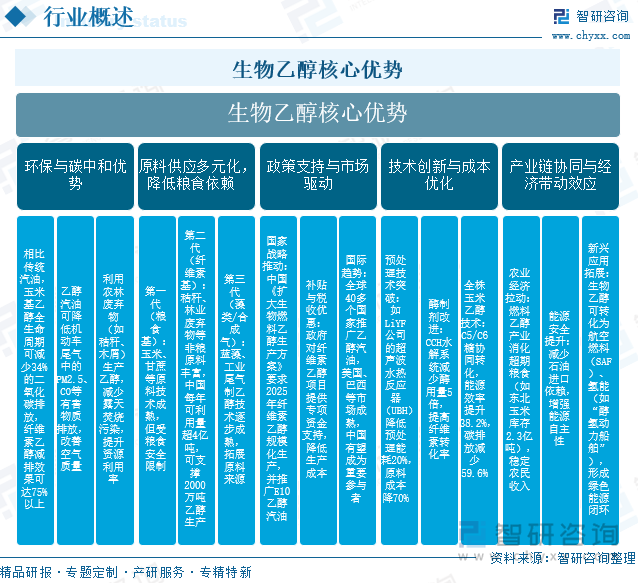
Core Insights - Bioethanol is a renewable energy produced from biomass, playing a significant role in transportation and industry due to its environmental benefits, diverse raw materials, policy support, and continuous technological innovation [1][3][7] - The industry is transitioning from food-based to non-food raw materials, focusing on carbon neutrality and high-end applications, supported by a series of national policies [1][7][19] Industry Overview - Bioethanol is produced through fermentation and distillation, primarily used as a gasoline additive or alternative fuel [2][3] - The core advantages of bioethanol include its environmental benefits, diverse raw materials, policy support, and ongoing technological innovations [3][5] Policy Analysis - The Chinese government has introduced several policies to support the bioethanol industry, emphasizing its role in energy transition and carbon reduction [7][9] - Key policies include the "14th Five-Year Plan for Bioeconomic Development" and the "14th Five-Year Plan for Renewable Energy Development," which provide strong support for high-quality development in the bioethanol sector [7][9] Industry Chain - The bioethanol industry chain in China includes upstream raw materials (corn, cassava, straw), midstream production processes, and downstream applications [10][12] - Fuel ethanol accounts for over 70% of downstream demand, primarily used in transportation, while industrial and medical ethanol also contribute to the market [10][12] Current Development Status - China is the fifth-largest bioethanol producer globally, with a projected production of 10.41 million tons in 2024 [17] - The industry faces challenges from the promotion of E10 gasoline and the increasing market share of coal-based ethanol, which may limit growth in traditional bioethanol production [17][19] Competitive Landscape - The bioethanol industry in China is characterized by an "oligopoly with coexistence of small and medium enterprises" [19] - Leading companies include Guotou Bio, COFCO Technology, and Hongzhan Distillery, with Guotou Bio holding approximately 29% market share [19] Development Trends - The industry is moving towards non-food raw materials, high-end applications, and integrated layouts, with cellulose ethanol technology breakthroughs driving down costs [21][23] - The demand for aviation biofuels and bio-based materials is expected to grow significantly, with annual growth rates exceeding 30% in high-end markets [21][23]

工信部又发文,事关非粮生物基材料产业!
DT新材料· 2025-06-26 15:06
Core Viewpoint - The article discusses the recent notification issued by the Ministry of Industry and Information Technology and the Ministry of Agriculture and Rural Affairs regarding the promotion of innovative development in the non-grain bio-based materials industry, emphasizing the importance of key technologies, application scenarios, and the cultivation of specialized industrial bases [2][3]. Summary by Sections Notification Overview - The notification aims to implement the "Three-Year Action Plan for Accelerating the Innovative Development of Non-Grain Bio-Based Materials" by addressing key issues in the collection, storage, and transportation of non-grain biomass, promoting key technologies and quality products, and fostering advanced industrial clusters [3]. Target Audience - Non-grain bio-based material companies: Those utilizing non-grain biomass for producing products such as sugars, fermentation substitutes, and basic chemicals [3]. - Enzyme and microbial companies: Focused on the separation and fermentation processes of non-grain biomass [3]. - Equipment manufacturers: Companies producing separation and purification equipment for biomass [3]. - End-user companies: Businesses applying non-grain bio-based materials in various sectors like logistics, hospitality, and healthcare [3]. - Industrial bases: Established parks focusing on the comprehensive utilization of non-grain biomass [3]. Recommended Case Areas - Key technology innovation: Emphasizing disruptive and efficiency-enhancing technologies in areas like enzyme development, biomass fermentation, and chemical production [5]. - Application scenario expansion: Highlighting commercial applications of bio-based materials in products like household plastics and medical materials across various industries [6]. - Specialized base cultivation: Focusing on industrial bases that effectively address biomass collection and utilization challenges, contributing to regional economic development [7]. Benefits of Case Application - Official endorsement: Increased publicity through various media channels for selected typical cases [8]. - Policy support: Financial backing for technology transfer and product application through various governmental initiatives [10]. - Evaluation advantages: Priority support in green factory and industrial park evaluations for recommended units [9]. - Financial support: Encouragement for financial institutions to provide green financing for relevant enterprises [10]. Application Submission Details - Submission deadline: Applications must be submitted by July 31, 2025 [11]. - Eligible applicants: Production enterprises, research institutions, and industrial parks with independent legal status [11]. - Key requirements: Technologies must have independent intellectual property rights, and cases should demonstrate promotional value [12].