Credit card debt

Search documents
Investor Kevin O'Leary Says Credit Cards Aren't 'Evil'— But Dave Ramsey Warns They're A Snake That'll 'Bite Your Freaking Head Off'
Yahoo Finance· 2025-12-01 17:31
Core Perspective - The article contrasts the views of Kevin O'Leary and Dave Ramsey on credit card usage, highlighting O'Leary's belief in personal discipline versus Ramsey's view that credit cards are inherently harmful [1][2][3]. Group 1: O'Leary's Approach - O'Leary advocates for a structured use of credit cards, employing three cards with specific purposes to maintain control and avoid high-interest debt [1]. - He emphasizes that the real issue lies with individuals' financial discipline rather than the credit cards themselves, suggesting that proper management can lead to significant savings [1]. Group 2: Ramsey's Philosophy - Ramsey argues that credit cards are designed to trap users, regardless of their intentions, and uses a metaphor of a dangerous snake to illustrate the risks involved [2][3]. - He acknowledges that while some wealthy individuals may use credit cards responsibly, he still does not endorse their use, reinforcing his belief that credit cards lead to financial harm [3]. Group 3: Credit Card Statistics - According to Ramsey Solutions, 82% of American adults possess at least one credit card, contributing to an average credit card debt of approximately $6,730 per person [4].
6 Things Keeping the Middle Class From Getting Richer
Yahoo Finance· 2025-11-21 19:25
Core Insights - Many middle-class individuals make poor financial decisions that hinder their ability to save and grow wealth [1][2] - Continuous overspending can lead to high debt levels, making it difficult to save for retirement and invest long-term [2] Group 1: Debt Management - Student loans and other forms of debt can lead to lifelong financial burdens; understanding repayment plans is crucial before taking on significant loans [4][5] - Managing debt effectively is essential to enhance earning potential and long-term financial health [5][6] - Many middle-class individuals carry substantial debt, which can impede financial progress; pursuing affordable education options can help achieve financial goals [6] Group 2: Subscription and Membership Costs - Memberships and subscriptions, while seemingly inexpensive individually, can accumulate to a significant monthly expense; for example, combined streaming services can total around $38 monthly [7] - Effective wealth building relies not just on income but on prudent spending and saving practices [8] Group 3: Investment Choices - Investing in depreciating assets is a common pitfall for middle-class individuals, as such purchases can lead to financial waste [9]
A Single Father Owes $140,000 In Credit Cards With Rates Up To 32%. Dave Ramsey Host Asks, 'Can You Take Your Kid With You To Do DoorDash?'
Yahoo Finance· 2025-11-15 23:31
Core Insights - A single father from Los Angeles, Dave, is struggling with $140,000 in credit card debt after a family crisis, emphasizing that he has no regrets about the choices made during that time [2][3] - His monthly income is approximately $8,400, with half going to mortgage payments, leaving no disposable income for emergencies [3] - The hosts of "The Ramsey Show" advised against using third-party debt negotiation services, labeling them as scams and suggesting that Dave should focus on increasing his income instead [5] Financial Situation - Dave's credit card debt includes individual balances of $22,000 and $32,000, with interest rates ranging from 25% to 32% [3] - His mortgage payment is temporarily inflated due to unpaid property taxes, but it is expected to decrease by $1,500 in March [4] Advice from Hosts - The hosts highlighted that there is no quick fix for debt and warned against shortcuts through debt relief firms [4] - They encouraged Dave to explore creative ways to increase his income rather than relying on third-party services [5]
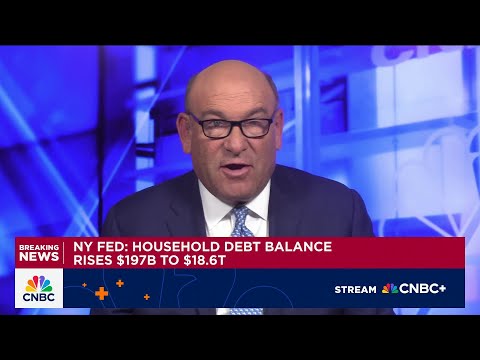
New York Fed: Household debt balance rises $197B to $18.6T
CNBC Television· 2025-11-05 17:00
Getting some breaking news out of the New York Fed. For that, we'll turn to Steve Leeman. Morning, Steve. >> Morning, Carl.Household debt, the third quarter New York Fed household debt and credit report, household debt uh balances rising uh by 197 billion. Call it 200 billion to 18.6% trillion. Uh that's a new record, but up only modestly.Mortgage and student loan and credit card debt all rose modestly. He locked debt up a little bit uh more actually a little bit elevated but auto loan debt which we've been ...

Dave Ramsey Caller Sparks Debate Over Credit Cards, Arguing It's Fine If You Pay Them Off Monthly. 'Banks Have Screwed Over The American People'
Yahoo Finance· 2025-10-26 23:01
Core Insights - The discussion on "The Ramsey Show" highlighted differing opinions on credit card usage, particularly focusing on the balance between rewards and potential overspending [1][3]. Group 1: Credit Card Usage - A caller named Miguel shared his experience of paying off credit cards in full each month and using points for family travel, specifically mentioning $4,000 in flights for a trip to Europe [2]. - Co-host George Kamel acknowledged Miguel's disciplined approach but questioned the overall value of the rewards earned, suggesting that significant spending may not justify the benefits [3][4]. Group 2: Behavioral Economics - Kamel raised concerns about the potential for overspending, illustrating that spending $200,000 to earn $4,000 in rewards equates to only 2% cashback, which could be avoided by using a debit card [4]. - Co-host Rachel Cruze emphasized behavioral studies indicating that credit card usage often leads to increased spending due to a lack of emotional connection to money, which can result in unintentional overspending [4]. - Cruze also criticized the banking industry for profiting from consumers, particularly those in debt, highlighting the moral implications of credit card rewards systems [4].
When raiding your retirement to pay off debt might be a good idea
Yahoo Finance· 2025-10-23 18:57
Core Insights - The rising credit card debt among baby boomers and Generation X is a significant financial concern, with average balances reaching $9,600 for Gen X and $6,795 for baby boomers [2] - Financial experts suggest that tapping into retirement accounts to pay down high-interest credit card debt can be a viable option, especially for those nearing or in retirement [3][4] Group 1: Credit Card Debt Situation - Credit card balances have increased significantly in 2025, creating a financial burden for many Americans [2] - The oldest Gen X-ers are now reaching retirement age, raising concerns about managing high-interest debt without a steady income [2][3] Group 2: Retirement Account Considerations - Financial advisors typically advise against withdrawing from retirement accounts, but in cases of crippling debt, it may be a necessary option [3][4] - Experts highlight that using retirement savings to pay off one-time emergency debt can be beneficial [7] Group 3: Alternative Strategies - Financial planners recommend considering alternatives to enhance income during retirement, such as delaying retirement, working part-time, or reducing discretionary spending [8]
My mom, 85, stopped paying her credit card and is already $25K in debt — but will the impact of her freefall pass to me?
Yahoo Finance· 2025-10-22 19:00
Core Insights - The article discusses the financial challenges faced by an elderly woman, Marie, who has accumulated $25,000 in credit card debt after receiving a terminal diagnosis, raising concerns about asset protection and debt collection [2][4]. Financial Situation - Marie receives approximately $1,300 monthly from Social Security and $1,600 from her late husband's pension, totaling $2,900 per month [3]. - Her house is valued at around $100,000 but is held in an irrevocable trust under her daughter Jean's name, complicating asset seizure by creditors [3][6]. Debt Collection Process - Debt collectors must obtain a court judgment before pursuing assets, and protections vary by state law [5]. - In Marie's case, most of her assets are protected from creditors due to their ownership structure [5][6]. Asset Protection - Social Security benefits are protected from garnishment by federal law, with exceptions for federal debts [6]. - The house in an irrevocable trust and the car owned by Jean's brother are not eligible for creditor claims [6]. - Non-exempt valuables, vehicles, bank accounts, and real estate owned in the debtor's name may be pursued by creditors, but specific protections apply [7].
I have $25K in credit card debt, but $0 saved — should I prioritize digging out of debt or building a safety net?
Yahoo Finance· 2025-10-17 19:00
Core Insights - The article discusses the financial dilemma faced by individuals with significant credit card debt, particularly focusing on the case of Alice, who owes $25,000 across her credit cards and is considering whether to prioritize paying off her debt or building an emergency fund [4][5]. Group 1: Credit Card Debt and Interest Rates - The average interest rate on credit card debt is significantly high, averaging 21.16% as of May, which far exceeds the return on investment from a high-yield savings account [2][5]. - Credit card debt in the U.S. reached an all-time high of $2.21 trillion in Q2 2025, with the average American owing $6,492 on credit cards [5]. Group 2: Financial Strategies for Debt Management - Alice's instinct is to pay off her credit cards first, which has advantages such as improving her credit utilization ratio and credit score, making it easier to secure loans in the future [1][5]. - There are two main strategies: focusing on paying off credit card debt first or building an emergency fund. Each has its pros and cons, with the former potentially leading to significant interest savings and the latter providing a safety net for unexpected expenses [8][11]. Group 3: Emergency Fund Considerations - If Alice opts to build an emergency fund first, she may save three to six months of living expenses, but this could result in losing money due to the high interest on her credit card debt compared to the lower interest earned on savings [8][9]. - A suggested approach is to save a mini emergency fund of $1,000 before focusing on debt repayment, allowing for minor emergencies without accruing more debt [12]. Group 4: Practical Steps for Debt Reduction - To expedite debt repayment, Alice should identify areas of overspending, create a strict budget, automate payments, and consider using windfalls to pay down debt [15]. - Two methods for debt repayment are highlighted: the Snowball Method, which pays off smaller debts first for motivation, and the Avalanche Method, which targets the highest interest debts first to save on overall interest [15].
Cam Newton talks post-NFL finances — how to prepare for an income dip
Yahoo Finance· 2025-10-10 09:17
Core Insights - Cam Newton, a former NFL quarterback, is facing financial challenges after retiring from professional sports, highlighting the difficulties of transitioning to life after fame [2][3] - The economic landscape is volatile, affecting not only athletes but also ordinary workers who are experiencing income fluctuations [4][5] Group 1: Financial Realities Post-Retirement - Newton's contract with the Carolina Panthers was worth $6 million for one year, and after its expiration in 2021, he has not received similar income, impacting his ability to provide for his family [2][3] - The sudden drop in earnings has led Newton to feel inadequate in supporting his eight children, contrasting his previous financial status [3] Group 2: Broader Economic Context - The job market is unpredictable, with significant layoffs totaling 275,240 in March due to federal spending cuts, affecting both federal and private sectors [5] - Many laid-off workers are struggling to find new employment at comparable salaries, leading to lifestyle adjustments similar to those faced by retired athletes [5] Group 3: Debt Management - American households reached a record high of $1.21 trillion in credit card debt by the end of 2024, indicating a potential financial strain for many if income decreases [7] - The average credit card interest rate is 20%, which can exacerbate financial difficulties for households facing income drops [8]
Strategies to pay down debt: Here's what you need to know
CNBC Television· 2025-09-19 14:55
Interest Rate Impact - A quarter of a percent rate cut will lower borrowing costs, especially on variable rates like credit cards and auto loans, but will also lower saving rates [1] Budgeting and Expense Management - Individuals should create a budget to track monthly income and expenses to identify areas for potential cuts [2] - Selling unused items around the house can generate extra cash [2] - Limiting credit card use and using cash or debit cards can help reduce impulse buys [2] Credit Card Debt Reduction - Extra cash should be directed towards paying down debt [3] - Consumers should ask their credit card companies for lower rates [4] - Setting up autopayments for more than the minimum balance can gradually reduce debt [5] - Utilizing 0% interest credit cards for balance transfers can help focus on debt repayment, but a 3% to 5% fee may apply [5] - A $6,000 balance transfer with 0% interest over 15 months requires monthly payments of $400 to pay it off [7] Mortgage Management - Bi-weekly mortgage payments or rounding up payments can help reduce the principal [8] - Refinancing at a lower rate can be beneficial, but may be difficult for some [8] - Shortening the loan term can maximize the mortgage [9] - Consider potential prepayment penalties before paying off the mortgage early [9] Loan Management - If struggling with car loan payments, consider selling or trading in the car for a cheaper one [11] - In cases of financial hardship, request a loan modification from lenders [11] - For federal student loans, explore income-driven repayment plans via studentaid.gov [11][12] - Refinance private student loans, but avoid refinancing federal loans into private loans due to loss of federal protections [12]