Oil Supply Disruption

Search documents
ExxonMobil CEO talks oil supply amid Iran-Israel conflict
Fox Business· 2025-06-17 20:26
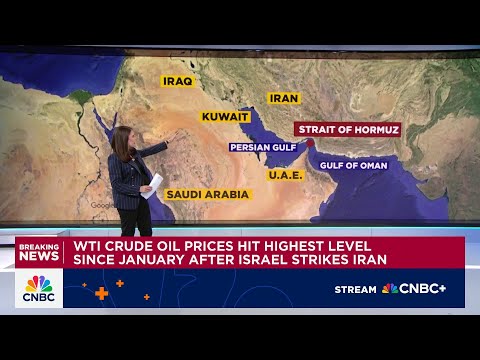
Group 1: Market Supply and Demand - ExxonMobil CEO Darren Woods stated that there is sufficient supply in the global oil market to handle any disruptions to Iranian exports, emphasizing that the main concern is the potential impact on infrastructure and shipping through the Strait of Hormuz [1] - Iran produces 3.3 million barrels per day of crude oil and exports approximately 1.6 million barrels per day, which constitutes less than 2% of total global demand [3] - The Strait of Hormuz is a critical chokepoint, with an average of 20 million barrels per day flowing through it in 2024, representing about 20% of global petroleum liquids consumption [4] Group 2: Price Movements - Oil prices surged following Israeli strikes on Iran's nuclear facilities, with U.S. West Texas Intermediate prices reaching $72 per barrel due to concerns over potential disruptions to Iranian energy supplies [5] - Although the loss of Iranian oil could increase prices by up to $7.50 per barrel, significant disruptions through the Strait of Hormuz could push prices to $100 [7] - Prices began to stabilize as it was reported that export capacity remained intact despite the attacks [7] Group 3: Infrastructure and Capacity - Iran has 11 refineries with a total refining capacity of 2.5 million barrels per day, while Israel has two refineries with a combined capacity of 300,000 barrels per day [9][11] - The Shahr Rey Refinery in Iran, targeted by Israeli missiles, has a capacity of 225,000 barrels per day, indicating the scale of potential impacts on refining capabilities [8]



Israel-Iran conflict unlikely to cause oil supply disruption, says Energy Aspects' Richard Bronze
CNBC Television· 2025-06-13 18:16
Energy Market Impact of Geopolitical Events - Rising oil prices will likely lead to increased gasoline prices [2] - The market is assessing whether the current rally in crude oil prices will escalate further [3] - The energy sector and commodities could be viewed as an insurance against geopolitical risks, but the timing of buying this insurance is uncertain [4] - A dramatic escalation is viewed as unlikely, as maintaining energy market flow is in the best interest of developed countries, Israel, and even Iran [5] - The probability of a supply disruption is not currently high, though risks exist [8] Investment Strategies - Investors who previously abandoned the energy sector are now considering their options regarding crude oil [2] - It may be too early to sell or short positions given the uncertainty heading into the weekend [7] - If there is escalation without infrastructure damage, the market may soften next week [6] - It might not be advisable to buy insurance (energy sector investments) ahead of the weekend, pending potential escalation [6] Geopolitical Considerations - The US might intervene to improve the situation [1] - President Trump may use the current situation to pressure Iran to renegotiate the nuclear deal [9] - Iran may consider advancing its nuclear program, weighing its options in the current environment [9][10]
The importance of Iran's energy complex. Here's a breakdown
CNBC Television· 2025-06-13 18:15
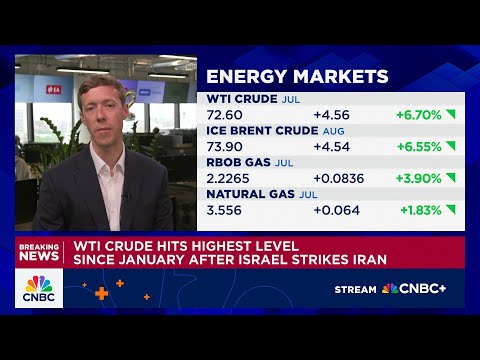
Market Overview - Energy sector is the only sector performing well today due to rising oil prices following Israel's air strikes against Iran [1] - Crude oil prices are up approximately 7% [1][7] Iran's Energy Sector and Oil Exports - Iran exports about 17 million barrels of oil per day, with over 90% of these exports originating from Car Island [2][10] - Car Island, a small island in the northern Persian Gulf, is the primary export point for Iranian crude oil [2][9][10] - Israel's decision not to target Car Island is noteworthy [8][10] - Iran's oil exports are now almost entirely directed to China [8] Strait of Hormuz - The Strait of Hormuz is a crucial artery for global energy trade, only 21 miles wide at its narrowest point [4] - Approximately 20 million barrels of oil pass through the Strait of Hormuz daily, accounting for about 20% of global oil and product demand [4] - The Strait handles 34% of the global seaborne oil trade [5] - About a third of the oil passing through the Strait is destined for China [5] - Saudi Arabia, the UAE, and Kuwait also export crude oil through the Strait [5] - The Strait is the sole export route for Qatar and the UAE, which together account for about 20% of global LNG supply [6] - Energy firm Kepler suggests that a closure of the Strait could push Brent crude oil prices above $100 per barrel [6] Market Reaction - WTI crude oil initially rallied 14% overnight but is now up a more modest 7% [7] - The market is focusing on the fact that no oil supply has been disrupted [7] - Traders are exhibiting a more measured response, possibly due to past experiences where geopolitical events did not significantly impact oil supply [7]