Reinforcement Learning (RL)

Search documents
MiniMax 技术闭门会分享:长上下文是 Agent 的 Game Changer
Founder Park· 2025-07-18 18:24
Core Insights - The article discusses the advancements in Reinforcement Learning (RL) and its potential to enhance model capabilities, particularly in the context of limited context lengths and the importance of pre-training data diversity [6][8][10]. Group 1: RL and Model Capabilities - RL can indeed provide new capabilities to models, especially when dealing with limited context lengths, by altering the output distribution and reducing the number of tokens needed to solve specific problems [6]. - The pass@k metric is highlighted as a useful measure for evaluating model capabilities, with the definition of k being crucial depending on the problem context [7]. - Reward modeling remains a significant challenge in RL, particularly for non-outcome-based rewards, which complicates the training process [7]. Group 2: Pre-training and Data Distribution - Pre-training is essential for exposing models to diverse data distributions, which is currently more varied than the narrower distributions used in RL training [8]. - The article emphasizes that while RL can potentially fill gaps in pre-training, the quality and diversity of pre-training data are critical for effective model training [8]. Group 3: Long Context and Agent Workflows - Long context windows are identified as game-changers for agent workflows, allowing for the processing of extensive information in a single pass, which enhances output quality [15][16]. - The application of long context models is particularly beneficial in fields such as legal compliance analysis and customer research, where comprehensive data processing is required [17][18]. Group 4: Hybrid Architectures - Hybrid attention mechanisms are positioned as the future of model design, combining the strengths of linear and full attention models to improve efficiency and performance [19][20]. - The article notes that the effective deployment of hybrid architectures is currently limited by infrastructure challenges, despite their proven potential [20]. Group 5: Practical Applications and Challenges - The implementation of hybrid architectures in real-world applications is crucial, especially for handling large-scale requests efficiently [22]. - The article discusses the need for unified abstraction layers to optimize both traditional and hybrid architectures in inference engines [21]. Group 6: Future Directions - The exploration of latent reasoning and self-training models is highlighted as an exciting frontier in RL research, with implications for the development of more autonomous AI systems [13][14]. - The importance of evaluating model performance based on computational budgets rather than fixed output lengths is emphasized for a more accurate assessment of efficiency [24].


对VLA的RL最新进展的梳理~
自动驾驶之心· 2025-07-03 12:41
Core Viewpoint - The article discusses the recent advancements in Vision-Language-Action (VLA) models, particularly focusing on the integration of Reinforcement Learning (RL) techniques to enhance their performance and stability in various tasks [1]. Group 1: Early Exploration of iRe-VLA - The core algorithm of iRe-VLA is PPO, which introduces a two-stage training paradigm to address instability in online reinforcement learning [2]. - The implementation utilizes BLIP-2 3B as the VLM backbone, replacing the final fully connected layer with an action head that includes a token learner and an MLP [2]. - The experimental setup involves simulation environments like Meatworld and Franka Kitchen, with tasks divided into three categories for evaluation [2]. Group 2: Preference Alignment with GRAPE - GRAPE introduces preference alignment into VLA training, specifically designed for VLA characteristics [6]. - The reward for each trajectory is composed of three parts: success reward, self-reward, and external reward based on a custom cost function [8]. - The external reward is calculated by decomposing trajectories into stages and evaluating them using a VLM task decomposer [9]. Group 3: LOOP and RIPT-VLA - LOOP combines RLOO and PPO to address challenges in sparse rewards and long sequences in multi-task scenarios [11]. - The RIPT-VLA employs the LOOP algorithm for online RL and provides open-source code for implementation [13]. - The approach includes various tricks to enhance training efficiency, such as dynamic rejection mechanisms and multi-task sampling [15]. Group 4: System and Algorithm Innovations in RL4VLA - RL4VLA models the action generation process as a multi-modal dialogue, using PPO training with dense pseudo-rewards to guide the training process [18]. - The training involves a Robotic Process Reward Model that predicts the likelihood of action sequences, enhancing the reward signal [20]. - The article emphasizes adaptive curriculum selection strategies to improve sample efficiency and generalization capabilities [21][23]. Group 5: Engineering Challenges and Future Directions - The article highlights the need for new RL algorithms suitable for VLA-RL, particularly addressing sparse reward issues and enhancing sample efficiency [30]. - It points out the engineering challenges in improving sampling efficiency and managing memory costs in VLA scenarios [30]. - The exploration of effective reward design and the implementation of RL in non-autoregressive VLA structures are identified as critical areas for future research [30].

对谈 DeepSeek-Prover 核心作者辛华剑:Multi Agent 天然适合形式化数学 |Best Minds
海外独角兽· 2025-06-12 13:27
Group 1 - The core idea of the article emphasizes the importance of "experience" in achieving AGI, particularly through reinforcement learning (RL) and the accumulation of high-quality data that is not present in human datasets [3][4] - The article discusses the significant advancements in AI's mathematical proof capabilities, highlighting the success of models like DeepMind's AlphaProof and OpenAI's o1 in achieving superhuman performance in mathematical reasoning [3][4] - The transition from static theorem provers to self-planning, self-repairing, and self-knowledge accumulating Proof Engineering Agents is proposed as a necessary evolution in formal mathematics [4][5] Group 2 - The article outlines the challenges faced by contemporary mathematics, likening them to issues in distributed systems, where communication bottlenecks hinder collaborative progress [26][27] - It emphasizes the need for formal methods in mathematics to facilitate better communication and understanding among researchers, thereby accelerating overall mathematical advancement [24][30] - The concept of using formalized mathematics as a centralized knowledge base is introduced, allowing researchers to contribute and extract information more efficiently [30] Group 3 - The DeepSeek Prover series is highlighted as a significant development in the field, with each iteration showing improvements in model scaling and the ability to handle complex mathematical tasks [35][36][38] - The article discusses the role of large language models (LLMs) in enhancing mathematical reasoning and the importance of long-chain reasoning in solving complex problems [41][42] - The integration of LLMs with formal verification processes is seen as a promising direction for future advancements in both mathematics and code verification [32][44] Group 4 - The article suggests that the next phase of generative AI (GenAI) will focus on Certified AI, which emphasizes not only generative capabilities but also quality control over the generated outputs [5] - The potential for multi-agent systems in formal mathematics is explored, where different models can collaborate on complex tasks, enhancing efficiency and accuracy [50][51] - The vision for future agents includes the ability to autonomously propose and validate mathematical strategies, significantly changing how mathematics is conducted [54][58]

Claude 4 核心成员:Agent RL,RLVR 新范式,Inference 算力瓶颈
海外独角兽· 2025-05-28 12:14
Core Insights - Anthropic has released Claude 4, a cutting-edge coding model and the strongest agentic model capable of continuous programming for 7 hours [3] - The development of reinforcement learning (RL) is expected to significantly enhance model training by 2025, allowing models to achieve expert-level performance with appropriate feedback mechanisms [7][9] - The paradigm of Reinforcement Learning with Verifiable Rewards (RLVR) has been validated in programming and mathematics, where clear feedback signals are readily available [3][7] Group 1: Computer Use Challenges - By the end of this year, agents capable of replacing junior programmers are anticipated to emerge, with significant advancements expected in computer use [7][9] - The complexity of tasks and the duration of tasks are two dimensions for measuring model capability, with long-duration tasks still needing validation [9][11] - The unique challenge of computer use lies in its difficulty to embed into feedback loops compared to coding and mathematics, but with sufficient resources, it can be overcome [11][12] Group 2: Agent RL - Agents currently handle tasks for a few minutes but struggle with longer, more complex tasks due to insufficient context or the need for exploration [17] - The next phase of model development may eliminate the need for human-in-the-loop, allowing models to operate more autonomously [18] - Providing agents with clear feedback loops is crucial for their performance, as demonstrated by the progress made in RL from Verifiable Rewards [20][21] Group 3: Reward and Self-Awareness - The pursuit of rewards significantly influences a model's personality and goals, potentially leading to self-awareness [30][31] - Experiments show that models can internalize behaviors based on the rewards they receive, affecting their actions and responses [31][32] - The challenge lies in defining appropriate long-term goals for models, as misalignment can lead to unintended behaviors [33] Group 4: Inference Computing Bottleneck - A significant shortage of inference computing power is anticipated by 2028, with current global capacity at approximately 10 million H100 equivalent devices [4][39] - The growth rate of AI computing power is around 2.5 times annually, but a bottleneck is expected due to wafer production limits [39][40] - Current resources can still significantly enhance model capabilities, particularly in RL, indicating a promising future for computational investments [40] Group 5: LLM vs. AlphaZero - Large Language Models (LLMs) are seen as more aligned with the path to Artificial General Intelligence (AGI) compared to AlphaZero, which lacks real-world feedback signals [6][44] - The evolution of models from GPT-2 to GPT-4 demonstrates improved generalization capabilities, suggesting that further computational investments in RL will yield similar advancements [44][47]

Unleashing the Power of Reasoning Models
DDN· 2025-05-15 19:50
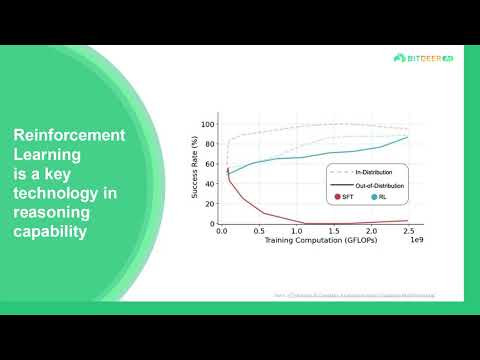
AI Development & Trends - The industry is focusing on achieving Artificial General Intelligence (AGI), aiming for AI that matches or surpasses human intelligence [1][2] - Reasoning is a key component in achieving AGI, with research institutions and enterprises focusing on reasoning models [2] - Reinforcement Learning (RL) is crucial for generalization capability in AI models, enabling consistent performance across varying data distributions [3][4] - AI is being integrated across various industries, including manufacturing, healthcare, education, and entertainment, impacting both automation and strategic decision-making [10] - Widespread adoption of AI is anticipated, driving insights, real-time analysis, and AI-powered solutions across industries [11] Company Solutions & Infrastructure - The company offers solutions for AI experimentation (Jupyter Notebooks, containerization), scalable training (distributed training jobs on GPUs), and deployment (virtual machines, containers) [6][7] - The company has data centers globally, including in the US, and is based in Singapore [7] - The company is utilizing DDN solutions to prevent data from becoming a bottleneck in AI training [8] - The company aims to make AI more efficient and cost-effective, allowing businesses to focus on innovation [12] - The company aims to transform high-performance computing by making AI computing accessible beyond big tech, focusing on developing AI in Singapore [14]