Founder Park

Search documents
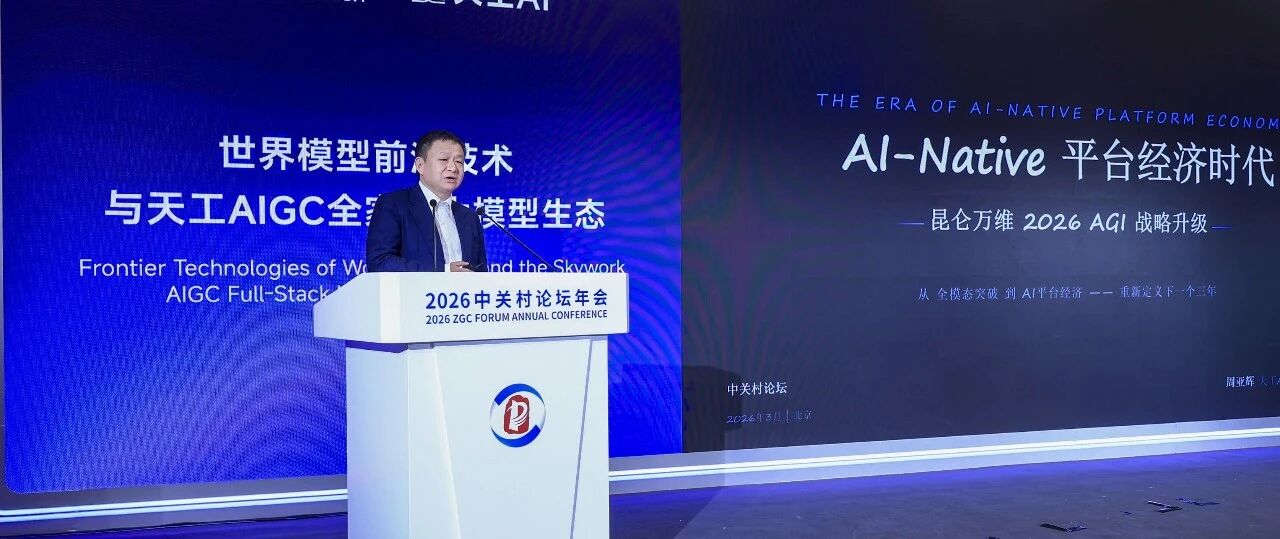
三大模态模型全部登顶后,昆仑万维正式披露了 2026 年 AGI 战略
Founder Park· 2026-03-30 10:14
Core Insights - Kunlun Wanwei and its subsidiary Tiangong AI are positioned uniquely in the Chinese AI landscape, not fitting into the typical categories of major tech players like BAT or ByteDance, yet their diverse business operations and unique market position make them a significant player across technology, finance, and the internet [2][3]. Group 1: AGI Strategy and Ecosystem - In 2026, Kunlun Wanwei's video model SkyReels V4 achieved the top position in the global evaluation platform Artificial Analysis for "text-to-video (including audio)," surpassing competitors like Google Veo 3.1 [3]. - The company's AGI strategy has evolved into a "3+1" ecosystem architecture, consisting of four SOTA models at the base, three AI-native platforms in the middle, and a super agent at the top, aimed at enhancing creativity and transitioning to an AI Native platform economy [3][10]. - The three AI-native platforms include DramaWave, an AI version of Netflix with 80 million monthly active users, Mureka, an AI music platform, and a gaming platform that allows voice interaction [12][10]. Group 2: Technological Innovations - The Matrix-Game 3.0 model addresses key challenges in interactive world modeling, significantly improving memory, scene generalization, and generation quality, achieving real-time generation at 40 FPS in 720P resolution [16][24]. - SkyReels V4 is the first video generation model to support multi-modal input and joint audio-video generation, utilizing a dual-stream architecture for precise alignment of audio and video [32][34]. - Mureka V9 enhances music creation by integrating reasoning capabilities, allowing the model to understand the emotional context and structure of music, thus producing higher quality outputs [37][40]. Group 3: Market Position and Future Outlook - The AI video generation market is highly competitive, with major players like OpenAI and Google, but Kunlun Wanwei aims to redefine the landscape by reconstructing the logic of video generation from the ground up [30][31]. - The company's ambition is to create a comprehensive multi-modal ecosystem that benefits content creators by lowering barriers and costs, potentially leading to a significant increase in the number of creators globally [41][44]. - Kunlun Wanwei aspires to transition from a tool provider to a standard-setting entity in the AI-native platform economy, similar to Apple's ecosystem approach, aiming for a complete system and experience for users [45][46].

字节出来的 00 后团队,做了一款主动式 AI 桌面助手:只记录意图,想「预测你的下一步」
Founder Park· 2026-03-30 06:08
Core Insights - AirJelly has launched its beta version, which is a desktop AI assistant designed to capture user context through screenshots and understand user intent to proactively assist in task execution [2][3] - The development team, "Low Entropy AI," is led by a post-00s founder who previously worked on a context engineering product called MineContext at ByteDance [3][4] - AirJelly's core philosophy is to capture key moments of user intent rather than recording all user behavior, aiming to predict the next steps users might take [4][5] Team Background - The founder, Bert, has a background in AI from Xi'an University of Electronic Science and Technology and has experience in various projects and internships, including at ByteDance [9][10] - The team consists of 11 members working in Beijing, emphasizing efficient communication and collaboration without a strict attendance policy [11][12] - The team is characterized by three A's: Agency (self-driven), Ambitious (aiming for significant achievements in AI), and AI Native (highly proficient in using AI tools) [12][13] Product Evolution - AirJelly evolved from MineContext, which focused on context collection, to a more proactive tool that delivers results, addressing the limitations of purely context-recording tools [15][19] - The transition was influenced by user feedback indicating that tools solely focused on context collection had low monetization potential and user engagement [19][20] - The product's design shifted from full context recording to capturing key moments, significantly reducing the volume of data processed and improving user experience [20][21] Functionality and User Engagement - AirJelly's memory system organizes information into tasks rather than a linear timeline, allowing for more efficient retrieval and management of user data [33][35] - The product aims to provide proactive suggestions based on user behavior, enhancing the overall user experience by anticipating needs [39][41] - The design includes a playful element with a jellyfish mascot that interacts with users, making the experience more engaging while maintaining functionality [44][60] Market Position and Future Outlook - The company sees a significant opportunity in the PC market, which is currently underexplored, and aims to establish itself as a leading product in proactive AI assistance [63][66] - The long-term vision includes creating a network of agents that can communicate and collaborate, enhancing the capabilities of personal assistants [70][71] - The team believes that as AI technology evolves, every individual will require their own agent, leading to a new paradigm in personal and professional productivity [70][71]

拿下 Kickstarter 只是 AI 硬件出海的第一步,线下渠道才是终局
Founder Park· 2026-03-29 05:30
Core Insights - The article emphasizes the importance of offline channels for hardware teams entering the North American market, where offline retail accounts for 80%-85% of sales, compared to only 10%-15% for online [2][11] - It highlights the need for a strategic approach to entering offline retail, as many products that succeed on platforms like Kickstarter may still struggle in major retailers like Walmart and Costco [3][11] Group 1: Market Structure and Differences - North America's retail market is dominated by offline channels, making it essential for brands to penetrate this space to achieve significant growth [11] - There is a stark contrast between the retail environments in China and the U.S., with China having a much higher online sales percentage, leading to a gap in understanding for entrepreneurs accustomed to the Chinese market [12] - The article outlines three phases of Chinese companies' international expansion: OEM/ODM, product-focused sales primarily through online platforms, and finally, brand establishment [16] Group 2: Key Considerations for Offline Strategy - The article discusses the fundamental differences between online and offline retail, emphasizing that offline retail is driven by buyer decisions based on shelf space and sales potential rather than product features [14][17] - It stresses the importance of aligning product development with buyer logic, focusing on how new products can replace existing ones on shelves and enhance overall sales [19] - The article identifies common pitfalls for Asian companies entering U.S. retail, including product adaptation, pricing confusion, and supply chain stability [20][21][22] Group 3: Preparation and Process for Retail Entry - Companies must prepare by assessing their product's market fit, ensuring compliance with local regulations, and establishing a clear pricing strategy that considers all associated costs [30] - The entry process involves several steps, including market research, product planning, negotiations with buyers, and trial sales in select stores [33][34] - The article emphasizes that achieving sell-through rates is critical for maintaining shelf space in retail, with a focus on promotional strategies and leveraging online content [36][39] Group 4: Brand Narrative and Consumer Engagement - Effective brand storytelling in North America should focus on real-life scenarios, relatable content, and alignment with local values such as sustainability [54][55] - The article advises that initial efforts should prioritize online validation and content ecosystem development before heavily investing in offline channels [56] - It highlights the importance of timing in engaging with buyers, suggesting that brands should wait until they have solid local data before making formal pitches [57] Group 5: Operational Considerations - Packaging and logistics play a crucial role in overall cost management, with a need for tailored solutions that fit the retail environment [58] - The article notes that high-ticket items require different retail strategies compared to lower-priced products, focusing on customer experience and trust-building [59][60]

ChatGPT 让所有人变成了超级个体,却没让你的公司成为超级组织
Founder Park· 2026-03-28 03:34
Core Insights - The article discusses the limitations of AI in enhancing organizational productivity despite individual efficiency gains, highlighting a disconnect between personal productivity and overall company performance [3][5][13]. Group 1: AI's Impact on Productivity - AI tools usage increased by 65% in 400 companies over 16 months, but code delivery only rose by less than 10% [3]. - Over 80% of surveyed executives reported no measurable impact of AI on productivity [3]. - The article compares the current situation to the late 19th century when factories adopted electric motors without redesigning workflows, leading to minimal productivity gains [4][13]. Group 2: Systemic Challenges - Four systemic challenges hinder productivity improvements: coordination collapse, noise amplification, productivity illusion, and AI's counterproductive effects [5][8][10]. - Coordination issues arise as employees use AI tools differently, leading to fragmented outputs [5]. - Noise amplification results from the low cost of generating content, making it harder to discern valuable insights [7]. - A study found that developers using AI tools were actually 19% slower, despite believing they were 20% faster, indicating a significant perception-reality gap [8]. Group 3: Organizational Design and AI Integration - Organizations need to redesign processes to integrate AI effectively, moving from viewing AI as a tool to treating it as a team member [15][16]. - New roles such as AI Agent Manager and Intent Engineer are emerging to manage AI's integration into workflows [16]. - The article emphasizes that organizations must focus on outcomes rather than just efficiency, as merely speeding up existing tasks does not lead to transformative results [13][14]. Group 4: Case Studies and Solutions - The article presents examples of companies like Goldman Sachs and Palantir that are successfully integrating AI into their operations by rethinking workflows and decision-making processes [20][21]. - Tezign's Generative Enterprise Agent (GEA) is highlighted as a system that understands context and drives business results, moving beyond traditional AI tools [23][28]. - GEA's Context System allows for better utilization of non-structured data, significantly increasing the efficiency of content usage [29]. Group 5: Future Directions - The article concludes that organizations must evolve from simply adopting AI tools to creating systems that leverage AI's capabilities for strategic decision-making and operational efficiency [56]. - The need for a shift in mindset is emphasized, where companies must ask if their processes are designed for AI rather than just implementing AI tools [56].

对话贝陪科技:好的 AI 陪伴产品,应该让 AI 少说话
Founder Park· 2026-03-26 11:46
Core Viewpoint - The article discusses the unique approach of Bepei Technology's product "Kedou Peipei," which focuses on children's emotional companionship rather than solely on AI interaction, utilizing NFC cards for engagement and storytelling [2][3][5]. Product Features - "Kedou Peipei" employs plush dolls without AI capabilities, relying on smart glasses for interaction and a significant number of NFC cards for storytelling and games, which are seen as the AI entry point for children [2]. - User feedback indicates that children engage with "Kedou Peipei" for an average of 51 minutes daily, with a retention rate of 51% after 150 days [2]. - The product's usage is primarily driven by free conversation (65%) and NFC card interactions (28%), indicating that children view it as a chat partner rather than just a content player [31]. Target Audience - The product is designed for children aged 2 to 8 years, based on three key considerations: the biological window of emotional connection, the plasticity of early personality development, and the shift in children's needs as they approach school age [13][14][17]. Emotional and Educational Approach - The founder emphasizes that companionship is the best form of education, advocating for a model where children learn through equal dialogue and understanding rather than didactic teaching [17][21]. - The product aims to create a nurturing environment that fosters emotional growth and communication skills in children [21][24]. Market Acceptance - The acceptance of AI companionship among parents has exceeded expectations, with many valuing emotional support over early education features [22][24]. - Parents report positive changes in their children's behavior, such as improved emotional well-being and the development of good habits, which are more significant than traditional educational outcomes [25][80]. Communication Design - The design of "Kedou Peipei" focuses on short, emotionally resonant responses that encourage children to express themselves, avoiding overly complex adult-like communication [43][70]. - The product incorporates a structured emotional response system to help children understand and articulate their feelings, fostering better communication skills [70][88]. NFC Card Integration - NFC cards are designed to align with children's cognitive development, allowing for interactive storytelling and engagement that suits their recognition abilities [47][49]. - The cards cover various themes, including emotional recognition and adventure, enhancing the interactive experience for children [54][58]. Product Development Philosophy - The company prioritizes understanding children's needs and emotions, ensuring that the product evolves alongside the child's development [71][75]. - The memory system is designed to capture significant emotional and developmental milestones rather than merely storing data, reflecting a deeper understanding of children's psychological needs [77][92]. Conclusion - The success of "Kedou Peipei" hinges on its ability to retain children's interest and gain parental approval, with a focus on emotional engagement and positive behavioral changes [78][81].

创业者出海必读,3 万字讲清 AI 产品达人营销全流程
Founder Park· 2026-03-26 09:51
Core Insights - The article emphasizes the increasing importance of influencer marketing for AI products due to the rapid growth and homogeneity of the market, where user attention is scarce [10][11][12] - Influencer marketing serves as a critical bridge between product features and user understanding, helping to translate complex AI functionalities into relatable benefits [11][12][18] - The article outlines a comprehensive framework for executing influencer marketing, detailing the entire process from preparation to execution and evaluation [6][7][10] Group 1: Importance of Influencer Marketing - Influencer marketing is essential for AI products as it addresses key challenges in user acquisition, such as high explanation costs and trust issues [10][11] - The article identifies influencers as "translation officers" for product features, helping users understand the practical benefits of AI tools [11][12] - Trust transfer from influencers to products significantly enhances user acceptance and reduces skepticism towards new AI tools [19][20] Group 2: Influencer Marketing Process - The article breaks down the influencer marketing process into stages: awareness, consideration, and conversion, emphasizing the need for a full-funnel approach [64][65][67] - It highlights the importance of selecting the right platforms for different types of content, with YouTube being the primary channel for in-depth product understanding [71][72] - The article discusses the necessity of establishing a structured creator ecosystem, using the example of HeyGen to illustrate effective influencer collaboration [42][44][48] Group 3: Metrics and Evaluation - Key performance indicators (KPIs) such as CPM, CPC, and CTR are essential for evaluating the effectiveness of influencer marketing campaigns [50][55][60] - The article stresses the importance of cross-referencing these metrics to diagnose issues in the marketing funnel and optimize future campaigns [60] - It suggests that understanding the cost of acquiring a customer (CAC) versus their lifetime value (LTV) is crucial for assessing the viability of influencer marketing channels [60]

OpenClaw 闭门局:和 30 位创业者一起聊聊,真正值得关注的 Agent 生态位在哪?
Founder Park· 2026-03-24 01:05
Core Insights - OpenClaw has ignited the Agent ecosystem, presenting a significant opportunity for a complete overhaul of related infrastructures, including payment systems, identity verification, and AI collaboration frameworks [2][3][4] Group 1: Entrepreneurial Opportunities - Entrepreneurs should focus on identifying valuable ecological niches in the rebuilding process rather than merely asking what products can be created with OpenClaw [4] - The AI Product Marketplace Meetup has gathered insights from over thirty AI entrepreneurs discussing viable opportunities post-OpenClaw [4] Group 2: Token Consumption and Value Creation - The shift in focus is from the quantity of work done by individuals to the qualitative transformation enabled by AI, where sometimes one AI can outperform ten humans [6][8] - Companies are exploring ways to reduce token consumption while maximizing value, addressing user experience issues that lead to inefficient token usage [11][12] Group 3: Payment Infrastructure Challenges - The payment infrastructure for agents is critical yet often overlooked, with traditional payment systems not aligning with the task-based payment model that OpenClaw requires [13][16] - The need for agents to have purchasing capabilities is emphasized, as they must learn to spend money before they can generate revenue [13][19] Group 4: Identity and Responsibility Issues - The biggest challenge in agent payments is determining who is responsible for the actions taken by AI, especially in transactions [19][20] - There is a consensus that agents need to be able to conduct transactions safely, with suggestions for dedicated procurement agents to mitigate risks [20][21] Group 5: Hardware and Environmental Understanding - The future of agent interaction is tied to hardware that can better understand and interpret the user's environment, moving beyond small screens and complex inputs [26][30] - Companies are exploring voice and smart glasses technologies to enhance user interaction with AI, focusing on capturing and interpreting ambient sounds and environmental data [28][30] Group 6: Memory Utilization in Agents - The challenge of memory in agents lies not in storage but in the accurate retrieval of information, with various companies developing unique memory systems [36][40] - There is potential for memory solutions to become independent companies, catering to different user needs across various platforms [41][45] Group 7: Market Dynamics and Strategic Positioning - The concept of a "moat" is seen as outdated; instead, companies should focus on timing and creating new markets rather than competing directly with established platforms [58][61] - The rise of agents presents opportunities to build new services alongside existing platforms that may resist AI integration [61]

Claude Cowork 负责人:别再给 AI 配工具了,给它一台电脑
Founder Park· 2026-03-20 12:11
Core Insights - Claude Cowork initiates a local Agent trend, automating workflows for users who may not be technically inclined [1] - The new feature "Dispatch" allows users to control Cowork remotely via mobile, enhancing productivity [2][4] - Cowork operates on a virtual machine, enabling Claude to perform tasks in a secure environment, akin to a human colleague [5][16] Group 1: Product Features and Functionality - Cowork is a user-friendly version of Claude Code, designed to cater to non-technical users while maintaining powerful capabilities [8] - The integration of a virtual machine allows Claude to install necessary software and execute tasks without user intervention [17][19] - Skills, a feature within Cowork, enables users to automate tasks easily and personalize their experience [24][26] Group 2: Development and Design Philosophy - The rapid development of Cowork in just 10 days was built upon existing prototypes and internal research [10] - The approach to product development emphasizes quick prototyping and testing rather than extensive documentation [13][15] - The platform's value is enhanced by its ability to combine existing components rather than starting from scratch [12][18] Group 3: Market Position and Future Directions - Cowork is positioned to support typical knowledge work, contrasting with Claude Code's focus on coding tasks [22] - The future of Cowork includes enhanced collaboration features, potentially integrating with tools like Slack for better teamwork [37][39] - The company believes that highly specialized AI applications may have short lifespans as models become more generalized [30]

阿里开启 Token 战略,喊出云+AI 年收入破千亿口号,底气从哪来?
Founder Park· 2026-03-19 15:46
Core Viewpoint - Alibaba has set an ambitious financial target to exceed $100 billion in annual revenue from cloud computing and AI commercialization over the next five years, with a compound annual growth rate of approximately 47% [2] Group 1: Transition from User Dividend to Token Economy - The growth of tech companies in the past decade was limited by the physical constraints of user numbers and fragmented time, primarily competing for advertising and distribution fees, which are now experiencing diminishing marginal returns [4] - In the generative AI era, the core billing unit has shifted to "Token," allowing cloud service providers to break free from previous physical limitations as AI agents become widely deployed, transferring the consumption of computing power from limited "humans" to theoretically unlimited "machines" [4] - Alibaba Cloud is undergoing a significant business model transformation, evolving from Infrastructure as a Service (IaaS) to Model as a Service (MaaS), transitioning from a server rental model to a high-frequency billing model based on Token consumption [4] Group 2: Chip Production and Pricing Power - Amid ongoing geopolitical and capacity constraints in the global GPU supply chain, a shortage of computing power is expected to persist for two to three years [5] - In the last three months, the Token consumption on Alibaba Cloud's MaaS platform surged sixfold, and the company announced price increases of up to 34% for core computing and storage products [5] - Alibaba's self-developed chip business, Tmall Genie, has achieved large-scale production, delivering 470,000 GPUs, with over 60% serving external commercial clients, supporting AI tasks across various industries [5][6] Group 3: Revenue Growth and Profitability Potential - Alibaba Cloud's revenue growth rate accelerated to 36% in a single quarter, with external commercial revenue expected to exceed 100 billion RMB this fiscal year [7] - The cloud computing model has high fixed costs, and with existing business covering these costs, the combination of rapid demand growth and a 34% price increase is likely to trigger significant operating leverage [7] - Analysts predict that Alibaba Cloud's profit margins could rise significantly, potentially aligning with the financial models of leading international cloud providers like Amazon AWS and Microsoft Azure, which typically have profit margins exceeding 30% [7] Group 4: Market Perception and Future Outlook - The market currently views Alibaba as a mature e-commerce company, with its valuation anchored in low P/E ratios [8] - As the revenue from MaaS increases and profit margins align with AWS, there will be pressure on Wall Street to reassess Alibaba's valuation [8] - Alibaba is attempting to redefine its identity and enter the AI era by leveraging its foundational infrastructure and the application ecosystem of the Token economy [8]


一款产品,同时为人类和 Agent 设计,LibTV 是怎么做的?
Founder Park· 2026-03-19 12:23
Core Insights - The article discusses the launch of LibTV, an AI video creation platform by LiblibAI, which aims to serve both human creators and AI agents simultaneously, marking a significant shift in video production tools [4][10][11]. Group 1: Product Overview - LibTV is designed to cater to both human creators and AI agents from its inception, providing two distinct entry points within the same product architecture [11]. - The platform features a highly controllable workflow canvas for human creators, allowing them to integrate text, images, videos, audio, and scripts seamlessly [12][14]. - For AI agents, LibTV offers a Skill interface that enables them to execute video creation tasks autonomously, with the ability to track project progress and make real-time adjustments [15][18]. Group 2: Market Context - The AI product landscape is evolving, with companies like Figma, Canva, and Spotify integrating AI capabilities, indicating a growing recognition of AI agents as legitimate users [7][34]. - The article highlights the need for products to adapt to the unique requirements of AI agents, which differ significantly from human users in terms of interaction and functionality [19][20]. Group 3: Design Philosophy - The design approach for AI agents differs fundamentally from that for human users, as agents do not require visual interfaces or spatial layouts to function effectively [19][21]. - LibTV's design philosophy emphasizes the need for a balance between automation and user control, allowing agents to operate efficiently while still providing a robust interface for human creators [21][22]. Group 4: Economic Considerations - The cost structure of video creation tools is critical, as AI agents require affordable access to generate multiple versions and conduct comparisons, making pricing a key factor in the platform's viability [27][29]. - LibTV's pricing strategy is positioned to lower the trial-and-error costs for creators and ensure that agents can operate economically, facilitating broader adoption [28][30]. Group 5: Industry Implications - The emergence of platforms like LibTV reflects a broader industry trend where AI agents are increasingly recognized as distinct user entities, necessitating tailored product designs [34][36]. - The article suggests that companies must prepare for the integration of AI agents into their workflows, as this shift is expected to redefine product development and user interaction in various sectors [35][36].