
Retirement Plan

Search documents
Suze Orman: These 3 Curveballs Could Derail Your Retirement Plan
Yahoo Finance· 2025-10-13 12:16
Core Insights - Suze Orman emphasizes the importance of understanding potential challenges as retirement approaches, highlighting three key issues that could impact retirement plans Group 1: Continuing to Work for Pay - The Employee Benefit Research Institute's survey indicates that 75% of working individuals expect to earn money during retirement, but only 30% of retirees are actually doing so [2][3] - The disparity may arise from age differences, as those still working are likely to be younger retirees compared to those who are not working [3] - Economic factors also play a role, particularly the impact of earning income on Social Security benefits, where exceeding a certain income threshold can significantly reduce benefits [4][5] Group 2: Social Security Considerations - If retirees begin collecting Social Security before reaching full retirement age, they risk losing a portion of their benefits if their earnings exceed $23,400 [4][5] - An example illustrates that a retiree earning $50,000 while collecting Social Security could see their monthly benefit reduced from $2,000 to approximately $891.67 due to exceeding the income limit [5] - Conversely, a retiree earning below the threshold can retain their full Social Security benefits, as demonstrated by another example [6] Group 3: Planning Implications - The key takeaways suggest that individuals may overestimate their ability to work for pay in retirement, necessitating careful planning [7] - It is advisable for those intending to work post-retirement to delay taking Social Security benefits until reaching full retirement age to avoid reductions [7]
6 Smart Ways To Use Your Social Security Income After Retiring
Yahoo Finance· 2025-10-04 11:24
Core Insights - The article emphasizes the importance of effectively utilizing Social Security checks as they only replace about 40% of pre-retirement income on average [1] Group 1: Essential Expenses - Social Security should be viewed as the foundation of retirement income, primarily used to cover non-negotiable costs such as housing, groceries, and healthcare [3] - Essential expenses like utilities, food, and Medicare premiums should be prioritized with Social Security income, while discretionary spending should come from savings or investment accounts [4] - Covering essential expenses first ensures that Social Security income provides steady support before drawing on other savings [5] Group 2: Coordination with Other Income Sources - Social Security is one component of a comprehensive retirement plan, which should also include pensions, 401(k)s, IRAs, and brokerage accounts [5] - It is recommended to coordinate withdrawals and investments to smooth cash flow and minimize taxes [5] - Consulting with a CPA can help map out projected income and required minimum distributions, aiding in the management of tax brackets over time [6] Group 3: Emergency Cash Cushion - It is advisable to maintain a cash cushion of six to twelve months' worth of essential expenses in a highly liquid account to handle unexpected costs [7] - This buffer allows individuals to manage surprises without needing to sell investments during market downturns [7]
X @Investopedia
Investopedia· 2025-10-04 00:00
Retirement Plan Overview - Qualified retirement plans adhere to government guidelines safeguarding employee savings [1] - These plans typically offer tax advantages to both employees and employers [1]
Suze Orman: 3 Accounts Can Make or Break Your Retirement
Yahoo Finance· 2025-09-23 10:01
Core Insights - The article emphasizes the importance of establishing a solid retirement plan to achieve personal dreams and financial security in retirement [1] Group 1: Retirement Accounts - The 401(k) or 403(b) is highlighted as a foundational element of a solid retirement plan, with many individuals neglecting to actively manage their contributions [3][4] - Approximately 25% of savers are not contributing enough to qualify for maximum employer matching contributions, which can lead to significant financial losses [4] - The Roth 401(k) is introduced as a beneficial option that combines features of traditional 401(k) and Roth IRA, allowing for after-tax contributions and tax-free withdrawals in retirement [5][6] Group 2: Tax Benefits - The Roth 401(k) offers long-term tax benefits, as contributions are made with after-tax dollars, and withdrawals during retirement are completely tax-free [7]
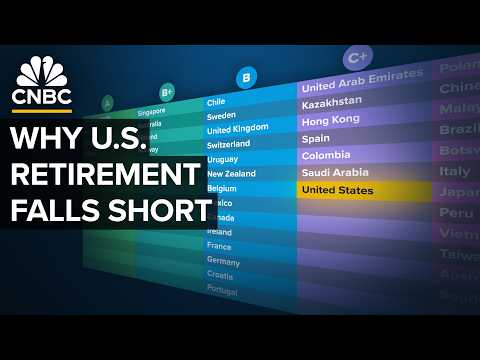
Why The U.S. Retirement System Gets A C+ Rating
CNBC· 2025-08-29 16:00
U.S. Retirement System Challenges - U.S Social Security is facing insolvency by 2033, potentially leading to a 20% benefit cut if the trust fund runs short [1] - The U S retirement system received a C+ rating from the Mercer CFA Institute Global Pension Index in 2024, indicating a solid system with significant risks [1][2] - 401(k) system may not be effective as funds are often withdrawn before retirement for various needs [3] - By 2050, the world could face a $400 trillion shortfall in retirement savings, with the U S being a major contributor to this problem [29] - In 2019, the estimated loss of savings due to 401(k) cash outs ranged from $60 billion to $105 billion [19] Global Comparison and Solutions - Countries are raising retirement ages and requiring mandatory contributions to address issues like longer lifespans and fewer workers paying into the system [4] - A grade retirement systems often feature a net replacement rate of at least 65% for median income earners, private pension coverage of at least 80% of the working-age population, and pension contributions of at least 12% of wages [5][6] - The Netherlands, with its mandatory contributions, serves as a model, transitioning from defined benefit to defined contribution plans [7][9][10] - Australia's mandatory defined contribution plan, covering everyone, is highlighted as a successful approach [11] U.S. Strengths and Weaknesses - U S retirement plan assets are 250% (two and a half times) the median of OECD countries, indicating high savings rates [14] - Despite high savings, the median retirement savings for baby boomers is zero, highlighting inequality [15] - While 70% of U S workers had access to a retirement plan as of March 2023, only 53% participated, indicating a coverage issue [17] - The U S system's voluntary nature and allowance of pre-retirement withdrawals are criticized, but the high savings rates and retirement incomes suggest some success [10][13][34]

The Near-Perfect 7% Income Portfolio: My Blueprint For Financial Freedom
Seeking Alpha· 2025-08-08 11:30
Group 1 - The article discusses the inadequacy of Social Security for a decent retirement and suggests alternative retirement plans [1] - It highlights the importance of exploring various income alternatives such as REITs, mREITs, Preferreds, BDCs, MLPs, and ETFs for retirement planning [1] Group 2 - The article emphasizes the need for in-depth research on investment options to secure financial stability in retirement [1]


X @Investopedia
Investopedia· 2025-06-27 13:01
Retirement Plan Enrollment - Vanguard 报告显示,18% 有资格通过雇主参与退休计划的员工未注册 [1]