Turnaround strategy

Search documents
Allbirds is closing its last brick-and-mortar store in San Francisco
TechCrunch· 2026-01-28 16:48
Core Insights - Allbirds is closing almost all of its physical stores by the end of February, leaving only two outlet stores in the US and two full-price stores in London [1][2] - The CEO of Allbirds stated that this move is part of a turnaround strategy aimed at achieving profitable growth by reducing costs and exiting unprofitable locations [2] - The company, founded in 2015, quickly gained popularity among tech employees but has struggled financially since going public in 2021, with a current market capitalization of approximately $32 million and stock prices hovering at just a few dollars per share [4] Company Overview - Allbirds was established in San Francisco and became known for its comfortable yet minimalist footwear, appealing primarily to tech workers [3] - The brand raised significant venture capital, leading to an inflated valuation before its public offering, which has since resulted in financial difficulties [4] Market Context - The closure of Allbirds stores may signify a shift in the tech industry, where the perception of job stability has changed, and companies are now more focused on efficiency and cost-cutting [5][7] - The nostalgia for the mid-2010s tech culture is evident, as the current economic climate contrasts sharply with the previous era of perceived stability and growth [8]



Allbirds to Close Remaining Full-price U.S. Stores
Yahoo Finance· 2026-01-28 16:32
Core Viewpoint - Allbirds Inc. is closing its remaining full-price stores in the U.S. to enhance profitability and focus on e-commerce, wholesale, and international distribution, which are seen as offering greater reach and flexibility [1] Group 1: Store Closures - The company will close all full-price stores in the U.S. by the end of February, retaining only two outlet stores in the U.S. and two full-price stores in London to maintain key brand touchpoints [1] - The closures are part of a broader strategy to reduce costs and support long-term business health, as stated by CEO Joe Vernachio [1] - Allbirds has been reducing its brick-and-mortar presence over the past two years, indicating a shift towards a more capital-efficient growth model [1][2] Group 2: Financial Performance - In the most recent third quarter, Allbirds reported a net revenue decline of 23.3% to $33.0 million, down from $43.0 million in the same period last year [1] - The company also experienced a net loss of $20.3 million, which is an improvement compared to a net loss of $21.2 million a year ago [1] - Allbirds plans to discuss the financial impact of the store closures during its fourth-quarter and full-year 2025 earnings call, expected in March [2] Group 3: Strategic Implications - Reducing the number of stores eliminates investments in those locations and mitigates exposure to inventory risks amid a challenging retail environment [3] - This strategy allows Allbirds to respond more quickly to changing market conditions without the burden of store operations and overhead costs [3]
Citi Trends Details Turnaround at Conference, Targets $45M EBITDA and 650 Stores by 2027
Yahoo Finance· 2026-01-12 16:36
Core Viewpoint - Citi Trends is positioned as the only off-price retailer specifically targeting African-American customers, offering styles and brands at competitive prices for an underserved demographic [1][7]. Company Overview - Citi Trends is an off-price retailer specializing in family apparel, accessories, and home categories, headquartered in Savannah, Georgia, with 591 stores across 33 states [2][22]. - The average store size is approximately 12,000 square feet, with a strong presence in the Southeast [2]. Sales Performance - The company has shown consistent quarter-over-quarter sales performance over the past five quarters, with holiday comparable store sales increasing by 9.3%, building on a 7.1% increase from the previous year, resulting in a two-year stack of 16.4% [3][4]. - Citi Trends has achieved "industry-leading comparable sales growth" since the current CEO took over 19 months ago, driven by transaction increases and broad-based product strength [4][7]. Financial Position and Growth Strategy - Citi Trends operates with a debt-free balance sheet and has approximately $140 million in total liquidity, planning $45 million in capital spending for remodels and new stores in 2026-27 [6][16]. - The company targets approximately $45 million in EBITDA by 2027, with projected sales of about $900 million and around 650 stores by the end of 2027 [6][24]. - Management aims for annual store sales gains of 6-8% and category expansion, including footwear and plus sizes [19]. Customer Demographics - The core customer base has an average age of around 40, with over one-third shopping weekly or biweekly, and household incomes ranging from $75,000 to $150,000 [8]. - The company employs a three-tier product strategy to cater to different income levels, aiming to grow the extreme value segment to represent an additional 10% of total sales [7][10]. Marketing and Community Engagement - During the holiday season, Citi Trends launched a marketing campaign that garnered over 12 million viral views, emphasizing community connection and trust [11]. - The company positions its stores as "community anchors," enhancing local engagement and customer loyalty [11]. Store Expansion and Technology - Citi Trends plans to open 25 new stores in 2026 and at least 40 stores annually starting in 2027, utilizing AI-driven site selection to replicate successful store profiles [13][15]. - The company has refreshed 62 high-volume stores and expects to remodel about 50 stores per year as part of ongoing market investment [12]. Long-term Financial Goals - The company aims for a gross profit rate expansion of about 400 basis points to 42% and SG&A leverage improvement of 200 basis points by fiscal 2027 [24]. - Long-term financial goals include restoring foundational practices and optimizing inventory management through AI-based systems [18].

Alto Ingredients Faces Sales Pressure: Is a Turnaround in the Cards?
ZACKS· 2026-01-06 17:41
Core Insights - Alto Ingredients (ALTO) has faced a consistent decline in sales due to lower average sales prices per gallon and reduced volumes of essential ingredients sold, influenced by weak oil and gasoline prices [1][8] - The company is implementing a turnaround strategy by diversifying into higher-value specialty alcohols and essential ingredients, aiming to reduce earnings volatility and dependence on fuel ethanol pricing [3][8] Sales Performance - ALTO's revenues are highly sensitive to ethanol price movements, corn input costs, and demand from fuel blenders and industrial end markets, with sales declines noted across all major segments [2] - The company has idled or exited underperforming facilities and low-margin contracts to preserve liquidity and stabilize profitability, resulting in revenue contraction [2] Strategic Initiatives - ALTO is expanding carbon dioxide capture and utilization at its facilities, monetizing fermentation-derived CO2 to create a higher-margin revenue stream aligned with sustainability initiatives [3] - The company continues to streamline its cost structure and prioritize capital investments with near-term visibility, although sales are expected to decline in 2025 [4] Peer Comparison - Green Plains Inc. (GPRE) is also experiencing uneven sales due to fluctuating ethanol prices and is reshaping its business mix toward higher-margin products [5] - Gevo, Inc. (GEVO) is generating modest sales as it advances renewable fuel projects, with expectations for sales growth as projects reach commercialization [6] Stock Performance - ALTO's stock has gained 45.4% over the past year, outperforming the industry and the S&P 500 composite [7] - The stock is currently trading at a price-to-earnings multiple of 16.63, which is higher than the industry average of 15.95, indicating an expensive valuation [10] Earnings Estimates - The Zacks Consensus Estimate for ALTO's fourth-quarter 2025 EPS has not changed in the last 30 days, with expectations for a year-over-year decrease in revenues for 2025 and an increase for 2026 [11][12]


Noodles & Company receives delisting determination letter
Yahoo Finance· 2026-01-02 18:15
Core Viewpoint - Noodles & Company is facing imminent delisting from the Nasdaq Stock Market due to its stock price falling below the required minimum of $1 per share, with a current price of 63 cents as of December 22, 2025 [1] Group 1: Delisting and Compliance - The company received a delisting warning on June 24, 2025, and was given 180 days to comply with the minimum share price requirement [2] - Noodles & Company plans to request a hearing to stay the delisting process, which will allow it to continue trading while the hearing is pending [2] - A special stockholder meeting is scheduled for February 4, where the company will propose a reverse stock split to increase its share price [2] Group 2: Financial Performance and Strategy - The company has been attempting a turnaround for over a year, launching a revamped menu and operational improvements [4] - For the quarter ending September 30, the company reported a 4% increase in same-store sales, with October showing an 8% increase, despite a 0.5% decrease in total revenue and a net loss of $9.2 million [4] - Noodles & Company has engaged Piper Sandler to explore options for maximizing shareholder value, including a potential sale of the company [4] Group 3: Investor Actions - Activist investor Galloway Capital Partners has urged Noodles & Company to sell approximately 200 of its 349 company-owned restaurants [4]
Nike shares jump 5% after Apple CEO Tim Cook doubles personal stake that's now worth $6M
New York Post· 2025-12-24 16:44
Core Insights - Tim Cook, CEO of Apple, purchased approximately $3 million worth of Nike shares, increasing his stake in the company and indicating confidence in Nike's turnaround strategy under CEO Elliott Hill [1][2] - Following the announcement of Cook's purchase, Nike's shares rose by 5% [1] - Cook's acquisition of 50,000 shares at $58.97 each is noted as the largest open market stock purchase by a Nike director or executive in over a decade [2] Company Performance - Nike has reported weaker quarterly margins and declining sales in China, despite efforts by CEO Hill to boost demand through new marketing strategies and innovation [3][4] - The company's margins have been under pressure for over a year, and its stock has decreased nearly 13% since the results were announced on December 18, indicating ongoing challenges [4] - Nike's shares were trading at $60.19 on Wednesday, reflecting a trend of declines over the past four years [4] Strategic Moves - CEO Elliott Hill is focusing on reviving Nike's market position by phasing out underperforming lifestyle brands and strengthening relationships with wholesalers like Dicks Sporting Goods [3] - Tim Cook has been closely involved with Nike's strategic decisions, including advising on key appointments such as Hill's [6][8] - Other board members, including former Intel CEO Robert Swan, have also made significant stock purchases, indicating confidence in the company's future [8]


BP share price forecast as it sells Castrol to Stonepeak Partners
Invezz· 2025-12-24 08:18
Group 1: Company Strategy and Financials - BP has initiated its divestment strategy by selling a majority stake in its Castrol business to Stonepeak Partners for $10.1 billion, expecting to net about $6 billion in cash from the transaction while retaining a minority stake [1][2] - The company aims to unload businesses worth over $20 billion in the coming years as part of its turnaround strategy, which is intended to simplify operations and improve performance [2][3] - BP's recent management change, appointing Meg O'Neill as CEO, is part of this strategy, replacing Murray Aunchincloss, whose previous efforts received mixed reviews from investors [3][4] - In the third quarter, BP reported a replacement cost profit of $2.2 billion and an operating cash flow of $7.8 billion, with plans to reduce net debt to between $14 billion and $18 billion by the end of 2027 [4] Group 2: Market Performance and Technical Analysis - BP's share price has decreased by 10% from its peak in November, currently trading at 427p, amid declining energy prices, with Brent and WTI down by 25% from their highs this year [1][5] - The stock has shown signs of bearish trends, having formed a double-top pattern and moving below key technical indicators, including the 100-day Exponential Moving Average and the 61.8 Fibonacci Retracement level [8][9] - The next key support level for BP's stock price is at the 50% Fibonacci Retracement level of 393p, while a rise above 435p would invalidate the bearish outlook [9]

Nike tops earnings estimates as rising North America sales help to offset China weakness
CNBC· 2025-12-18 21:25
Core Viewpoint - Nike is undergoing a turnaround strategy under CEO Elliott Hill, focusing on regaining growth and market share while addressing inventory issues and enhancing wholesale relationships [1][2]. Financial Expectations - Analysts expect Nike to report earnings per share of 38 cents and revenue of $12.22 billion for the second fiscal quarter of 2026 [6]. Business Performance - In the fiscal first quarter, improvements were noted in wholesale, running, and North America, but challenges remain in the China segment and direct business, which are expected to persist into the new year [2]. - Nike's stock has dropped over 11% this year, indicating market concerns about its performance [1]. Impact of Tariffs - Nike anticipates tariffs to cost approximately $1.5 billion, impacting its gross margin by 1.2 percentage points in fiscal 2026, an increase from earlier estimates of $1 billion and 0.75 percentage points [3]. Leadership Changes - The company has made leadership changes to streamline operations, including the departure of Chief Commercial Officer Craig Williams, as part of its "Win Now" strategy aimed at growth [4]. Strategic Partnerships - Nike has reported a strong start in its partnership with Kim Kardashian's shapewear brand, NikeSKIMS, which has received a positive response [5].
Verizon's CEO Calls Its 6.6% Dividend "Sacrosanct." How Safe Is It Really?
The Motley Fool· 2025-12-12 21:28
Core Viewpoint - Verizon Communications is facing challenges despite its 6.6% dividend yield, which has been described as "sacrosanct" by the CEO, Daniel Schulman. The company has a history of increasing dividends for 19 consecutive years, but the growth has been modest compared to inflation [1][2][10]. Financial Performance - Verizon reported $134.8 billion in revenue for 2024 and serves 146.1 million wireless retail connections, covering 99% of Fortune 500 companies and 99% of the U.S. population with its 4G LTE service [5]. - The company has lost 30% of its market share since 2017 and is now ranked No. 3 in the telecom industry, indicating heightened competition [6]. - In the last quarter, Verizon lost 7,000 postpaid phone customers and laid off 13,000 employees, reflecting dissatisfaction with its performance [7]. Dividend Analysis - Verizon's dividend has increased by only 1.8% this year, which is below the annual inflation rate of 3%. Since 2020, the dividend has grown by 12%, also lagging behind inflation [2][12]. - The company declared a quarterly dividend of $0.69 per share, amounting to $2.92 billion in dividends next quarter, which is less than half of the $7 billion in cash flow from operating activities [10]. - Verizon has paid off $9.4 billion in debt over the last year, which is nearly equivalent to the $11.2 billion paid in dividends for 2024, allowing for potential flexibility in maintaining dividends [11]. Strategic Outlook - The new CEO aims to reclaim network leadership, with some positive indicators such as 306,000 net adds in the broadband segment, totaling 13.2 million subscribers [8]. - Efficiency gains have led to a record $7 billion in free cash flow for the company, marking a 17% year-over-year increase [9]. - While the dividend is expected to remain stable, future hikes may be minimal, making it less appealing for long-term investors due to inflation concerns [12].


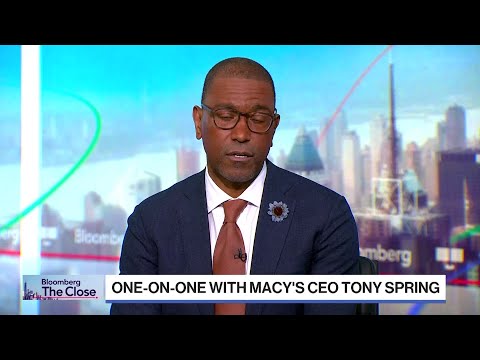
Macy’s CEO: Will Close More Stores in 2026
Bloomberg Television· 2025-12-09 18:44
Strategy & Transformation - Macy's is implementing a turnaround strategy focused on a leaner organization and improved customer experience [1] - The strategy includes shrinking the store footprint from a peak of 700-800 stores to approximately 350 [7] - Macy's is remodeling existing stores, with 125 already completed and more planned for 2026, alongside store closures [7] - A healthier digital business is crucial, serving as both a transaction platform and a discovery hub to build customer relationships [8] Customer Experience & Service - Macy's is focused on improving customer service, achieving record Net Promoter Scores (NPS) [2] - Enhancements include improving the quality and breadth of assortments, offering a range from "good, better, best contemporary" brands [3] - The company aims to provide a seamless experience across digital and physical channels [9] Leadership & Culture - Leadership emphasizes the importance of strategy, culture, leadership, and execution working together [4] - A combination of a great business and a great culture is essential for success [5] - Patience and determination are necessary to achieve long-term goals [6]