trade deficit

Search documents
‘No president’s ever read it this way’: Trump faces major legal challenge over tariff justification
MSNBC· 2025-08-03 16:34
Is Donald Trump's sweeping tariffs go into effect? We are waiting on a ruling from a federal appeals court that may answer a crucial question. Are the bulk of Trump's tariffs even legal? During a likely legal argument on Thursday, federal appeals courts judges seem skeptical that Trump had the power to bypass Congress and impose tariff rates around the world by using a 1977 emergency law. Joining us now is the lead lawyer who argued the tariffs case against Trump's executive order, former US acting solicito ...

Trump's tariffs go to court: 'They have yet to make a case for why this actually works'
MSNBC· 2025-07-31 21:45
Trade War & Tariffs - The Trump administration's tariff authority is facing legal challenges, with arguments presented before a federal appeals court questioning the necessity of congressional approval for imposing tariffs [1] - The lawsuit argues that tariffs imposed by President Trump represent the largest tax increase on Americans since 1993, costing the average American household $1,300 per year [1] - The administration defends the tariffs by citing the large trade deficit as an emergency, but the executive order mentions persistent trade deficits over the past 50 years, potentially undermining the emergency claim [1] - A lawyer argues that historically, no president has unilaterally imposed tariffs in the manner that President Trump has [3] - Congress has granted the president limited power to increase tariffs by 15% for 150 days in response to large trade deficits, but Trump bypassed this statute [4] Impact on Businesses - Small businesses are claiming that the tariffs are crippling them, with one company, Micro Kits, canceling orders and facing potential payroll issues [5] - Reshoring manufacturing to the US to avoid tariffs is projected to cost trillions of dollars and potentially take decades [7]
Former U.S. Trade Rep. Ron Kirk: President Trump's trade policy is more performative than strategic
CNBC Television· 2025-07-08 15:22
Trade Deficit and Tariff Impact - The trade deficit has widened, partly due to retaliatory measures from other countries in response to the US's more aggressive trade policies [3][4] - Blanket tariffs are not seen as effective in addressing trade imbalances, with little support outside the administration [18] - There's concern that tariffs are more performative than strategic, causing market downturns without achieving reshoring or manufacturing goals [5][6] US Economic Position and Trade Relations - The US is considered the most desirable economic market, but its reputation is being damaged by perceived bullying tactics and disregard for the rule of law [14][15] - Other trading partners are questioning whether they can rely on the US's word, potentially seeking alternatives [16] - The administration's approach is putting US businesses in a difficult situation [16] Tariff Revenue and Economic Impact - The administration is expected to collect $3.7 trillion in tariffs, potentially to offset tax cuts, but this cost will ultimately be borne by American businesses and consumers [11] - Tariffs are viewed as a tax on American businesses and consumers, despite being presented as a toll on access to the US market [10] - Companies dependent on foreign inputs may face layoffs or business closures due to tariffs [12] Alternative Trade Strategies - Sectoral targets, focusing on specific industries and egregious behavior, are considered a more effective and targeted approach than blanket tariffs [17][18]
‘Take Any Job You Can Get’: Danielle DiMartino Booth
CNBC· 2025-06-24 16:00
Economic Outlook & Strategy - Companies should prioritize cost-cutting and productivity improvements to navigate economic uncertainty, as they lack pricing power due to stagnant income levels [2][3] - Tariffs, even at 10%, can significantly impact companies with low profit margins, such as Walmart with a 2.8%-2.9% profit margin, potentially leading to passing costs onto consumers [5][6] - Correcting the trade deficit is a complex, multi-year process requiring careful planning and incentives for American companies to produce domestically [8][9] - The U S national debt has increased by $15 trillion since the pandemic, raising concerns about the country's reserve currency status [10][11] - The growth rate of deficit spending is unsustainable, with over $1 trillion spent annually on servicing the debt, limiting Congress's flexibility [12][13] - The U S economy may have entered a recession in the first three months of 2024, with net job losses beginning in the second quarter, highlighting the limitations of economic models [19] Federal Reserve & Monetary Policy - The Federal Reserve is criticized for relying on lagged data and being "behind the curve," suggesting they should be lowering interest rates in response to economic conditions [21][22] - University of Michigan data indicates that when over 50% of Americans expect rising unemployment, a recession is likely, with recent surveys showing 64%-66% anticipating higher unemployment [23][24] Labor Market & Future of Work - The labor market is polarizing into high demand for roles that AI cannot replace (e g, home health aides) and those requiring advanced education to train AI [25] - A liberal arts education is valuable for developing imaginative thinking skills needed to train AI, while trade skills are also in high demand, with some high school graduates earning $70,000 annually [26][27] - Younger workers should seek any available job to demonstrate work ethic during tough economic times and broaden their skill set for an uncertain future [28][29]
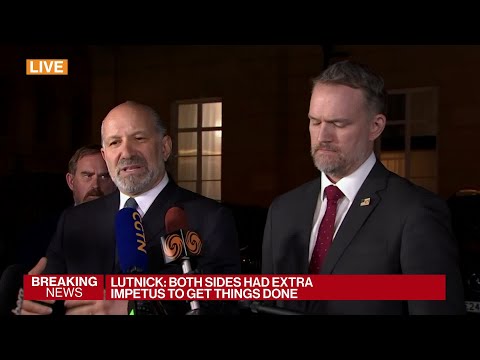
Lutnick: Trump Needs to Approve Plan Between US, China to Ramp Down Trade Tensions (Reporter Q&A)
Bloomberg Television· 2025-06-11 13:45
Trade Relations & Negotiations - The primary objective is to reduce the trade deficit and increase trade between the US and China [1][17] - The US and China aim to achieve positive trade growth that benefits both nations [1] - The Geneva agreement serves as a framework for trade discussions, but implementation was slow [7][11] - A phone call between President Trump and President Xi provided a strong foundation for reaching an agreement [7][8][12] - Both sides are motivated to reach an agreement, with a focus on making it beneficial for both countries [2] - The two largest economies in the world have reached a handshake for a framework to implement agreements [13][14] Key Issues & Implementation - Expects the topic of rare earth minerals and magnets to be resolved within this framework [5] - The US put measures on when those rare earths were not coming, expect those to come off in a balanced way [6] - The focus is on implementing the Geneva agreement and the president's consensus [5][19] - The implementation of the Geneva agreement is contingent on mutual agreement from both presidents [21] - Fentanyl is a priority issue for the US, and progress is expected from China on this matter [21][22] Future Outlook - The framework aims to unlock the ability to discuss broader economic issues between the US and China [20] - The US seeks to grow trade with China in a positive way, which will reduce the trade deficit [17]