
Mortgage rates

Search documents
Mortgage and refinance interest rates today for September 22, 2025: Rates are unsteady since Fed meeting
Yahoo Finance· 2025-09-22 10:00
Core Insights - Current mortgage rates have decreased, with the 30-year fixed rate at 6.32% and the 15-year fixed rate at 5.70%, providing a potential opportunity for homebuyers to secure lower rates [1][17][19] Current Mortgage Rates - The national average mortgage rates are as follows: - 30-year fixed: 6.32% - 20-year fixed: 5.86% - 15-year fixed: 5.70% - 5/1 ARM: 6.84% - 7/1 ARM: 6.92% - 30-year VA: 5.83% - 15-year VA: 5.36% - 5/1 VA: 5.83% [4][17] Refinance Rates - Current mortgage refinance rates are generally higher than purchase rates, with the following averages: - 30-year fixed: 6.46% - 20-year fixed: 5.72% - 15-year fixed: 5.73% - 5/1 ARM: 7.18% - 7/1 ARM: 7.40% - 30-year VA: 5.85% - 15-year VA: 5.61% - 5/1 VA: 5.55% [5][17] Monthly Payment Examples - For a $300,000 mortgage at a 30-year term with a 6.32% rate, the monthly payment would be approximately $2,481, resulting in a total interest payment of $493,199 over the loan's life [8] - For the same mortgage amount at a 15-year term with a 5.70% rate, the monthly payment would increase to $3,311, with total interest paid being $195,969 [10] Adjustable-Rate Mortgages (ARMs) - ARMs typically start with lower rates than fixed-rate mortgages but carry the risk of rate increases after the initial fixed period. For example, a 5/1 ARM has a fixed rate for the first five years [11][12] - Recent trends show that ARM rates can be similar to or even higher than fixed rates, emphasizing the need for consumers to shop around for competitive offers [13] Strategies for Securing Low Rates - To obtain lower mortgage rates, consumers should focus on higher down payments, improving credit scores, and reducing debt-to-income ratios. Additionally, options like buying down interest rates at closing can be considered [14][15]
Adjustable-rate mortgages are staging a comeback as buyers seek lower rates
Yahoo Finance· 2025-09-20 12:00
Core Insights - Demand for adjustable-rate mortgages (ARMs) has surged, making up 12.9% of all mortgage originations last week, marking a post-crisis high [1] - ARMs offer lower initial rates compared to 30-year fixed-rate mortgages, with a 7/6 ARM averaging 5.78% versus 6.35% for a 30-year fixed mortgage [2] - Many potential homebuyers are willing to accept the risks associated with ARMs due to high home prices and elevated mortgage rates [4] Industry Trends - The interest in ARMs has increased as prospective clients show curiosity, with some mortgage brokers noting a rise in inquiries [5] - Historically, ARMs accounted for up to one-third of overall loan volume before the 2008 financial crisis, but fell to less than 1% by late 2008 [6][7] - The resurgence of ARMs in 2022 was brief, driven by rising interest rates, but they are now gaining traction again as borrowers seek more affordable options [7]
What Does a Fed Rate Cut Mean for Mortgages?
Yahoo Finance· 2025-09-19 17:03
Group 1 - The Federal Reserve has begun cutting the federal funds rate, leading to market excitement and expectations of more cuts by year-end [1] - Current average mortgage rates for a 30-year loan are at 6.26%, which has deterred many potential homeowners and investors [1] - Rate cuts are expected to lower mortgage rates, but the relationship between federal funds rate and mortgage rates is not direct, as lower borrowing rates may also increase housing prices [2][3] Group 2 - The federal funds rate influences lenders' offerings and housing demand indirectly, as mortgage rates are more closely tied to Treasury yields and the bond market [3] - The impact of the Fed's rate cuts on Treasury bonds will take time to materialize, potentially delaying the effects on mortgage rates until early 2026 [4]
Why mortgage rates are actually going up after the Fed cut interest rates
Yahoo Finance· 2025-09-19 02:05
Core Viewpoint - The increase in 30-year mortgage rates following the Federal Reserve's interest rate cut is attributed to market expectations regarding future policy moves, despite the initial counterintuitive nature of this trend [1][7]. Group 1: Federal Reserve Actions - The Federal Reserve cut its benchmark interest rate by 25 basis points, bringing it to a range of 4% to 4.25% [4]. - This rate cut was anticipated by the market, which has historically seen mortgage rates react differently than expected [7]. Group 2: Mortgage Rate Movements - Following the Fed's announcement, the 30-year mortgage rate increased by 9 basis points to 6.22% on the same day, and then rose an additional 15 basis points to 6.37% the next day [5]. - In contrast, Freddie Mac's report indicated that mortgage rates fell to the lowest level in 12 months, as it collected data before and after the Fed's decision [6]. Group 3: Market Reactions - The spike in mortgage rates was relatively small and reflects how financial markets are interpreting the Fed's future policy direction [1]. - The crash of Mortgage News Daily's website during the announcement indicates a significant public interest in mortgage rate changes [4].
Treasury counselor Lavorgna: Mortgage rates coming down as inflation eases, Fed moves toward neutral
CNBC Television· 2025-09-18 19:51
Let's stay on bonds and stocks and markets because we've got new highs across the board for equities. Nearly all major averages on pace for new records. The market seems to have adjusted to tariffs.But what happens if the Supreme Court rules that the tariffs are actually illegal. Would that hurt America's massive debt load. Let's talk about that and more.Joe Leavone is well known to our audience as a markets guy, but now serves as counselor to Treasury Secretary Scott Bessant. Joe, good to have you on the p ...

Treasury counselor Lavorgna: Mortgage rates coming down as inflation eases, Fed moves toward neutral
Youtube· 2025-09-18 19:51
Group 1 - The equity markets are reaching new highs, indicating a market adjustment to tariffs, but potential Supreme Court rulings on tariffs could impact the U.S. debt load [1] - The Federal Reserve has cut its overnight lending rate, yet bond yields are rising, suggesting a complex market response [2][3] - Mortgage rates are nearing their lowest in a year, influenced by lower inflation and the Fed's movement towards a neutral stance [3] Group 2 - Tariffs are generating record revenue, contributing to a more sustainable fiscal position for the U.S., which may lead to lower interest rates over time [4][15] - The Congressional Budget Office (CBO) has been criticized for its low estimates of potential GDP growth, which contradicts observed economic indicators such as strong blue-collar wage growth and capital expenditure recovery [12][13] - The CBO projects that tariffs could reduce deficits by $4 trillion over a decade, highlighting their significance in fiscal planning [15]
Mortgage rates up after Fed rate cut
CNBC Television· 2025-09-18 18:08
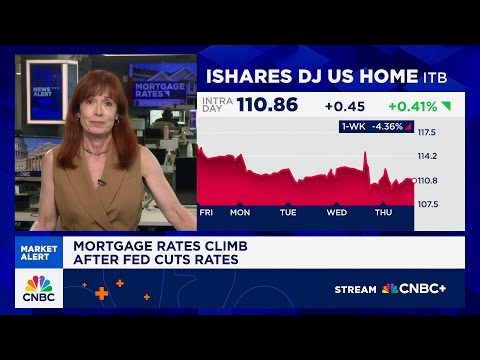
Mortgage rates, meantime, on the move after yesterday's rate cut. Let's get straight to Diana Ol for the latest. Diana.>> Well, Melissa, as we discussed on Tuesday before the Fed cut, mortgage rates could go up and they did. They went up 15 basis points this morning, adding to nine basis points that they rose yesterday, making 24 basis points specifically since the Fed cut its rate. And that all according to Mortgage News Daily.Now, that's because, you know, as many experts weighed in, they expected that pe ...
Mortgage rates edge down, refinancing applications tick up (XLRE:NYSEARCA)
Seeking Alpha· 2025-09-18 16:29
Core Insights - Mortgage rates have decreased slightly, leading to an increase in refinancing applications [2] - The average rate for 30-year fixed-rate mortgages is 6.26% as of September 18, down from 6.35% the previous week, but higher than 6.09% from the same week last year [2] Mortgage Rate Trends - The current average for 30-year fixed-rate mortgages is 6.26% [2] - This represents a decrease of 0.09 percentage points from the previous week [2] - Year-over-year, the rate has increased from 6.09% [2]
Mortgage rates tick up following Fed move, though they’re still near 2025 lows
Yahoo Finance· 2025-09-18 16:12
Group 1 - Mortgage rates increased after the Federal Reserve's 25 basis-point cut, with the average 30-year fixed mortgage rate rising to 6.22% [1][2] - The Fed's interest rate decisions influence mortgage rates, but they do not directly control them, as noted by Fed Chairman Jerome Powell [2][4] - Despite the Fed's rate cuts, mortgage rates have historically risen during similar periods, indicating uncertainty in future trends [4][5] Group 2 - The 10-year Treasury yields initially fell but ended higher, influenced by a significant drop in unemployment claims [3] - Freddie Mac reported mortgage rates at 6.26%, the lowest since early October 2024, although much of the data was collected before the Fed's cut [4] - There is a notable increase in refinancing demand, surging 58% week-over-week and up 70% year-over-year, alongside a 3% rise in mortgage applications for home purchases [6]
Mortgage rates ticked up after the Fed cut, following a familiar path
Yahoo Finance· 2025-09-18 16:12
Core Insights - Mortgage rates have increased following the Federal Reserve's recent interest rate cut, which is a common but counterintuitive trend [1][2] - The average 30-year fixed mortgage rate rose to 6.35% from 6.13% just before the Fed's rate cut [1] - Fed Chairman Jerome Powell indicated that while the Fed's decisions influence mortgage rates, there is no guaranteed outcome as the economy faces challenges [2] Mortgage Rate Trends - Prior to the recent increase, mortgage rates had been declining for several weeks as markets anticipated the Fed's cut and employment data showed a slowdown [4] - The Fed's recent 25 basis point cut did not lead to a decrease in mortgage rates, which have historically risen during previous rate cut periods [5] - Financial markets are expecting a more aggressive easing of monetary policy than what the Fed is likely to implement, suggesting limited further declines in mortgage rates [6] Borrower Behavior - There has been a significant increase in refinancing demand, which surged by 58% week-over-week and is up 70% year-over-year [7] - Mortgage applications for home purchases also saw a 3% increase week-over-week, indicating a potential uptick in market activity [7] - Despite the improvement in mortgage demand, home sales have remained sluggish due to high home prices and elevated mortgage rates [7][8]