Economic Growth

Search documents
X @The Economist
The Economist· 2025-12-05 17:00
One tailwind to economic growth is that the aftermath of the covid pandemic is now playing out in Europe’s favour. The other, grimly, is defence https://t.co/jv7ICpjjcg ...
X @Bloomberg
Bloomberg· 2025-12-05 07:18
Economic Activity - German factory orders surged in October [1] - This surge boosts the idea that Europe's biggest economy eked out growth in the final quarter [1]
German Parliament to Vote on Key Pension Bill
Bloomberg Television· 2025-12-05 06:37
What is at stake then, Oli, for the German chancellor today, I think once again, his authority is at stake, which is something we've seen really from the very beginning of his chancellorship. He's not somebody that was beloved really by really anybody in the German sort of political arena, even within the CDU. And there's this pension vote that's going before the Bundestag today in which there is a rebellion, not just from the broader parts of his coalition, but actually within a fragment of his own CDU, th ...


Economic growth has slowed to unacceptable levels, says author Jim Paulsen
CNBC Television· 2025-12-04 21:46
Although the overall market is flat today, some momentum names staging a strong comeback such as quantum computing stocks and the Buzz ETF. So, are investors once again willing to take on riskier parts of the markets. Joining me now is Paulson Perspectives author Jim Pollson and Ariel Investments vice chairman Charlie Babrinskoy.Guys, welcome. Jim, you're concerned about economic growth here. What what's the impact potentially in the markets.Yeah, I I think that um I think the economy is fairly weak awardly ...

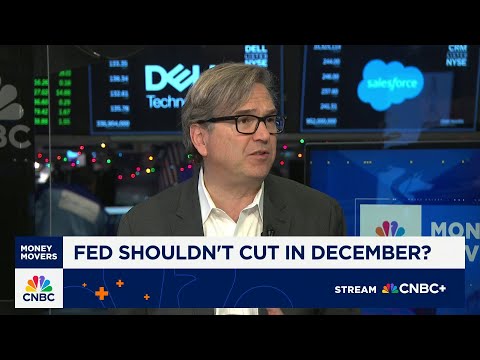
Why former CEA chair Furman says Fed shouldn’t cut rates in December
CNBC Television· 2025-12-04 17:24
The odds for a rate cut at next week's meeting now 90% according to the bond market. But our next guest says the Fed should not be cutting. Joining us here is former CEA chair Jason Ferman who is now a professor at Harvard Kennedy School was in the Obama administration.It's great to have you Jason. Welcome. >> Great to be with you.>> You do not think the Fed should be cutting. >> Yes. First of all, I don't disagree.They are going to cut next week. >> But they have a dual mandate. They are about onetenth of ...
X @Bloomberg
Bloomberg· 2025-12-04 07:42
Denmark raised its growth projections for this year, suggesting Novo Nordisk is able to fuel its economy despite mounting pressures https://t.co/1LDsIDr1JV ...

X @Bloomberg
Bloomberg· 2025-12-04 04:34
The RBI's last rate decision of the year is proving to be one of its trickiest, with policymakers having to weigh up record low inflation against a plunging currency and 8%-plus economic growth https://t.co/PbPV1H2XBO ...
These are the Economic Reports We’re Still Waiting On After the Shutdown
Investopedia· 2025-12-04 01:02
Core Insights - The federal government shutdown has delayed the release of key economic data, impacting the ability of agencies to provide timely information on inflation, employment, and economic growth [1] Economic Data Release Schedule - Agencies are working to catch up on missed economic reports following a 43-day shutdown, with several reports rescheduled, consolidated, or canceled [1] - New release dates include: - December 3: September industrial production and capacity utilization (originally scheduled for October 17) - December 5: September Personal Consumption Expenditures (PCE) price index, personal incomes and outlays (originally scheduled for October 31) - December 9: September and October Job Openings and Labor Turnover Survey (JOLTS) (originally scheduled for November 4 and December 2) - December 10: Q3 employment cost index (originally scheduled for October 31) - December 16: November U.S. employment report, including October payrolls (originally scheduled for November 7 and December 5; October household survey canceled) - December 18: November Consumer Price Index (CPI), including a subset of the October report (originally scheduled for November 13 and December 10) - December 23: Q3 Gross Domestic Product, initial estimate (advance GDP estimate scheduled for October 30 canceled; subsequent estimate originally scheduled for December 19 postponed) - December 23: October and November industrial production and capacity utilization (originally scheduled for November 18 and December 16) [1] Pending Reports - Several reports still need to be rescheduled, including: - September housing starts (originally scheduled for October 17) - September new home sales (originally scheduled for October 24) - September advanced reports on trade deficit, wholesale inventories, and retail inventories (originally scheduled for October 29) - September U.S. trade deficit (originally scheduled for November 4) - September business inventories (originally scheduled for November) - October retail sales (originally scheduled for November) - October PCE price index, personal incomes and outlays (originally scheduled for November 26) [1]

X @Bloomberg
Bloomberg· 2025-12-03 09:59
France’s private sector grew for the first time in more than a year, defying an initial assessment that it stagnated https://t.co/N0TzKJUG49 ...
Reimagine Asia's Future To 2030 | Ben Simpfendorfer | TEDxLianyang
TEDx Talks· 2025-12-02 16:07
[music] [applause] What will Asia look like in 2030. How will geopolitics, supply chain, artificial intelligence change the landscape. We we know the region accounts for onethird of the global economy, twothirds of its population.It we know it will be a consumption hub, production hub, innovation hub. But what does this mean for business. What does this mean for markets.Well, to answer that question, we brought together 80 business leaders from across the region, leading multinationals, Asian corporate cham ...