inflation

Search documents
X @Bitcoin Archive
Bitcoin Archive· 2025-11-02 14:23
🇺🇸 TREASURY SECRETARY BESSENT: If inflation is dropping, Fed should be cutting rates https://t.co/eaJbO0DR2t ...
X @Watcher.Guru
Watcher.Guru· 2025-11-02 14:17
JUST IN: 🇺🇸 Treasury Secretary Bessent says the Fed should continue to cut interest rates if inflation is dropping. ...
X @Nick Szabo
Nick Szabo· 2025-11-01 19:11
RT Saifedean Ammous (@saifedean)After quadrupling the money supply in 2 years, Milei finally comes up with an explanation, and it's textbook inflationist Keynesian nonsense:Without inflation, the 'undermonetized' economy would suffer deflation that would kill economic growth. 🤡Viva La Carry Trade Carajo! ...
Peter Schiff says recent sell-offs of 1 hot asset are meant to ‘scare’ weak hands — but the market is ‘alive and well’
Yahoo Finance· 2025-11-01 10:55
Core Viewpoint - The recent volatility in gold prices, including a significant drop of 6.3% on October 21, is seen as a correction within a continuing bull market rather than an end to the upward trend [2][4]. Market Sentiment - Market sentiment can shift rapidly, with investors often reacting emotionally to price movements, leading to potential selling at unfavorable levels [1][2]. - Peter Schiff emphasizes that during a bull market, the largest price movements are typically downward, which can mislead investors into thinking the market is reversing [2][3]. Gold Market Analysis - Schiff argues that the recent decline in gold prices is a necessary reset to eliminate weaker investors and prepare for future gains, suggesting that gold remains a strong buy below $4,000 [4][5]. - He predicts that gold could reach prices as high as $26,000 or even $100,000, driven by a decline in the value of fiat currency rather than changes in gold itself [4][6]. Investment Perspectives - Gold is viewed as a safe haven asset, especially during economic turmoil, as it is not subject to inflationary pressures like fiat currencies [5][6]. - Prominent investors, including Ray Dalio and Jamie Dimon, support the notion that gold should be a significant part of investment portfolios, especially in uncertain economic conditions [6]. Investment Strategies - One suggested method for investing in gold is through a gold IRA, which combines the benefits of retirement accounts with gold investments, providing tax advantages [7].
Fed's Logan: Will find it difficult to cut rates again in December
CNBC Television· 2025-10-31 14:13
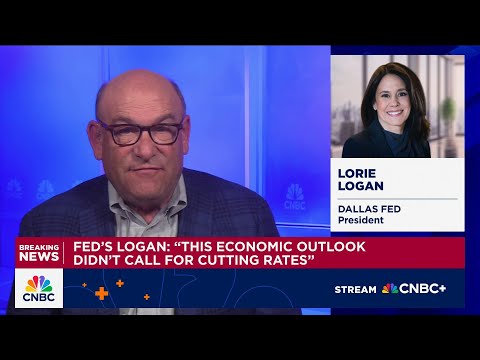
Stephen. >> Yeah. More hawkish comments this morning from the Fed.Dallas Fed President Lori Logan saying this economic outlook did not call for cutting interest rates. She says she will find it difficult to cut rates again in December. Not a voter this year, but a voter next year.She says that is true unless inflation is falling faster or the labor market is cooling more than appears apparent now or than forecast. The labor market, she says, remains balanced. It's cooling slowly.inflation is too high and it ...

X @Bloomberg
Bloomberg· 2025-10-31 12:40
Federal Reserve Bank of Kansas City President Jeff Schmid said he voted against the US central bank’s decision to lower interest rates this week because he’s concerned that economic growth and investment will put upward pressure on inflation https://t.co/mNjJhG92Fg ...
We're in a range bound environment when it comes to yields, says JPMorgan's Kelsey Berro
CNBC Television· 2025-10-31 11:16
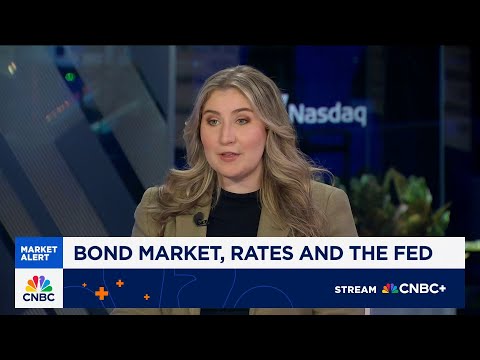
Take a look at Treasury yields right now. Look at the 10-year. Look at the 10-year. 4.1%, the 2-year, 3.6%.People are not totally rattled. Uh, joining us right now, uh, Kelsey Burrow, fixed income portfolio manager at JP Morgan Asset Management. Are you surprised, by the way, that the bond market has not been more rattled by just everything.>> I'm not too surprised. You know, I think that we I there's been a fair bit of data even though there's been a lack of official data with the government shut down. Um ...

X @Bloomberg
Bloomberg· 2025-10-31 07:00
ECB Governing Council member Martin Kocher says recent economic reports have improved a little and inflation is set to remain close to 2% for the next two years https://t.co/jA8JdVaTQs ...
X @Forbes
Forbes· 2025-10-30 13:18
.@SteveForbesCEO responds to the election victory for Argentinian President Javier Milei's party by pointing out that now world leaders have to finally understand the nature of inflation, and solve it before it leads to more social and economic destruction. #WhatsAhead https://t.co/7TMxZa3b4P ...
Fed Chair Powell wants to give the Fed control of the outcome, not the markets: Roger Ferguson
CNBC Television· 2025-10-30 11:11
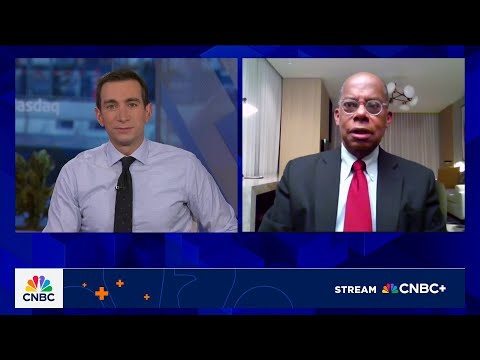
Fed Policy & Market Outlook - The Fed cut rates by 25 basis points, but the possibility of a further rate cut in December is uncertain due to differing views within the committee [1] - Markets may have been overly optimistic about future rate cuts, as the Fed aims to maintain control over outcomes rather than being driven by market expectations [6][7] - The Fed acknowledges dissension within its ranks, stemming from differing tolerances for inflation above the 2% target and unacceptably high unemployment [5][15] Stagflation Concerns - There are concerns about a potential mild stagflation scenario, with a weakening job market and inflation stuck around 3% year-over-year [8][9] - Inflation remains well above the 2% target, and the labor market's weakness presents a mystery regarding the balance between supply and demand factors [10] - Monetary policy may have limited ability to address labor market issues primarily driven by supply-side factors like declining labor force participation and reduced immigration [10] AI & Economic Impact - The Fed acknowledges the limitations of its tools in addressing specific unemployment issues, particularly those potentially caused by AI-driven layoffs [12][13] - The impact of AI on employment is not yet evident in aggregate data, but the Fed is monitoring the situation [15] - The Fed's tools are too blunt to effectively tamp down on potentially excessive capital expenditure in the AI space, which is driven by expectations of high returns [16][17]