
柔性制造

Search documents
从“释放需求”到“精准供给” 促消费政策再升级
Zheng Quan Ri Bao· 2025-11-27 16:22
Core Insights - The Chinese government has implemented a series of comprehensive consumption promotion policies to unleash consumer potential, with recent upgrades to these policies aimed at enhancing the adaptability of supply and demand in consumer goods [1][2] Group 1: Policy Initiatives - The "Implementation Plan" emphasizes a shift from "demand release" to "precise supply," proposing measures such as developing flexible manufacturing factories to respond efficiently to personalized consumer needs [1][3] - The plan includes a "thousand factories, thousand faces" transformation initiative, establishing a digital system that integrates user demand, intelligent design, and flexible production across various industries [3] Group 2: Flexible Manufacturing - Flexible manufacturing factories are characterized by their ability to quickly respond to diverse production demands, enabling companies to adopt a "make-to-order" approach that aligns with consumer preferences [2][3] - The automotive industry is leading this transformation by modularizing components, allowing for personalized vehicle production based on consumer orders [2] Group 3: New Consumption Scenarios - The "Implementation Plan" encourages the development of new consumption scenarios and business models, such as promoting the "first release economy" and fostering health and digital consumption [4][5] - Technological innovations, particularly in AI and IoT, are driving the creation of new consumption experiences, such as AI toys that provide emotional interaction, catering to the growing demand for companionship among consumers [5][6] Group 4: Market Trends - The rise of personalized consumption and market segmentation is supported by flexible manufacturing capabilities, which allow companies to effectively tap into long-tail market demands [3][6] - Investment in new consumption scenarios is increasing, with significant funding directed towards product development and market expansion in sectors like education and entertainment [6]
3个万亿、10个千亿市场将启,你的 “买买买” 要变了
2 1 Shi Ji Jing Ji Bao Dao· 2025-11-27 14:39
Core Insights - The Ministry of Industry and Information Technology, along with five other departments, has released a plan to enhance the adaptability of supply and demand in consumer goods, aiming to cultivate three trillion-level consumption sectors and ten hundred-billion-level consumption hotspots by 2027 [2] Group 1 - The core logic of promoting consumption is shifting from "supply-driven" to "demand adaptation" [2] - Key sectors identified include smart connected vehicles, consumer electronics, and elderly products [2] - The integration of AI into daily life and flexible manufacturing is making personalized consumption more accessible to the general public [2]
六部门发文,到2027年我国将形成3个万亿级消费领域!
Ren Min Ri Bao· 2025-11-27 10:12
Core Viewpoint - The State Council's executive meeting emphasizes enhancing supply-demand adaptability as an effective measure to unleash consumption potential and facilitate economic circulation. The Ministry of Industry and Information Technology, along with five other departments, has issued an implementation plan aiming to establish three trillion-level consumption sectors and ten billion-level consumption hotspots by 2027 [1]. Group 1: Development of New Technologies and Models - Focus on key industries such as smart connected new energy vehicles, smart home, consumer electronics, modern textiles, food, and green building materials, launching a dual-hundred innovation application initiative to create a hundred iconic products and a hundred innovative enterprises [1]. - Promote flexible and customized manufacturing models, implementing a "thousand factories, thousand faces" transformation plan, and establishing a digital system that connects user demand, intelligent design, and flexible production [3]. - Encourage the application of artificial intelligence across the entire consumer goods industry, promoting generative AI and 3D digital design tools [4]. Group 2: Expansion of New Product Supply - Adapt to the trend of green and low-carbon consumption by improving energy efficiency and water efficiency standards for consumer goods, and revising national standards for volatile organic compounds (VOCs) and heavy metals [8]. - Encourage the development of energy-efficient appliances and green building materials, as well as the promotion of green low-carbon consumption in sectors like new energy vehicles [8]. - Support the development of rural-friendly high-efficiency products and enhance rural commerce infrastructure [9]. Group 3: Targeted Consumer Matching - Promote the development of high-quality, intelligent products for infants and children, focusing on feeding, travel, outdoor activities, and educational toys [20]. - Encourage the design of protective writing tools and personalized learning kits for students, integrating traditional stationery with smart hardware [23]. - Enhance the development of age-friendly products for the elderly, including care robots and multifunctional nursing beds [26]. Group 4: Cultivation of New Consumption Scenarios and Business Models - Support the establishment of flagship stores and new concept stores, and organize product launch events to enhance consumer engagement [28]. - Develop new business models such as live e-commerce and instant retail, leveraging AI to match user needs with products and services [29]. - Promote the development of shared consumption models, including shared bicycles and wheelchairs in public spaces [32].


科技反攻带动市场情绪,缩量整理稳定大盘预期
Sou Hu Cai Jing· 2025-11-27 00:33
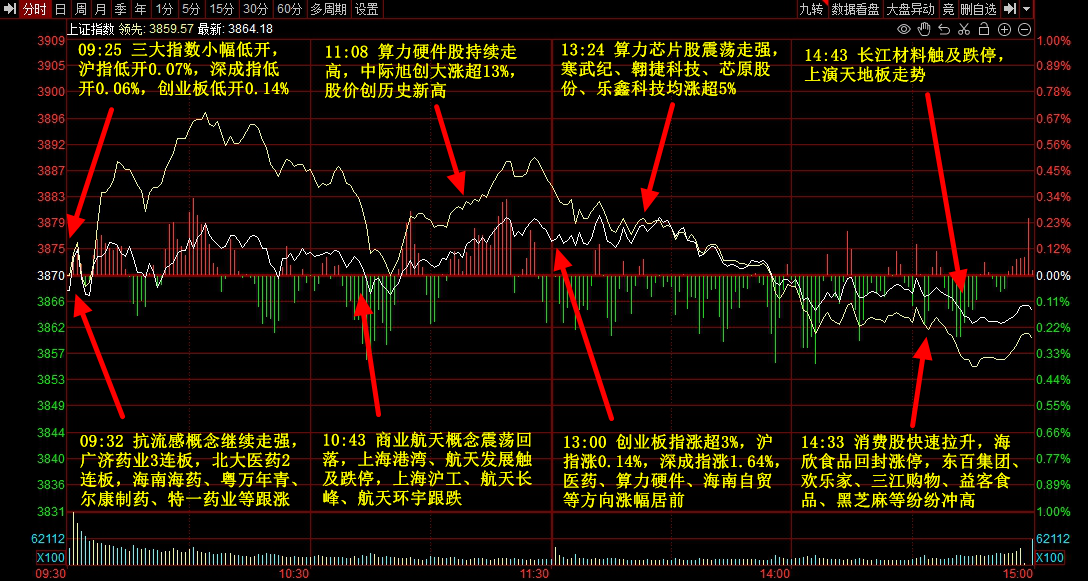
Market Overview - A-shares showed mixed performance with the Shanghai Composite Index down 0.15% at 3864.18 points, while the Shenzhen Component Index rose 1.02% to 12907.83 points, and the ChiNext Index led with a 2.14% increase [1] - The market sentiment was generally warm, with 3168 stocks rising and a total trading volume of 1.78 trillion yuan, slightly lower than the previous trading day [1][2] - Key sectors that performed well included telecommunications, pharmaceuticals, and electronics, while the consumer sector was boosted by favorable policies [1][2] Policy Developments - The Ministry of Industry and Information Technology initiated commercial trials for satellite IoT services, aiming to enhance market supply and stimulate industry growth [5] - The "Credit Repair Management Measures" were announced, effective from April 1, 2026, allowing eligible entities to apply for credit repair [5] - A joint implementation plan was released by six departments to enhance the adaptability of consumer goods supply and demand, targeting significant improvements in consumer goods structure by 2027 [3][5] Sector Insights - The technology sector, particularly the computing power concept, showed strong performance, with notable stocks like Dongxin Co. hitting the daily limit [1][2] - The consumer sector is expected to gain momentum, with potential new driving forces emerging from policy support [2] - The report highlighted the importance of focusing on sectors with high policy adaptability, such as AI applications and digital twin technologies [3] Company Highlights - Ideal Auto reported a Q3 revenue of 27.4 billion yuan, maintaining its lead among new car manufacturers, with significant investments in R&D [6] - Predictions indicate that China's battery production will exceed 1500 GWh by 2025, with a substantial portion dedicated to energy storage [6][7] - The Ministry of Natural Resources announced breakthroughs in the efficient extraction of rare metals, enhancing domestic production capabilities [6]

蓝箭航天朱雀三号将于11月29日首飞,商业航天产业链受益;工信部等六部门发文,事关进一步促进消费——《投资早参》
Mei Ri Jing Ji Xin Wen· 2025-11-26 23:58
Market News - The three major U.S. stock indices closed higher, with the Dow Jones up 0.67%, S&P 500 up 0.69%, and Nasdaq Composite up 0.82% [1] - Major tech stocks mostly rose, with Oracle up over 4%, AMD up over 3%, and Nvidia, Tesla, Netflix, and Microsoft up over 1% [1] - The U.S. economic activity has nearly stalled, influenced by government shutdowns affecting consumer decisions, with manufacturing and retail facing cost pressures due to tariffs [1] Industry Insights - Beijing Blue Arrow Aerospace's Zhuque-3 rocket is set for its maiden flight on November 29, with the National Space Administration promoting commercial aerospace development [3] - The satellite communication industry is projected to grow from a market size of approximately 40-50 billion yuan to over 200-400 billion yuan by 2030, with an annual growth rate of 10%-28% [4] - The Ministry of Industry and Information Technology and other departments have issued a plan to enhance consumer goods supply and demand adaptability, promoting flexible and customized manufacturing [5] - China Commercial Aircraft Corporation's registered capital increased from 50.101 billion yuan to 94.098 billion yuan, with a significant boost in production capacity for the C919 aircraft [6] Investment Opportunities - The flexible manufacturing model aims to address supply-demand mismatches and enhance responsiveness to consumer needs, supported by technologies like industrial internet and AI [5] - The increase in capital for China Commercial Aircraft Corporation signals strong governmental support for the domestic aircraft industry, potentially disrupting the Airbus and Boeing duopoly [6]
晚报 | 11月27日主题前瞻
Xuan Gu Bao· 2025-11-26 14:37
Group 1: Organic Silicon - Dow Chemical announced a price increase of 10-20% for its Xiameter organic silicon products starting December 10, with variations depending on the product line [1] - Recent discussions in the domestic organic silicon industry have focused on pricing mechanisms and production reduction strategies, leading to a significant price increase in organic silicon products, improving profitability [1] - As of November 24, the market price for DMC in East China reached 13,200 yuan/ton, reflecting a 20% increase for the month [1] Group 2: DRAM Industry - TrendForce forecasts a 30.9% revenue growth for the DRAM industry in Q3 2025, reaching $41.4 billion, driven by rising contract prices and increased shipment volumes [2] - The fourth quarter is expected to see a 45-50% increase in conventional DRAM contract prices, with overall contract prices for conventional DRAM and HBM projected to rise by 50-55% [2] - The demand for core storage chips related to AI systems is driving a "super cycle" in the storage market, with price increases expected to continue through 2026 and possibly into 2027 [2] Group 3: Industrial Internet - Six Chinese government departments issued a plan to enhance the adaptability of consumer goods supply and demand, promoting flexible and customized manufacturing models [3] - The core of flexible manufacturing is "production based on demand," which addresses mismatches in supply and demand and enhances responsiveness to external shocks [3] - The integration of new technologies like industrial internet and AI is strengthening the foundation for flexible manufacturing systems [3] Group 4: Data Elements - The National Data Bureau is supporting the establishment of a comprehensive service system for data circulation and trading [4] - Data trading markets are experiencing growth driven by policy support and technological breakthroughs, with high-value sectors like finance and healthcare leading the way [4] - The data circulation market is projected to exceed 200 billion yuan by 2025 and reach 700 billion yuan by 2030, with significant value release expected in various sectors [4] Group 5: Energy Storage - Huawei's digital energy division is innovating in grid-connected energy storage technologies, achieving significant breakthroughs in performance testing and application [5] - The construction of a new power system is increasing the share of renewable energy, presenting new challenges for grid stability [5] - Grid-connected energy storage is becoming a key measure to support high levels of renewable energy integration and enhance the stability of power systems [5] Group 6: Smart Glasses - Li Xiang, CEO of Li Auto, announced the upcoming launch of smart glasses, indicating a shift towards a multi-scenario intelligent solution provider [6] - The AI glasses market is entering a competitive phase, with major tech companies releasing new products [6] - Global AI glasses sales are expected to reach 5.1 million units by 2025, with the Chinese market projected to grow by over 200% [6] Group 7: Macro and Industry News - A joint plan by six government departments aims to optimize the supply structure of consumer goods by 2027, creating three trillion-level consumption sectors and ten hundred-billion-level consumption hotspots [7] Group 8: Miscellaneous - Tesla's Austin Robotaxi fleet is expected to double in size next month, indicating growth in autonomous vehicle deployment [8] - The Ministry of Industry and Information Technology has initiated commercial trials for satellite IoT services, with a two-year trial period [10] - The market for flu medications has surged, with sales of antiviral drugs experiencing significant increases due to rising flu cases [10]
利好来了,六部门联合发文
2 1 Shi Ji Jing Ji Bao Dao· 2025-11-26 14:25
Core Viewpoint - The article highlights a significant opportunity emerging from the government's new consumption policy aimed at enhancing the adaptability of supply and demand in consumer goods, with a focus on innovation and quality improvement in the market [1][3]. Group 1: Policy Implementation - The State Council has introduced an implementation plan to enhance the adaptability of supply and demand in consumer goods, which includes multiple key tasks such as accelerating the layout of new fields, promoting efficient manufacturing models, and integrating artificial intelligence [1][3]. - The plan sets clear targets, aiming to form three trillion-level consumption sectors and ten billion-level consumption hotspots by 2027, with a focus on high-quality development and increased contribution of consumption to economic growth [1][3]. Group 2: Industry Focus - The plan emphasizes key industries such as smart connected vehicles, smart home products, consumer electronics, modern textiles, food, and green building materials, aiming to create a hundred iconic products and a hundred innovative enterprises [5][6]. - The automotive sector, particularly in new energy vehicles, has shown strong growth, with October sales reaching 1.715 million units, a 20% year-on-year increase, marking a significant milestone in the market [5]. Group 3: Consumer Demand and Manufacturing - The article discusses the importance of flexible manufacturing to meet personalized consumer demands, highlighting the need for high-quality, small-batch, and specialized products [6][14]. - The plan proposes the promotion of efficient response manufacturing models, including flexible and customized production, to better align with consumer preferences [6][14]. Group 4: Artificial Intelligence Integration - The plan advocates for the application of artificial intelligence across the entire consumer goods industry, aiming to enhance product development efficiency and innovation through tools like generative AI and 3D digital design [8][10]. - AI is expected to play a crucial role in understanding consumer needs, providing customized products and services, and improving the overall shopping experience [11][12]. Group 5: Lifecycle Consumption - The plan addresses the needs of different consumer demographics, including children and the elderly, promoting the development of high-quality, intelligent products tailored to these groups [15]. - The focus on "lifecycle consumption" reflects a shift from merely meeting basic needs to creating quality living experiences, indicating a broader trend in consumer behavior [15].

促消费新政来了!加速供需适配,打造万亿级消费领域
2 1 Shi Ji Jing Ji Bao Dao· 2025-11-26 13:24
Core Viewpoint - The article highlights a significant opportunity in the market as the government shifts its approach to enhance consumer potential and meet higher consumption demands through a new implementation plan aimed at optimizing supply and demand in the consumer goods sector [1][10]. Group 1: Implementation Plan - The implementation plan, released on November 26, outlines multiple key tasks, including accelerating the layout of new fields, promoting efficient manufacturing models, and enhancing the integration of artificial intelligence [1][2]. - By 2027, the plan aims to optimize the supply structure of consumer goods, creating three trillion-level consumption sectors and ten billion-level consumption hotspots [1][2]. - The plan emphasizes a systematic and operational approach, proposing 19 tasks across various domains to avoid piecemeal solutions [1][2]. Group 2: Consumer Demand and Supply - The plan encourages enterprises to innovate supply to create demand, marking a shift from passive adaptation to proactive leadership in economic development [2][3]. - There is a focus on flexible manufacturing to meet personalized consumer needs, addressing the current limitations in high-quality, small-batch, and specialized products [3][4]. - The plan promotes a digitalized system that connects user demand with intelligent design and flexible production, particularly in industries like home appliances and textiles [3][4]. Group 3: Artificial Intelligence Integration - The plan advocates for the application of artificial intelligence across the entire consumer goods industry, enhancing product development efficiency and innovation [5][6]. - It encourages the development of various AI-enabled products, such as smart home devices, to transform consumer experiences and drive market growth [5][6]. - The integration of AI is expected to optimize consumer interactions and improve service delivery, contributing to a more dynamic consumption environment [6][7]. Group 4: Lifecycle Consumption Focus - The plan aims to expand the supply of unique and new products, including green products and those catering to rural consumers, reflecting a shift towards quality and diversity in consumption [8][9]. - It emphasizes the importance of addressing the needs of different demographic groups, including children and the elderly, to align with the concept of "lifecycle consumption" [9][10]. - The focus on personalized and quality-driven consumption is seen as a key driver for upgrading the consumer market in China [9][10].
伊之密:公司能够较好满足客户对“安全可控、高效交付、就近服务”的综合需求
Zheng Quan Ri Bao Zhi Sheng· 2025-11-26 11:45
Core Viewpoint - The company emphasizes its ability to meet the increasing demands for equipment delivery cycles, technical adaptability, and localized service capabilities in large projects [1] Group 1 - The company has a flexible manufacturing system that allows for rapid response to customer needs [1] - It possesses a nationwide service network to support its operations [1] - The company offers customized development capabilities for new material forming [1]

伊之密:依托数字化工厂的模块化生产优势,公司具备柔性制造能力
Zheng Quan Ri Bao Wang· 2025-11-24 09:44
Core Viewpoint - The company, Yizhiming (300415), emphasizes its flexible manufacturing capabilities supported by digital factory modular production advantages, ensuring high-quality and short-cycle delivery for strategic clients in high-demand sectors [1] Group 1 - The company leverages modular production advantages from its digital factory to enhance flexible manufacturing capabilities [1] - A flexible production scheduling mechanism is in place for strategic clients in high-demand sectors, allowing for prioritized resource allocation [1] - The company aims to ensure high-quality and timely delivery of equipment through its production strategies [1]