Capital Gains Tax

Search documents
X @Bitcoin Magazine
Bitcoin Magazine· 2025-11-20 15:32
RT Bitcoin Magazine (@BitcoinMagazine)JUST IN: 🇺🇸 Congressman Warren Davidson introduces "#Bitcoin for America" bill to:- Codify the Strategic Bitcoin Reserve Executive Order- Eliminate capital gains tax when paying taxes with BTC https://t.co/cFrqDEOfsE ...
X @Bitcoin Magazine
Bitcoin Magazine· 2025-11-20 15:22
JUST IN: 🇺🇸 Congressman Warren Davidson introduces "#Bitcoin for America" bill to:- Codify the Strategic Bitcoin Reserve Executive Order- Eliminate capital gains tax when paying taxes with BTC https://t.co/cFrqDEOfsE ...
X @mert | helius.dev
mert | helius.dev· 2025-11-18 10:25
trump did tell you that he would remove capital gains tax on crypto ...
X @Solana
Solana· 2025-11-12 21:45
RT Pyra (@GetPyra)Pyra V3 is the best way to grow wealth WHILE spending with ZERO capital gains tax.Now you can:🔁 SWAP assets while they're collateralizing loans💳 SPEND 100% of your portfolio value📈 SEE your projected 5-year returnsEnhanced portfolio management now LIVE on iOS & Android https://t.co/C64RoxzQ6Q ...
‘I’m in the home stretch’: I’m 80. Do I leave my kids a ‘Magnificent Seven’ dynasty trust or a brokerage account?
Yahoo Finance· 2025-10-23 12:02
Core Insights - The article discusses the complexities of estate planning for high-net-worth individuals, particularly regarding the decision between capital gains tax on dynasty trusts versus estate tax on personal accounts [2][4][6]. Group 1: Estate Planning Considerations - Dynasty trusts allow assets to be excluded from estate tax calculations, but beneficiaries face significant capital gains taxes upon sale [2][4]. - Transferring stocks back to a personal account can utilize the step-up rule, avoiding capital gains tax but incurring a 40% estate tax [2][4]. - The decision-making process involves various factors, including the size of the inheritance, asset appreciation, and potential changes in estate tax exemptions [4][6]. Group 2: Financial Implications - A hypothetical scenario suggests that if stocks are valued at $20 million, children may pay more in capital gains tax than in estate tax [6][7]. - The federal estate and gift-tax exemption for 2025 is projected to be $13.99 million per person, or $27.98 million for married couples [7].
Former World Bank President David Malpass: Markets all over need more dynamism
CNBC Television· 2025-10-22 12:03
Monetary Policy & Federal Reserve (The Fed) - The Fed needs reform, particularly regarding Quantitative Easing (QE), which is considered not stimulative and a cause of wealth inequality [1] - The Fed's large staff and control over markets are criticized, suggesting it's part of the "deep state" [1] - The Fed is skeptical of allowing others to participate in short-term markets, specifically stablecoins, and is slow to change [1] - A 50 basis point cut (0.5%) in the Fed Funds Rate is suggested for the next meeting, as the Fed is behind the curve [4] - Current short-term interest rates are at 415 basis points (4.15%) [3] Fiscal Policy & Taxation - The world needs more growth, which could be achieved through tax cuts in countries like Japan and the US [1] - High marginal tax rates (e.g., 45% in Japan) and VAT taxes are seen as detrimental to economic outlook [1] - Capital gains taxes in the US are too high, locking up unrealized gains and reducing market dynamism [1] - Lowering the capital gains rate to 10% for a limited time could create a government windfall [1] - Taxing wealth can lead to capital flight, as seen in Britain and Washington state [1] Economic Growth & Energy - More energy use is correlated with higher per capita income, advocating for more fossil fuels and less focus on renewable energy [1] - Increased energy production in the US is necessary for competition with China [1]

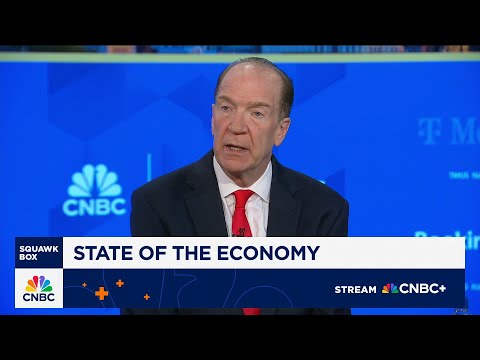
Former World Bank President David Malpass: Markets all over need more dynamism
Youtube· 2025-10-22 12:03
Economic Policy and Central Banks - The Fed needs to consider reforms, particularly regarding quantitative easing (QE), which has not been stimulative and has contributed to wealth inequality [1][2] - There is a call for the Fed to allow more market functionality and to be open to changes, especially concerning stable coins and short-term markets [1][2] - The current high capital gains tax in the US is seen as detrimental to market dynamism, and lowering it could lead to increased investment and growth [1][2][3] Taxation and Growth - Tax cuts are advocated for both the US and Japan to stimulate growth, with Japan's high marginal tax rate of 45% being a concern [1][2] - The idea of a temporary capital gains tax holiday is proposed, suggesting it could lead to a windfall for the government and potentially be extended if successful [2][3] - The impact of tax policies on market behavior is highlighted, with lower tax rates leading to increased equity values as they reflect growth opportunities [2][3] Interest Rates and National Debt - The current short-term interest rates set by the Fed at 4.15% are considered too high, especially in relation to long-term rates, indicating the Fed is behind the curve [3][4] - There is a concern that the national debt is too large, which could affect the demand for dollars, but recent trends show a preference for US assets as gold prices decline [3][4] - A suggestion for a 50 basis point cut in interest rates is made, arguing that the Fed should have started cutting earlier to align with market conditions [4][5]

X @Wu Blockchain
Wu Blockchain· 2025-10-19 03:55
Regulatory Scrutiny - UK tax authority HMRC sent "nudge letters" to approximately 65,000 suspected crypto tax evaders, more than double the previous year's figure [1] - HMRC will leverage exchange data to monitor tax evasion [1] - Starting in 2026, HMRC will collect detailed user information under the OECD's CARF framework [1] Tax Implications - In the UK, selling or spending crypto is subject to capital gains tax [1] - Staking and airdrops are considered income for tax purposes in the UK [1]
The 2026 Tax Brackets Are Out — What It Means For Your Money
Investors· 2025-10-16 11:00
Core Insights - The 2026 income tax brackets have been adjusted, providing taxpayers with more room in their respective brackets due to inflation adjustments [2][4][21] - The changes in tax brackets will result in lower taxes for many individuals if their income remains stable, with potential savings in the hundreds of dollars [4][6] - Strategic tax planning is essential for maximizing benefits from the updated brackets, particularly regarding Roth IRA conversions and capital gains [8][10][14] Tax Bracket Adjustments - Married couples filing jointly can earn up to $100,800 in the 12% bracket, an increase of $3,850 from the previous year [2] - Higher-earning couples in the 22% bracket can report income up to $211,400, up from $206,700 in 2025 [2] - The seven tax brackets range from 10% to 37%, with specific income thresholds for each bracket [5][21] Tax Planning Strategies - Taxpayers should consider both current and future tax implications when making financial decisions [6] - Knowing the tax brackets in advance aids in personal finance and tax-saving decisions, including Roth IRA conversions [7][8] - Filling up lower tax brackets without exceeding them is a recommended strategy to minimize tax liabilities [12][13] Roth IRA Conversions - The updated brackets allow for more income to be converted to Roth IRAs without moving into a higher tax bracket [9][10] - A couple in the 22% bracket in 2026 will have nearly $4,000 more room at the top of their bracket for Roth conversions [9] - Roth conversions are particularly beneficial for retirees with high traditional IRA balances, allowing for strategic tax management [11] Capital Gains Tax - The income threshold for the 0% capital gains tax rate will also increase, allowing more taxpayers to benefit from tax-free capital gains [14][15] - For 2026, the 0% capital gains rate applies to single filers with income up to $49,450 and joint filers with incomes up to $98,900 [14][16] - Taxpayers can realize significant capital gains without incurring federal taxes by managing their taxable income effectively [16][17] Withdrawal Strategies - Taxpayers close to crossing into a higher bracket should prioritize withdrawals from non-taxable accounts to minimize tax impacts [18][19] - Withdrawals from traditional IRAs and 401(k)s should be considered last, as they are treated as taxable income [19][20]
Labour Just Cost the UK $8BN?
20VC with Harry Stebbings· 2025-10-13 17:53
Financial Impact - UK government stands to lose $8 billion due to Revolut founder moving to Dubai [1] - The founder owns approximately 18% of Revolut [1] - Revolut's valuation is projected to reach $200 billion in the next 3 to 5 years [1] - The founder's position is valued at $36 billion [1] - The UK could have potentially collected $8 to $12 billion in capital gains tax [1] Policy & Talent - The UK is in a global war for talent [2] - Tax policies may hinder growth [2]