Upskilling

Search documents
Accenture to train 700,000 staffers to use agentic AI
Bloomberg Television· 2025-09-12 20:06
Workforce Strategy - Companies need to focus on upskilling their workforce, similar to the widespread training in GenAI, now focusing on Agentic AI [1] - Talent rotation is necessary as some employees may not adapt to the changes [1] - Addressing skills mismatch is crucial, as not everyone can be trained effectively [2] - Achieving efficiencies is a key component of the workforce strategy [2] Key Actions - Upskilling initiatives are essential for the existing workforce [2] - Talent rotation is a necessary process for adapting to change [2] - Companies should strive for efficiencies in their workforce management [2]


Amid hiring freezes, HR leaders turn to internal mobility and upskilling
Yahoo Finance· 2025-09-12 10:05
Core Insights - HR professionals are shifting focus towards internal mobility and skills-based development due to lower turnover rates and hiring freezes [1][2][3] Group 1: Hiring Trends - Quit rates have decreased to 2%, prompting HR teams to prioritize internal reskilling and workforce redeployment over external hiring [2] - The U.S. job market is showing signs of stagnation, with only 22,000 jobs added in August and a revision indicating a loss of 13,000 jobs in June [3] - A significant number of CHROs expect to reduce hiring in the next six months, with 66% of HR managers reporting hiring freezes [4] Group 2: Hiring Freezes - Among those with hiring freezes, 36% have paused all entry-level hiring, 30% have halted mid-level hiring, and 25% have stopped leadership hiring [5] - Nearly half of HR managers anticipate recruitment will remain paused for the next 12 months, with 16% projecting a two-year pause [5] Group 3: Reasons for Hiring Freezes - Hiring freezes are primarily due to cost reductions, economic uncertainty, and organizational restructuring [6] - HR managers are also facing board pressure to limit headcount and are adapting to automation that reduces the need for new roles [6] Group 4: Workforce Development - In response to hiring freezes, HR managers are focusing on reviewing career frameworks and enhancing employee engagement [7] - 43% of HR managers are upskilling their workforce, particularly in digital skills, risk management, cybersecurity, and leadership [7]
The future is a skill, not a destination | Dr. Nishtha Tyagi Pachouri | TEDxCareer College
TEDx Talks· 2025-07-22 16:40
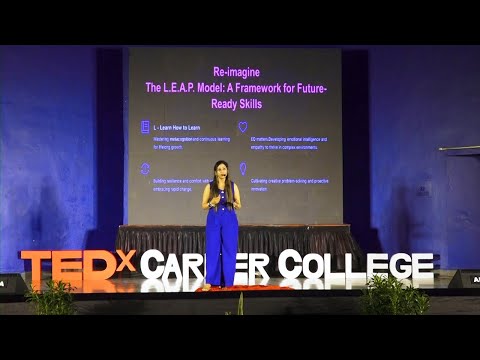
Future Skills & AI - The industry emphasizes that the future isn't a destination but a skill to be built, highlighting the importance of continuous learning and adaptation [1][7] - The industry notes a shift in focus from knowing all the answers to asking relevant questions, and from competition to collaboration, especially in the age of AI [2] - The industry stresses the need to upskill and reskill to keep pace with rapidly changing technologies and the evolving job market [2] - AI is not a destination but a language that requires practice and continuous learning [2][6] - The industry introduces the "LEAP" model, emphasizing Learn to Learn, Emotional Intelligence, Ambiguity into Creativity, and Prompt Engineering as essential skills [2][4] Education & Personal Development - Traditional education systems are not adequately preparing students for the future, as they still rely on outdated teaching methods [2] - The industry highlights the importance of courage in learning, relearning, and facing the world with updated skills [2][6] - AI can amplify one's voice and potential, as demonstrated by the example of a girl who started her own podcast channel after using ChatGPT to overcome her fear of public speaking [5] Strategic Imperatives - The industry encourages organizations and educational institutions to adopt the "LEAP" model to cultivate essential future skills [4] - The industry advocates for leaping into the future rather than chasing it, embracing AI intelligence and continuous skill development [6][7]
How to Win in an AI World | Zane Witherspoon | TEDxGramercy Park
TEDx Talks· 2025-06-24 15:49
AI Impact on Labor Market - AI技术正日益取代中等技能工作,对经济阶梯的中层造成冲击,尤其影响入门级职位和技术工作[12][13] - 过去两年,入门级职位空缺减少约三分之一,因为雇主发现管理AI工具比雇佣初级员工更经济高效[14] - 一家公司的CEO表示,其AI工具每天生成近10亿行代码,约占全球每日代码生成量的三分之一[10] - 部分公司鼓励雇主用AI员工取代现有员工,声称AI员工每周工作70小时且不会抱怨工作生活平衡[11] Societal Response and Mitigation Strategies - 面对AI带来的挑战,个人应提升自身技能,关注AI对其所在领域的影响,抓住机遇[15][16] - 借鉴19世纪农业革命的经验,政府、企业和非营利组织应承担起劳动力技能提升的责任,加大教育投入[17] - 鼓励创业,利用AI技术降低创业成本,投资者也在关注首个单人运营的十亿美元级别公司的出现[18][19] - 呼吁社会加快对AI监管的步伐,借鉴社交媒体成瘾问题的应对经验,避免重蹈覆辙[20] AI's Dual Nature - AI既能像2010年代那样帮助专家达到新的高度,也能像工业和农业革命中的自动化一样取代低技能体力劳动[6][12] - AI技术可能像社交媒体一样使人沉迷,2012年的研究表明,AI驱动的社交媒体与香烟和酒精一样容易让人上瘾[19] - 一家香港制药公司完成了首个完全由AI开发的药物的二期临床试验,该药物用于治疗特发性肺纤维化(IPF),每年有3万到4万人被诊断出患有IPF,平均寿命仅为3到5年,新药有望限制症状甚至逆转病情[4][5]