Consumer Spending

Search documents
X @The Economist
The Economist· 2025-08-07 23:00
Consumer Spending Behavior - Customers with access to loans spend at least 20% more compared to those without access [1]
Confused about the tariff turmoil? 'They are like a 5-dimensional Rubik's Cube'
MSNBC· 2025-08-07 20:45
Tariff Impact on Consumers - Consumers are projected to experience an annual price increase of approximately $2,400 due to tariff rates rising from around 25% to as high as 41% for specific countries and imports [2][3] - The American middle class and moderate-income consumers are strained and lack the capacity to absorb an additional $1,000 to $2,000 in costs [10][11] - Companies are resorting to shrinkflation (reducing product quantity while maintaining price) and sneakflation (gradually increasing prices) to offset tariff costs [11][12] Uncertainty and Economic Distortion - The varying tariff rates and potential for further tariffs, including a possible 100% tariff on chips, create significant uncertainty [5] - Stockpiling of goods by companies to avoid tariff increases has distorted GDP data and is expected to continue doing so for the coming months [6] - The economy's reliance on the spending of the wealthiest Americans will determine whether a recession occurs [19][20] Investment and Capital Flows - The Trump administration is using capital flows as a bargaining chip in trade negotiations, demanding increased investment from the EU and Japan [13][14] - There is uncertainty regarding the terms of investment deals, with the EU and Japan clarifying that their commitments are loans, not permanent financial bailouts [14] - Companies are hesitant to make significant investments due to uncertainty, except for sectors like data centers for big tech [31] Economic Disparity - The bottom 80% of Americans have depleted their savings from the pandemic and stimulus payments [17] - A "reverse Robin Hood effect" is occurring, with tax cuts disproportionately benefiting the wealthy while cuts to programs like Medicaid and food stamps, coupled with higher prices, impact those at the bottom [22] Consumer Sentiment and Spending - Polls indicate that a majority of people disapprove of Trump's handling of the economy and inflation [27] - Uncertainty is causing consumers to consider saving more and reducing spending [28]


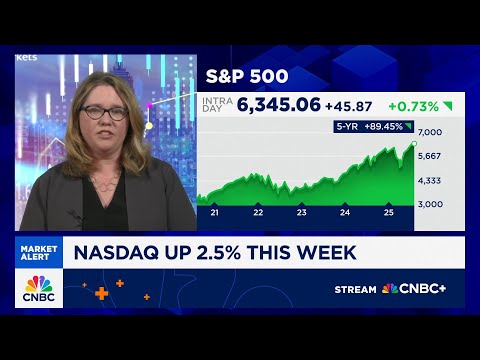
Expect choppy market conditions in back half of the year, says RBC's Lori Calvasina
CNBC Television· 2025-08-06 21:10
All three major averages finishing in the green today. The NASDAQ up 1%. Our next guest is warning of seasonal weakness ahead for the stock market.But could strong earnings reverse the usual August malaise. Well, let's bring in RBC Capital Markets head of US equity strategy Lori Calvacina as well as region's wealth management CIO Alan Mcnite. It's great to have you both here.Alan, you're sitting here on set with me. Welcome. Let's start this conversation.What do you think of markets here. What would you be ...
The 'Halftime' Investment Committee debate the catalysts for the market's next move
CNBC Television· 2025-08-06 17:25
Consumer Spending & Economic Outlook - Consumer spending remains resilient despite inflation and high credit card debt [5] - Consumers are shifting spending from services to goods due to increased goods prices, with core goods (excluding autos) increasing significantly month-over-month, reportedly at 6%, the highest level in a while [6] - The consumer will continue spending as long as they are employed, even with a slowing job market [7] - Concerns exist about the consumer, but some companies aren't seeing it [3] - Consumer spending through the end of July is up 5% [20] Market Dynamics & Investment Strategies - Fundamentals may be more important than momentum in the market [1] - High cash levels need to be deployed [2] - The market may be overly focused on mega-cap stocks [9] - The market is unusual, with a different cohort of investors less focused on fundamentals [19] - A significant portion (70%) of investment exposure is in big cap tech [22] Monetary Policy & Federal Reserve - Dovish Fed speak suggests potential for two rate cuts this year [2] - Rate cuts are coming, it's just a matter of when [8] Risks & Concerns - There's a danger of being complacent in the market [21] - Cracks in the consumer system could break out at any moment [12] - The labor market showing one more crack could force the market in the other direction [15]

X @Bloomberg
Bloomberg· 2025-08-05 22:43
Australian tourists face a levy to visit NZ sites, consumer spending weaker than expected ahead of anticipated RBA cut, Canberra awards naval contract https://t.co/uIV5HcRl8c ...
Trivariate's Adam Parker: Consensus view is we will get a market pullback on tariff-related fears
CNBC Television· 2025-08-05 19:46
Market Sentiment & Strategy - Dips in high-quality stocks should be bought, anticipating institutional investors' interest if prices drop by 10-15% [2] - The market's valuation is not currently a problem, with expectations of higher earnings trajectories for the next few years [3] - The risk is skewed to the positive for year-end, with any material weakness expected to be bought due to positive earnings outlook [11] - US equities are favored due to US companies' overexposure to themes expected to grow above global GDP [13] Economic Indicators & Consumer Behavior - Consumer spending remains strong, suggesting no immediate recession concerns [5] - The aggregate consumer is in good shape, although potentially eroding from highs [7] - The Fed is unlikely to cut rates unless data deteriorates significantly, as they tend to lag market indicators [17][19] Sector-Specific Insights - Semi-conductors performance is crucial for market momentum, particularly concerning tariff issues [7] - Bank earnings were strong, but the stocks' limited reaction may be a tactical concern [8] - US companies in tech, communication services, and financials are well-positioned for earnings growth, representing 58% of the S&P [13]
Gargiulo: Fast food chains face pressure from low-income consumers
CNBC Television· 2025-08-05 11:26
Market Trends & Consumer Behavior - The restaurant sector, especially fast food, is experiencing a decline in traffic due to consumers reducing spending amid deteriorating value perception [1] - Companies are shifting strategies towards higher speed of innovation to bring traffic back [2] - Macroeconomic pressures, particularly on lower-income consumers, complicate traffic recovery [4][5] - Product news and introductions can drive short-term consumer interest [4] - Consumer movement is happening across the board, but pressure remains within the low-income consumer segment [6] Company Strategy & Performance - Companies are pursuing new value platforms to attract consumers [2] - Companies are exploring alternative measures beyond value to attract consumers [4] - The success of value items and combo meals is being closely monitored [3] - Chipotle is considered a dislocated stock with potential for recovery after a pullback [8] - Restaurant Brands International (RBI) is favored due to compressed multiples and potential for multiple expansion once resilient brands (Tim Hortons, Burger King, Popeyes) are proven [8]

美国经济-《通胀削减法案》对消费者支出及群体的影响US Economics Impacts of OBBBA on Consumer Spending and Cohorts
2025-08-05 03:15
Summary of Key Points from the Conference Call Industry/Company Involved - The analysis focuses on the impacts of the One Big Beautiful Bill Act (OBBBA) on consumer spending in the US economy, particularly in North America. Core Insights and Arguments - **Consumer Spending Impact**: A slight boost to consumer spending is expected in 2026, estimated at approximately 15 basis points (bp), but larger negative impacts are anticipated in 2027 and beyond due to tax cuts expiring and spending cuts to programs like Medicaid and SNAP [1][9][10]. - **Cohort Analysis**: - Older and higher-income cohorts are expected to benefit the most from the bill, particularly through deductions for seniors and an increase in the SALT cap [1][11][24]. - Low-income consumers will face significant negative impacts due to cuts in transfer payments, with estimates suggesting that around 10 million individuals could lose access to federal health insurance by 2034 [1][27]. - Middle-income consumers may experience mixed effects, benefiting in the short term from new deductions but facing potential long-term negative impacts as tax cuts expire [1][26]. Additional Important Content - **Fiscal Multipliers**: The analysis indicates that spending cuts generally have larger multipliers than tax cuts, meaning that reductions in transfer payments to low-income consumers will have a more immediate and larger impact on demand [1][15]. - **Long-term Economic Growth**: The overall boost to consumption in 2026 is considered small relative to the drags from trade and immigration policy, which are expected to slow US economic activity [1][11][29]. - **Specific Provisions**: Key consumer-facing provisions include deductions for tips, overtime, and car loan interest, as well as changes to Medicaid and SNAP, which will have varying impacts across different income cohorts [1][12][31][50]. - **Projected Economic Growth**: The OBBBA is expected to add around 40 basis points to US GDP growth in 2026, primarily driven by defense spending and corporate tax changes, rather than consumer spending [1][10]. Data and Projections - **Consumer Spending Projections**: - 2026: +15 bp boost to nominal spending - 2027: -18 bp drag on nominal spending - 2029 and beyond: Negative impacts become more pronounced as tax cuts expire [1][19][21]. - **CBO Cost Estimates**: Various provisions have associated costs, such as the tips deduction costing $10 billion in 2026 and $31 billion total, while changes to Medicaid are estimated to save $7 billion in 2026 and $115 billion total [1][16][50]. This summary encapsulates the essential insights and projections regarding the impact of the OBBBA on consumer spending and various income cohorts, highlighting both the immediate benefits and the longer-term challenges posed by the legislation.
X @Bloomberg
Bloomberg· 2025-08-01 16:25
Economic Impact - Tariffs are characterized as a substantial tax burden on both households and businesses [1] - The implementation of tariffs is negatively impacting consumer spending [1] - Tariffs are hindering job growth [1]
Mastercard Q2 Earnings Beat Estimates on Robust Consumer Spending
ZACKS· 2025-07-31 17:36
Core Insights - Mastercard Incorporated reported second-quarter 2025 adjusted earnings of $4.15 per share, exceeding the Zacks Consensus Estimate by 2.5%, with a year-over-year improvement of 16% [1][11] - Net revenues increased by 16.8% year over year to $8.1 billion, surpassing the consensus mark by 1.9% [1][11] Financial Performance - Gross dollar volume (GDV) rose 9% on a local-currency basis to $2.6 trillion, beating the Zacks Consensus Estimate by 1.9% [3] - Cross-border volumes increased by 15% on a local currency basis, while switched transactions improved 10% year over year to 43.5 billion, slightly missing the consensus mark [4] - Net revenues from value-added services and solutions reached $3.2 billion, a 23% year-over-year increase, driven by acquisitions and higher demand for consumer engagement services [5] - Adjusted operating income grew 18% year over year to $4.9 billion, exceeding the model estimate of $4.7 billion, with an adjusted operating margin improvement of 50 basis points to 59.9% [7] Operational Metrics - Payment network rebates and incentives increased by 17% year over year, attributed to new and renewed deals [6] - As of June 30, 2025, Mastercard's clients issued 3.6 billion Mastercard and Maestro-branded cards [6] Financial Position - As of June 30, 2025, Mastercard had cash and cash equivalents of $9 billion, up from $8.4 billion at the end of 2024, with total assets increasing to $51.4 billion [8] - Long-term debt rose to $19 billion from $17.5 billion at the end of 2024, while total equity increased to $7.9 billion from $6.5 billion [8] Cash Flow and Capital Deployment - Mastercard generated cash flows from operations of $7 billion in the first half of 2025, up from $4.8 billion in the prior-year period [9] - The company repurchased 4.2 million shares for $2.3 billion in the second quarter and an additional 1.8 million shares for $1 billion through July 28, leaving a buyback capacity of $9.3 billion [10] Future Guidance - Management projects adjusted net revenues to grow at the high end of mid-teens year-over-year in the third quarter of 2025, with adjusted operating expenses also expected to grow at a similar rate [13][14]