Interest rates

Search documents
President Trump vs. the Fed: Larry Summers Warns of a Credibility Crisis
Bloomberg Television· 2025-09-06 14:00
Federal Reserve Independence & Credibility - The market is approaching a credibility crisis due to President Trump's actions regarding the Federal Reserve, including attempts to remove Governor Lisa Cook and influence interest rates [2][3] - The President's demands for a 3% interest rate cut and rhetoric towards Chairman Powell are unprecedented and concerning [3] - The financial industry expresses more concern over local grocery store policies than the potential politicization of the Fed, which poses a major threat to the financial system [6] Market & Economic Implications - Inflation expectations are trending upwards, and the spread between 30-year and 10-year bonds is widening, signaling potential market instability [4] - Markets are pricing in expected rate cuts, so the actual cut in September may not significantly impact long-term rates unless it signals a shift towards prioritizing easy rates [9] - Politicizing the Fed could lead to a pattern similar to the 1970s, where long-term rates rise despite rate cuts [10] Potential Policy Responses - If long-term rates increase, the administration might consider quantitative easing or pressure banks and pension funds to buy long-term bonds, which could compromise the financial system's integrity [11]

Just 22,000 jobs added in weak jobs report
NBC News· 2025-09-06 00:31
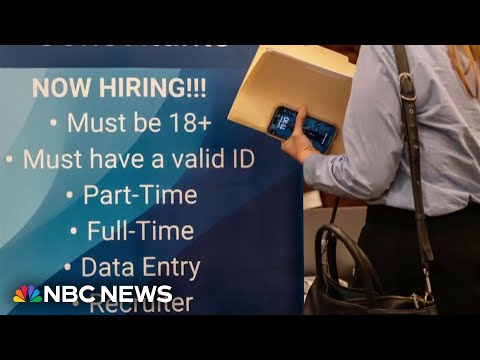
Tonight, President Trump is dismissing the latest disappointing jobs numbers. They'll say, "You're losing jobs." And then they say, "By the way, we have a correction a month later." It follows a weaker than expected jobs report. Employers only adding 22,000 new hires in August.And revised numbers show 13,000 jobs lost in June. The first time that's happened since the pandemic. Unemployment ticking up slightly to 4.3%.The White House acknowledges it's a setback. Inflation is low and economic growth is solid. ...
How The Economic Machine Works Part 3
Principles by Ray Dalio· 2025-09-05 14:37
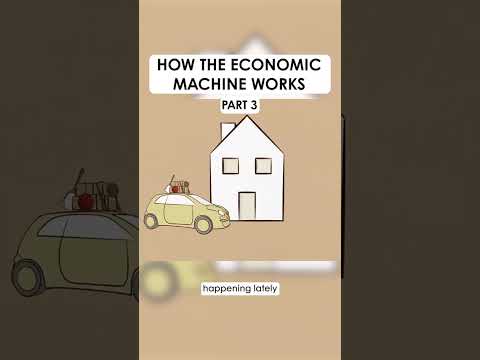
Economic Cycles - The economy functions like a machine, driven by short-term and long-term debt cycles [4] - Short-term debt cycles, typically lasting 5 to 8 years, are primarily controlled by the central bank through interest rate adjustments [5] - These cycles involve expansion fueled by credit, leading to inflation, followed by contraction (recession) when the central bank raises interest rates [1][2][3] - Long-term debt cycles occur because debts rise faster than incomes over decades, leading to a debt burden [6] - The ratio of debt to income is called the debt burden, which remains manageable as long as incomes rise [7] Debt and Credit - Spending increases are fueled by credit, which can be created instantly [1] - When credit is easily available, there's an economic expansion; when it's not, there's a recession [4] - Rising incomes and asset values help borrowers remain creditworthy for a long time, even with accumulating debt [8] - At some point, debt repayments grow faster than incomes, forcing people to cut back on spending, leading to a reversal of the cycle [9] - Debt burdens become too big, leading to deleveraging, as seen in 2008 in the United States and Europe [10][11] Inflation and Deflation - Inflation occurs when spending and incomes grow faster than the production of goods, causing prices to rise [1] - The central bank raises interest rates to combat inflation [2] - Deflation occurs when people spend less, causing prices to go down, leading to a recession [3] Human Behavior - People have an inclination to borrow and spend more instead of paying back debt, pushing the economy [5] - Lenders freely extend credit because everyone thinks things are going great, focusing on rising incomes and asset values [6] - People borrow huge amounts of money to buy assets as investments, causing their prices to rise even higher, creating a boom and potentially a bubble [8][7]
Fed's Goolsbee: 'Tariffs Are Terrible'
Bloomberg Television· 2025-09-05 13:48
So the history of tariffs, I mean, we've got precedent. You know, I don't know the answer to this. You look back at Smoot-Hawley and various tariffs over the last hundred years.Is there a trend line or. Okay. Yeah, there's a red line.Tariffs are terrible. As you joined the central bank. You're out of the fiscal policy business. Okay, You're out of the partisan business.People take the job extremely seriously. So I'm not going to with the president and Congress, in their wisdom, can pass whatever tariffs the ...

Watch CNBC's full interview with Commerce Secretary Howard Lutnick
CNBC Television· 2025-09-05 12:45
All right, President Trump signing an executive order Thursday that will allow tariffs on auto and other imports from Japan to be coming in at much lower rates, 15% versus the 25 to 27 1.5%. Uh joining us right now to talk about this is Commerce Secretary Howard Lutnik and SE Secretary Lutnik, thank you for being with us today. Let's walk through how this kind of played out and what the specific details are in this agreement. All right. So the Japanese in order to buy down their tariff rate, so they had a 2 ...
X @Anthony Pompliano 🌪
Anthony Pompliano 🌪· 2025-09-05 12:37
Economic Outlook - Jobs report 显示就业市场疲软 [1] - 预计美联储将在 2025 年多次降息 [1] - 房屋销售量有望回升 [1] Company Performance - $OPEN 公司收入大幅增长 [1]
3 Magnificent S&P 500 Dividend Stocks Down As Much As 36% to Buy and Hold Forever
The Motley Fool· 2025-09-05 08:15
Group 1: Investment Opportunities - The article emphasizes the importance of purchasing quality stocks at discounted prices, particularly dividend stocks, to maximize yield [1] - It highlights three S&P 500 dividend stocks that are currently down significantly from their highs, presenting potential buying opportunities [2] Group 2: Verizon Communications - Verizon Communications is noted for its stable dividend yield of 6.2%, which has been raised annually for the past 18 years, despite a nearly 30% decline from its late-2019 peak [5][6] - The company has a substantial debt load of $124 billion, resulting in annual interest payments of approximately $6.6 billion, but it is still capable of funding its dividend [7][8] Group 3: Accenture - Accenture, valued at $158 billion, generated $65 billion in revenue last fiscal year, with a net income of $7.7 billion, showcasing its diverse business model that includes both consulting and managed services [9][10] - The stock has decreased by 36% from its peak due to market fears regarding tariffs and rising interest rates, but the company reported an 8% year-over-year revenue increase last quarter [12][13] Group 4: Lockheed Martin - Lockheed Martin's stock has fallen 26% from its October high, primarily due to reduced orders for F-35 fighter jets, although this segment accounts for less than one-third of its total revenue [14][15] - The company is still expected to achieve revenue growth, projecting around $74 billion for 2025, and has maintained a solid dividend yield of 2.9%, having increased its dividend for 22 consecutive years [18][19]




Federal Reserve Needs to Help the US Solve Its Debt Problem, Wilson Says
Bloomberg Television· 2025-09-04 14:07
Fed Independence & Monetary Policy - Wall Street strategists are increasingly concerned about the Fed's independence as President Trump seeks to influence the central bank [1] - JPMorgan analysts note growing market concerns over Fed independence due to signs of a "Fed inflation trade" [1] - Goldman Sachs analysts also highlight increasing worries about the Fed's credibility [1] - Morgan Stanley suggests the Fed and Treasury are working more closely together due to high debt levels, a trend observed across several presidential terms [3][4] - The Fed may feel obligated to help the government with funding, potentially leading to running the economy "hot" to tackle the deficit [5][6][8] - Maintaining lower back-end rates is crucial, and the Treasury and Fed may intervene to prevent yields from rising back towards 5% [10] Economic Outlook & Market Strategy - Morgan Stanley believes the market was previously priced for a recession, which troughed in April, and is now in a rolling recovery [11][12] - The interest rate-sensitive sectors, like housing, are expected to be the next to recover, contingent on lower borrowing costs [13] - A more dovish Fed is anticipated over the next 6-12 months, contributing to a bullish outlook for equities [13][14] - The current administration is viewed as implementing pro-growth policies, potentially leading to a boom in CapEx and earnings next year [15][16] - Lower interest rates are seen as the missing piece for a full recovery [17] - While there might be short-term corrective activity or a "sell the news" reaction to the first Fed cut, dips should be viewed as buying opportunities, with a positive equity outlook for the next 6-12 months [19]
Stock Market Today: Dow Futures Slip, S&P 500 Rises As Trump Files Tariff Appeal—American Eagle, Salesforce, Lululemon In Focus
Benzinga· 2025-09-04 09:56
Market Overview - U.S. stock futures showed mixed movements following a mixed session on Wednesday, with major indices experiencing fluctuations [1] - The Dow Jones index decreased by 25 points or 0.05% to 45,271.23, while the S&P 500 rose by 0.51% to 6,448.26, and the Nasdaq Composite increased by 1.02% to 21,497.73 [7][8] Economic Indicators - The yield on the 10-year Treasury bond was at 4.20%, and the two-year bond yield was at 3.60% [3] - U.S. job openings fell by 176,000 to 7.18 million in July 2025, below market expectations of 7.4 million [6] - New orders for U.S.-manufactured goods declined by 1.3% month-over-month to $603.6 billion in July [6] Company Performance - Alphabet Inc. Class C shares surged over 9% following a favorable U.S. court ruling in the DOJ antitrust case [5] - Apple Inc. shares increased by about 4% due to the ruling preserving a significant revenue stream [5] - Campbell's Co. shares rose by 7% after reporting better-than-expected earnings [5] - Macy's Inc. shares jumped more than 20% after raising its FY2025 guidance [5] - American Eagle Outfitters Inc. saw a 24.30% increase in premarket trading after a successful second quarter [18] - Salesforce Inc. shares dropped by 6.61% after issuing third-quarter sales guidance below estimates [18] - Hewlett-Packard Enterprise Co. shares rose by 2.98% after posting strong earnings and raising fiscal 2025 guidance [18] - BrilliA Inc. shares skyrocketed by 155.87% following the announcement of a cash dividend [18] - Biodesix Inc. shares increased by 37.37% after a substantial insider purchase by a major shareholder [18] - Neonode Inc. shares plummeted by 76.53% despite announcing expected revenue from a patent settlement [18] Sector Performance - Most sectors on the S&P 500 closed negatively, with industrials, energy, and materials stocks experiencing the largest losses [4] - Communication services and information technology stocks performed well, leading to a mixed settlement in U.S. stocks [4]


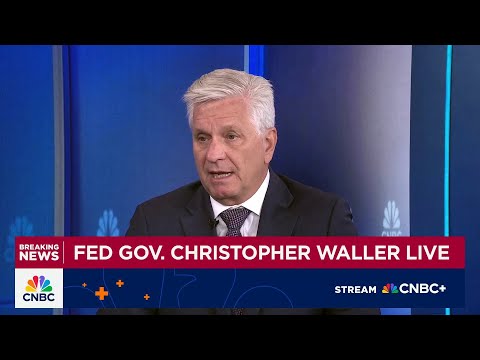
Fed Governor Christopher Waller: We should start cutting rates, can always adjust the pace
CNBC Television· 2025-09-03 13:33
So, let's get to Steve Leeman, who is with one of the potential Fed picks, who seemed to have gotten more popular uh as time has been going by and and even before he was mentioned, we had talked about him and and talking about cuts way before that. Uh Chris Waller, hi Steve. >> Yes, we had uh Joe and I am joined by Fed Governor Chris Waller, who because he's right here, he's my pick right now.Thanks for joining us, Governor Waller. Um I want to start off with what uh is is among the most interesting things ...