Business Cycle

Search documents
X @Raoul Pal
Raoul Pal· 2025-09-10 13:43
RT Julien Bittel, CFA (@BittelJulien)It’s been five days since the August jobs report dropped, and I’ve gone through at least 20 takes. The narratives are all over the place, making it hard to separate signal from noise.Here’s what actually matters:Unemployment keeps grinding higher, exactly as our lead indicators and GMI/MIT work flagged back in Q1. That keeps the Fed engaged.At the same time, the earliest signs of a cyclical recovery in employment are already showing up in the data.Our GMI Early Workforce ...
全球经济评论:对我们全球预测的技术更新-Global Economics Comment_ Technical Updates to Our Global CAIs
2025-09-04 15:08
Summary of Key Points from the Conference Call Industry Overview - The report focuses on global economic activity indicators, specifically the Current Activity Indicators (CAIs) developed by Goldman Sachs to assess underlying economic growth trends. Core Insights and Arguments - **GDP Limitations**: GDP is a commonly used measure of economic output but has excessive volatility, is released quarterly, and can be heavily revised, making it less reliable for real-time economic assessment [2][5][6]. - **CAI Advantages**: CAIs provide a more timely and less volatile growth signal compared to GDP, as they are based on a broader set of monthly activity and survey data [3][5][6]. - **Technical Updates**: Three technical changes were made to the CAIs: 1. Discontinued inputs were replaced with substitutes, and weights were re-estimated for affected economies [5][6]. 2. The exclusion period for pandemic-affected months was harmonized across economies to ensure consistency [7]. 3. Estimates of the relationship between business surveys and GDP were updated to capture nonlinearities more accurately [8]. - **Impact of Changes**: Most economies experienced only modest revisions to their CAIs, with some showing improved correlation with historical GDP data, indicating a modest improvement in tracking economic activity [9][14][17]. Additional Important Content - **Geographical Focus**: The updates affected various economies, including both developed markets (DM) and emerging markets (EM), with specific mentions of Australia, Estonia, Hungary, Latvia, Poland, Romania, and South Korea [14]. - **Data Availability**: CAIs are available monthly, providing a more immediate growth signal compared to the quarterly release of GDP [6]. - **Correlation Improvements**: The revisions generally led to an increase in the correlation between updated CAIs and quarterly GDP, enhancing the accuracy of economic activity tracking [14][17]. This summary encapsulates the essential insights and updates regarding the CAIs and their relevance in assessing global economic activity, highlighting the advantages over traditional GDP measures and the implications of recent methodological changes.

X @Raoul Pal
Raoul Pal· 2025-08-29 00:52
But our work suggests (probabilistically speaking) that the cycle extends into Q1 2026 and possibly Q2 2026 due to slow business cycle forcing more liquidity for longer.wen banana? 🍌 We've been in it since Aug 2024 and the acceleration phase lies ahead. ...
Coinbase Predicts Explosive Altcoin Season in September – "HERE'S EXACTLY HOW IT HAPPENS!"
Altcoin Daily· 2025-08-18 22:09
Market Trends & Altcoin Season Catalysts - Coinbase warned investors that altcoin season is approaching [1][12] - Altcoin season begins with the combination of global liquidity (Global M2), the business cycle, and Bitcoin dominance rolling over [2][9][10] - Global liquidity (Global M2) and Bitcoin price tend to correlate with Bitcoin lagging by approximately 12 weeks [2] - A liquidity wave in late Q3 2025 to early Q4 2025 could accelerate the rotation of capital [14] Bitcoin & Altcoin Performance - Bitcoin price tends to correlate with global liquidity, with an approximately 80% correlation observed [3] - Bitcoin dominance saw a decline from 65% to 59% in the last 2 months, signaling a potential altcoin season [10] - Coin Market Cap's altcoin season index is currently at 40%, needing to reach 75% of the top 50 altcoins outperforming Bitcoin over the last 90 days to signal alt season [14] Regulatory Environment & Institutional Interest - Clearer regulatory environment is driving liquidity, particularly in Bitcoin and stablecoins [15][16] - Institutional interest in Ethereum is rising, fueled by digital asset treasuries and stablecoin narratives [19] - SEC is working closely with exchanges to create a generic listing standard, potentially leading to the launch of altcoin ETFs in September/October [17][18] Future Outlook - The next high confidence move up for Bitcoin will be around August 23rd, potentially reaching $140,000 and then $150,000 by the end of September [4] - A positive Q3 2025 outlook stems from macro trends such as potential Fed rate cuts and expected regulatory advancements [12] - Global liquidity (Global M2) is expected to peak in September, coinciding with the potential market structure bill and Fed rate cuts [13]



Mad Money 6/17/25 | Audio Only
CNBC Television· 2025-06-17 23:54
Federal Reserve and Monetary Policy - The Federal Reserve (Fed) aims to promote maximum employment and stable prices, managing inflation without causing economic recession [1] - The Fed influences the economy by setting the federal funds rate, impacting short-term borrowing costs for banks, which then affects consumer and business loans [1] - Raising interest rates can slow down economic expansion by making borrowing more expensive, potentially leading to higher unemployment and recession [1] - The market anticipates Fed actions, with stock prices reacting immediately to signals about future rate hikes or cuts, reflecting collective views about the economy 6 to 9 months out [2] - The stock market tends to perform well when the Fed is perceived as supportive, meaning rate hikes are off the table and rate cuts are anticipated [3] Market Dynamics and Investment Strategies - The stock market acts as a forecasting machine, anticipating future economic conditions and reacting swiftly to new data that alters expectations [2] - During Fed tightening cycles, bad economic news can be good news for the stock market, as it increases the likelihood of the Fed easing up [2] - Certain sectors, such as home builders and automakers, are economically sensitive and can signal an upcoming economic slowdown [6] - Investors should monitor indicators like paper stocks and copper prices to gauge the economy's temperature and make informed investment decisions [6][7] Historical Crashes and Fed's Role - Historical market crashes, such as those in 1987, 1998, 2000, and 2008, highlight the Fed's potential impact on exacerbating or mitigating economic crises [5][6] - The Fed's actions, whether perceived as timely or tone-deaf, can significantly influence market stability and investor confidence [6]

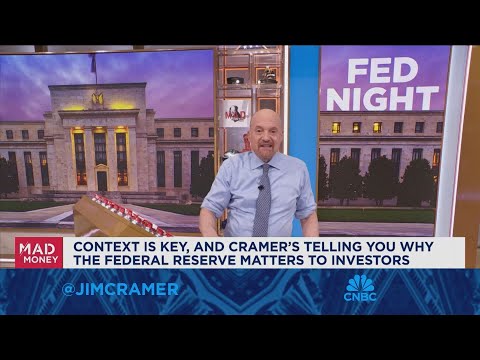
Jim Cramer breaks down all things Federal Reserve before Wednesday's rate decision
CNBC Television· 2025-06-17 23:44
Hey, I'm Kramer. Welcome to Mad Money. Welcome to Kramer.Other people want to make friends. I'm just trying to make you a little money. My job is not just to entertain, but to educate you.So call me at 1800743 CNNBC or tweet me at Jim Kramer. If you spend much time watching this network, you've heard endless chatter about the Federal Reserve, the business cycle, tariffs and trade, and of course all the ways our trading partners try to get over on us by breaking the rules of the Great Arbor, the World Trade ...

Jim Cramer on why the Federal Reserve matters to investors
CNBC Television· 2025-06-17 23:42
If you spend much time watching this network, you've heard endless chatter about the Federal Reserve, the business cycle, tariffs and trade, and of course, all the ways our trading partners try to get over on us by breaking the rules of the Great Arbor, the World Trade Organization, or at least breaking them in spirit. But for all the relentless focus on the Fed or trade policy or the inherent boom and bust nature of the economy, we don't always do a great job of putting this stuff into context and explaini ...