
Federal Reserve Policy

Search documents
X @Bloomberg
Bloomberg· 2025-11-14 15:52
Traders Pare Bets on December Fed Cut - Bloomberg Surveillance https://t.co/HpQma0nuC3 ...
Market Analysts Split on Bull Run through 2027 vs. 2026 Bear Market
Yahoo Finance· 2025-11-06 09:59
Market Outlook - Market analysts are divided on the future of the market cycle, with some predicting an extension through 2027 and others forecasting a bear market in 2026 due to historical patterns [1] - Bulls believe that loosening Federal Reserve policies and upcoming liquidity injections will support continued growth, while bears reference historical downturn precedents [1] Federal Reserve Actions - The Federal Reserve reduced interest rates by 0.25% on October 29 and announced a halt to balance sheet reduction effective December 1 [2] - These actions have influenced market reactions, including a 2.55% drop in Bitcoin to approximately $110,764 following the announcement [2] Bullish Perspectives - Analyst Lark Davis argues that the macro environment has shifted positively compared to 2022, suggesting that investors expecting a similar crash are misjudging the current situation [3] - Davis also noted that the Treasury General Account held $939.58 billion as of November 4, which could re-enter the market once the government shutdown is resolved [4] - Analyst Michaël van de Poppe predicts Bitcoin could reach $1.2 million after a bull run extending two more years, contrasting with current expectations of around $115,000 [7] - PlanB suggests that the market top could occur in 2026, 2027, or 2028, emphasizing the absence of typical bull market indicators and noting that the period around halvings has historically been profitable [8] Bearish Perspectives - Analyst Benjamin Cowen warns that Bitcoin closing below its 50-week moving average could confirm a cycle top, projecting a bear market in 2026 [5] - Trader Doctor Profit describes the current downturn as the beginning of a bear market, with Bitcoin targets between $54,000 and $60,000 by September or October 2026 [5] - The CNN Fear & Greed Index indicates extreme fear at a level of 21, reflecting market sentiment [6] Market Activity - On November 5, markets experienced $1.73 billion in crypto liquidations within a 24-hour period, with long positions accounting for $1.32 billion of the total [6]
This is the ‘BIG VALUE' of deregulation, says Fed chair candidate
Youtube· 2025-11-01 00:01
Core Viewpoint - The Federal Reserve is navigating economic challenges with a focus on labor market conditions and inflation data, despite criticisms of its policy approach [1][2][11]. Inflation and Economic Data - Current inflation rates are reported at 3% year-over-year, with core CPI also at 3%, indicating persistent inflation concerns [4][10]. - Grocery prices have increased by 3.2% over the past year, reflecting ongoing public concern about inflation [5]. - The Federal Reserve anticipates inflation will decrease, with forecasts suggesting a return to target levels [10][12]. Policy Decisions - The Federal Reserve is considering cutting policy rates in December, based on data indicating that inflation will eventually decline [11][12]. - There is a belief that tariffs have a minor and temporary effect on inflation, and the Fed should focus on broader economic indicators [3][6][9]. Economic Growth Projections - The Federal Reserve's long-term growth forecast is set at 1.8%, which some analysts argue is overly conservative given current economic policies [13][14]. - There is optimism regarding potential productivity gains from technological advancements, although immediate impacts may not be seen [15][16]. Regulatory Environment - Deregulation is viewed as a means to lower capital costs and stimulate economic growth, paralleling the effects of interest rate cuts [21][22]. - The Federal Reserve staff considers the impact of deregulation and tax incentives when estimating potential GDP growth [20][21].


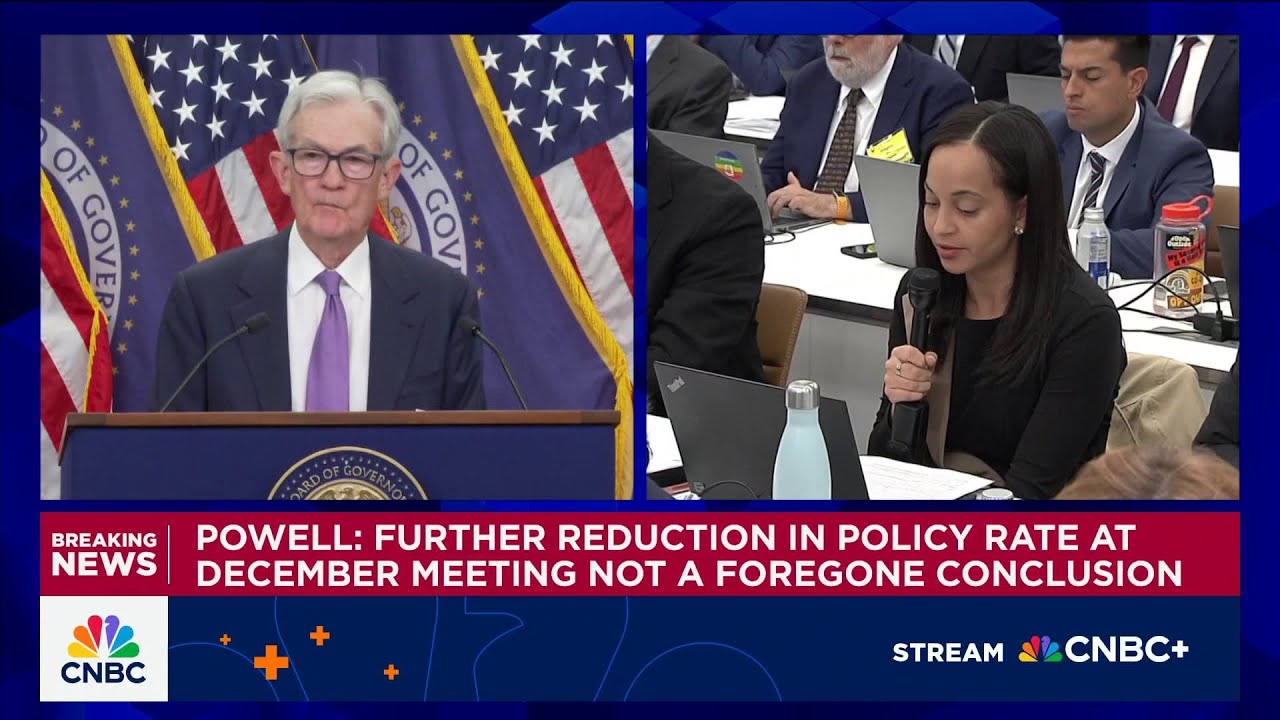
Goods prices increasing due to tariffs, housing services inflation lowering, says Fed Chair Powell
Youtube· 2025-10-29 19:19
Core Inflation Insights - Core inflation remains at 3%, with some components coming in lower than expected [1][2] - The inflation rate excluding tariffs is estimated to be around 2.3% to 2.4%, which is close to the 2% target [5][6] Goods and Services Inflation - Goods prices are increasing due to tariffs, contrasting with a long-term trend of mild deflation in goods [3][5] - Housing services inflation is decreasing and is expected to continue this trend, which is a positive sign [3][4] - Non-housing services inflation has been stable but does not provide significant signals about economic tightness [4][9] Labor Market and Economic Policy - The labor market is not perceived as overly tight, which reduces the risk of persistent inflation [7][10] - Current monetary policy is described as modestly restrictive, contributing to a gradually cooling economy and labor market [10][11] Future Inflation Expectations - There is a commitment to return inflation to the 2% target, with market surveys indicating credibility in this commitment [11]
10月29今日币圈:比特币、以太坊、山寨币行情分析及操作建议!
Sou Hu Cai Jing· 2025-10-29 06:28
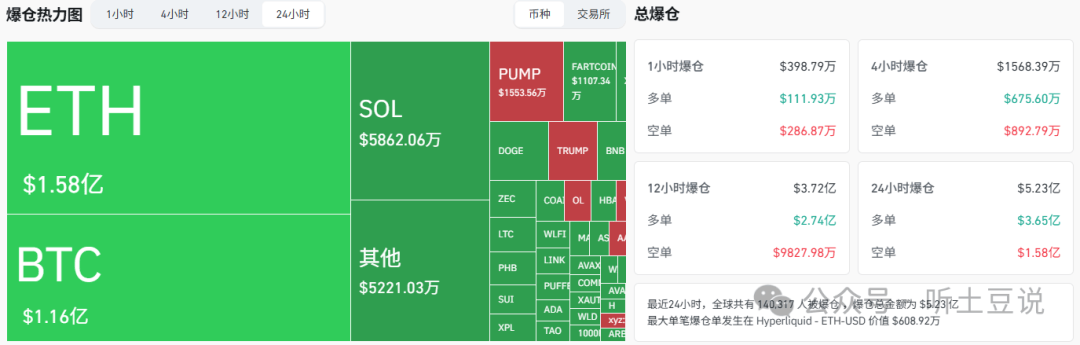
Core Viewpoint - The cryptocurrency market has experienced a decline of 1.12% in the past 24 hours, with cautious sentiment prevailing as investors await the Federal Reserve's policy decision [1] Market Sentiment - The total market capitalization of cryptocurrencies is approximately $3.81 trillion, with a 24-hour trading volume of about $171.86 billion. The current market sentiment is neutral at 50, reflecting caution among investors [9] Federal Reserve Concerns - Investor concerns regarding the Federal Reserve's policy have led to reduced investments ahead of the Federal Open Market Committee meeting [1] Solana ETF Performance - Despite a significant inflow of $69.5 million into Bitwise's SOL ETF, the price of SOL has decreased by 3% [2] Leverage Reduction - There has been a 17.5% decrease in open positions in derivatives, indicating a reduction in speculative activity. In the last 24 hours, 140,317 individuals were liquidated, totaling $523 million, with long positions suffering the most at $365 million [3] Major Cryptocurrency Performance - Bitcoin (BTC): Price around $113,135, down 0.51% in 24 hours. Key resistance at $113,600 and support between $111,700 and $111,400 [5] - Ethereum (ETH): Price around $4,034, down 1.06% in 24 hours. Key resistance at $4,040 and support at $3,915 [6] - BNB: Price around $1,110, down 1.35% in 24 hours. The price has shown signs of weakness after a previous rally [7] - Solana (SOL): Price around $195, down 1.78% in 24 hours. Key support at $197 [8] Top Gainers and Losers - Top 3 Gainers: 1. MDT: Price $0.02428, up 37% 2. SHELL: Price $0.1230, up 19% 3. FLM: Price $0.0233, up 16% [11] - Top 3 Losers: 1. KDA: Price $0.045, down 28% 2. OG: Price $10.54, down 25% 3. FUN: Price $0.00328, down 21% [11]
Trump Calls Fed Chair Powell a 'Real Stiff'
Youtube· 2025-10-22 16:08
Economic Overview - The economy is experiencing significant growth, with rising incomes and small business confidence at its highest level in over a decade [1] - Confidence levels among small businesses reflect a positive outlook, indicating a strong belief in the economy's performance over the past ten years [1] Price Trends - Gasoline prices have decreased significantly, contributing to overall economic relief [1] - Grocery prices are also down, which may enhance consumer spending power [1] - Energy prices have seen a decline, further supporting economic stability [1] - Mortgage rates have dropped, potentially making home ownership more accessible [1] Federal Reserve Context - There is a notable situation with the Federal Reserve, indicating potential changes in leadership soon [2]

Fed's evenly divided and investors will have to watch economy, says Jefferies' Richard Fisher
Youtube· 2025-10-09 20:19
Core Viewpoint - The Federal Reserve's policy decisions may be influenced by the current high stock market performance, with discussions among Fed officials about whether financial conditions are too restrictive or not [2][5][6]. Group 1: Federal Reserve's Perspective - The New York Fed President John Williams indicated that he does not believe the markets are being restricted, suggesting a focus on credit markets rather than equity markets [2][3]. - There is a significant debate within the Fed regarding the restrictiveness of current monetary policy, with some members advocating for further rate cuts while others are more cautious [6][9]. - The minutes from the Fed's meetings show a roughly even split among members on the desire to ease monetary policy, with some members indicating a preference for two more rate cuts this year [7][9]. Group 2: Economic Indicators - The Atlanta Fed's growth estimate of 3.8% for the quarter coincides with the stock market reaching an all-time high, complicating criticisms of the Fed's monetary policy [4][5]. - Current economic conditions are characterized by low spreads and yields in credit markets, indicating that financial conditions may not be as tight as perceived [3][5]. - There are concerns about inflationary pressures as businesses work through inventory accumulated in anticipation of tariffs, which may challenge the Fed's goal of reaching a 2% inflation target [10][11].


Fed policy will dominate market narrative when shutdown end, says Fed Watch Advisors' Ben Emons
CNBC Television· 2025-10-08 22:04
Meanwhile, the Fed minutes out today reflecting division little bit over the direction of rates. A slim majority of Fed governors expecting two more cuts this year, but the central bank overall currently dealing with a darth of data. Darth Darth Darth Darth Vader.Darth thanks to the government shutdown. I mean, seriously, the September jobs report. Darth of I mean don't give me Don't give me the daggers.It's Darth. Yes, it is. That's it.Darth is from the movie. Is he Lwig or whatever you seen earlier today. ...

What a government shutdown really costs the US economy
Yahoo Finance· 2025-10-02 10:28
Listen and subscribe to Stocks In Translation on Apple Podcasts, Spotify, or wherever you find your favorite podcast. The US government is shut down. So what does this all mean for Wall Street? In this episode of Stocks in Translation, RSM Chief Economist Joe Brusuelas joins host Jared Blikre and Senior Reporter Allie Canal to discuss the current economic outlook and how it could be impacted by the government shutdown. Brusuelas also offers top insight on Federal Reserve policy, the bond market, and the rol ...

International Investor Mindset Could Limit US Gains: RBC
Yahoo Finance· 2025-09-24 08:30
Group 1 - The outlook for equity markets is influenced by the US economy and Federal Reserve policy [1] - There are notable differences in portfolio strategies between US and non-US investors [1]