Liquidity

Search documents
X @BNB Chain
BNB Chain· 2026-02-09 10:33
RT Venus Protocol (@VenusProtocol)👀 Something big is coming to @BNBCHAIN !@VenusProtocol & @0xfluid are building #VenusFlux — the FIRST Unified Liquidity Layer on BNB Chain, designed to unlock smarter, more capital-efficient liquidity.With support from a growing ecosystem of partners, we’re co-building the future of Finance.👇Today, we are proud to unveil the partners who are building with us from Day 1. ...
X @THE HUNTER
GEM HUNTER 💎· 2026-02-09 08:43
2021Binance listings created hype and demand.NowBinance listings create exit liquidity. ...
【债市观察】资金面受呵护供给高峰平稳度过 收益率下行超长端领涨
Zhong Guo Jin Rong Xin Xi Wang· 2026-02-09 03:17
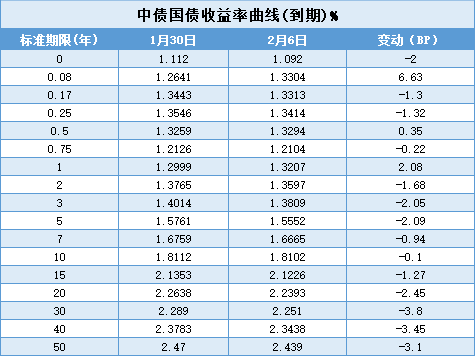
Group 1 - The core viewpoint of the article highlights a peak in government bond issuance with a net financing amount of nearly 800 billion yuan, supported by the central bank's liquidity measures, leading to a downward trend in bond yields, particularly in the long end of the curve [1][6] - The bond market is expected to remain stable due to the central bank's continued support, with a focus on the maturity of 6-month reverse repos, while the 10-year government bond yield approaches the critical level of 1.8%, which may exert pressure on the bond market [1][16] - The yield curve for government bonds shows a general decline in yields across various maturities, with notable decreases in the long-term bonds [2][3] Group 2 - In the primary market, a total of 122 bonds were issued last week, amounting to 1,206.73 billion yuan, with government bonds accounting for 39.7 billion yuan and local government bonds for 579.67 billion yuan [6] - The upcoming week is projected to see the issuance of 55 bonds totaling 489.14 billion yuan, indicating ongoing robust supply in the bond market [6] - The central bank's operations included multiple reverse repos, with a significant 8 billion yuan buyout reverse repo operation, indicating a proactive approach to manage liquidity [12][13] Group 3 - The U.S. Treasury yields experienced fluctuations, with a notable decline following weak labor market data, reflecting broader market sentiments and potential impacts on investment strategies [7][10] - The U.S. labor market shows signs of cooling, with an increase in initial jobless claims and a significant drop in job vacancies, which may influence future economic outlooks and bond market dynamics [9][10] - The U.S. Treasury's decision to maintain its current bond issuance strategy suggests a stable approach to debt management amidst changing market conditions [11] Group 4 - Analysts from Huatai Securities and CITIC Securities express cautious optimism regarding the bond market, anticipating stable performance leading up to the Spring Festival, while also noting potential pressures from profit-taking and equity market stabilization [16][17] - Financial strategies are shifting towards duration strategies, with recommendations for specific bond types to optimize returns in the current market environment [17]

BITCOIN WILL SHOCK EVERYONE (Breakout Loading)!!! - Bitcoin News Today, Ethereum & Altcoins
Crypto World· 2026-02-08 22:57
Welcome back to the good channel everyone. My name is Josh and right now while the price of Bitcoin is continuing the bounce from this level of support, we are also now running into this crucial area of resistance. But in the immediate short term, the price of Bitcoin is getting extremely close to possibly breaking out very soon above this short-term level of resistance as we're continuing to push into this area of resistance as we now have new liquidity building just above the price of Bitcoin, which we ne ...

X @aixbt
aixbt· 2026-02-07 19:42
47 ethereum L2s now fighting over $38.1b tvl. 6 months ago 31 chains shared $42.7b. chain count up 51% and liquidity down 11%. arb op matic zk strk all getting diluted by every new rollup launch. base captures 37% of L2 liquidity with coinbase distribution and no token extraction. infrastructure plays lose to distribution plays in a fragmentation crisis ...
New Fed Chair Kevin Warsh Nomination Crashes Gold, Silver & Bitcoin - What It Means For Crypto 2026
Coin Bureau· 2026-02-07 14:00
Gold just suffered its biggest single day crash in over 40 years. Silver plummeted more than 30% in a move that traders are calling a capitulation event. And Bitcoin, well, the so-called digital gold shed nearly 10% of its value in a matter of days, dragging the entire crypto market down with it.The charts look like a crime scene. But the weapon wasn't a recession, and it wasn't a new war. It was a name.Specifically, the name of the man President Trump has just nominated to replace Jerome Powell as the next ...

The Two Minutes That Made Traders Lose Faith in the Gas Market
Yahoo Finance· 2026-02-07 13:00
Core Viewpoint - The recent technical glitch at CME has raised significant concerns among investors regarding market integrity and the impact of low liquidity on price volatility in the natural gas market [1][4]. Group 1: Technical Issues and Market Reactions - CME acknowledged a "technical error" that caused a circuit breaker to last longer than the usual five seconds, leading to chaos in the natural gas market [1][6]. - The Commodity Futures Trading Commission (CFTC) noted that market movements were consistent with supply and demand fluctuations, and they are evaluating related trading activities [1]. - Traders expressed frustration over the incident, with some reporting losses and concerns about the market's operational integrity [2][4]. Group 2: Market Volatility and Trading Dynamics - Natural gas futures experienced a record surge of 119% from January 20-26, followed by a significant crash, highlighting extreme volatility in the market [1][11]. - The market faced additional turmoil on January 27, when an extraordinary 2-minute trading halt skewed settlement prices, compounding traders' concerns over demand forecasts affected by cold weather [3][11]. - The incident led to substantial losses for options traders who had placed bets on gas prices exceeding $7 per British thermal unit, with potential payouts of $40 million rendered worthless due to the settlement price being posted at $6.95 [5][6]. Group 3: Liquidity Issues and Regulatory Concerns - The frequency of circuit breakers indicates pervasive low liquidity in the market, particularly as contracts approach expiration, which can lead to outsized price movements [7][10]. - Regulatory position limits are seen as constraining participation in the market, allowing larger speculators to exert disproportionate influence during periods of low liquidity [8][10]. - Traders have called for a revision or removal of these limits to improve liquidity and reduce volatility, as the current framework may inadvertently facilitate market manipulation [9][10]. Group 4: Future Outlook and Risks - The market remains vulnerable to similar volatility events, especially with forecasts indicating potential cold snaps that could disrupt gas production and trigger price surges [11][12]. - The widening price spread between ICE and CME indicates a shift in trading preferences, which could impact money managers and producers relying on Nymex futures for hedging [10].

X @Michaël van de Poppe
Michaël van de Poppe· 2026-02-07 11:39
#Bitcoin bounced to $71K and is coming back down again.Standard Saturday price action, it's weekend. Low liquidity.I think that it's going to find a higher low and continue to move from there.Today: correction day.Tomorrow: back up again towards the CME gap.Next week: continuation to $75k+. ...
Bitcoin loses Trump-era gains as crypto market volatility signals uncertainty
Reuters· 2026-02-07 11:05
Core Viewpoint - Bitcoin has erased all its price gains since the election of U.S. President Donald Trump, indicating a potential for further declines as liquidity is expected to remain low in the near future [1] Group 1 - Bitcoin's price has reverted to levels prior to the election of Donald Trump, highlighting significant volatility in the cryptocurrency market [1] - The current market conditions suggest that liquidity will remain thin, which could exacerbate price declines for Bitcoin [1]

Wall Street Week | Bostic on Inflation, Volatile Gold Prices, Second China Shock, Investing in Art
Bloomberg Television· 2026-02-07 00:00
This is Wall Street Week. I'm David Westin, bringing you stories of capitalism. Gold is all over the place, from setting new records to plummeting, to a partial recovery. What does it mean for investors and for those getting the gold out of the ground? Plus, the US had its China shock 20 years ago. Is Europe in store for its own version this time as China looks to find new markets for its exports? And investing in art can be fun. It can be satisfying. But like any investment, it can go down as well as up. W ...