
Nuclear Power

Search documents
X @Bloomberg
Bloomberg· 2025-12-17 01:56
South Korea may need to pursue a separate bilateral accord with the US to secure the right to build nuclear-powered submarines, says the country’s national security adviser https://t.co/O3nVbfvK5W ...
X @Bloomberg
Bloomberg· 2025-12-16 11:52
In today’s India Edition, Menaka Doshi writes on India’s power paradox and Rajesh Kumar Singh looks at the importance of nuclear power in India’s energy mix. https://t.co/sh7Dn9odGb ...
Texas electricity providers draw on variety of sources
Dallasfed.Org· 2025-12-12 16:13
Company Overview - Vistra Corp. is the largest competitive power producer in the U.S., operating around 60 generating plants, with approximately half of its output serving Texas, meeting about 25% of the state's electricity needs [1][2] - The company serves 5 million homes and businesses nationwide, with a workforce of about 7,000 employees [1] Market Dynamics - Texas has the 10th-largest power market globally, accounting for about 10% of the U.S. electric grid, and has pursued a more competitive market structure than other states [3][4] - Since 2000, Texas has attracted over $100 billion in capital for power generation, with no costs passed onto customers [5][6] - The Texas electricity market allows for open access, enabling the construction of various types of power plants without needing prior approval from the Public Utility Commission [4][5] Grid Resilience and Changes - Following the February 2021 freeze, Texas implemented Senate Bill 3 to enhance winterization and emergency preparedness for utilities [6][7] - The grid has seen an increase in battery and solar energy integration, which can help during winter days, but challenges remain in ensuring reliability during extended cold spells [8][9] - The ERCOT system lacks a reserve and capacity market, which are present in other states, raising concerns about grid redundancy and reliability [9][10] Demand Trends - Texas has experienced a 5-6% growth in energy demand over the past two to three years, with data centers and industrial customers adapting their energy usage based on grid conditions [15][16] - The consumption of power by data centers could rise from 3-4% to 9-10% of total consumption, driven by increased electrification and demand from various sectors [18][19] Nuclear Power and Future Outlook - Texas operates two nuclear plants, with one recently relicensed to operate into the 2050s, providing reliable energy generation [21][22] - The cost of building new nuclear facilities remains high, but there is potential interest from large tech companies for carbon-free generation options [24][26] Price Trends and Market Challenges - Electricity prices have been rising across the U.S., with Texas not experiencing the same level of increase as other states, although the trend is concerning [26][27] - The retirement of coal plants and challenges in building new assets in other states have contributed to tighter supply and demand dynamics, leading to price pressures [28][29] - The Texas Energy Fund aims to incentivize gas plants amid rising construction costs and increased renewable penetration, highlighting the need for a balanced energy strategy [31][32]


X @Bloomberg
Bloomberg· 2025-12-09 12:00
The European Commission will approve Poland’s plan to provide state aid for its first nuclear power plant, Prime Minister Donald Tusk said https://t.co/81t894ewkM ...
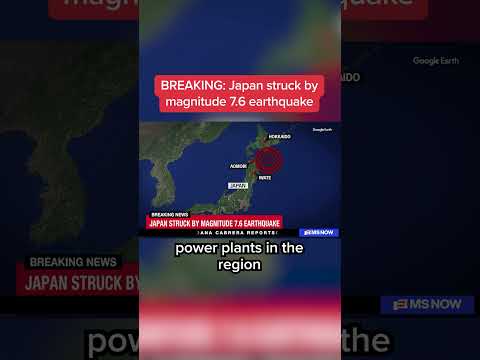
BREAKING: Japan struck by magnitude 7.6 earthquake
MSNBC· 2025-12-08 22:28
And now to some breaking news happening in Japan. Parts of that island are now under a tsunami warning after a massive 7.6% magnitude earthquake struck off Japan's eastern coast this morning. Local media say there are nuclear power plants in the region and they are running safety checks ahead of a possible 10-foot wave.Again, this just coming in. We'll bring you more developments as we get. ...
Jim Cramer Recommends Selling the Stock of Oklo
Yahoo Finance· 2025-12-05 03:45
Company Overview - Oklo Inc. (NYSE:OKLO) designs advanced fission power plants aimed at delivering scalable clean energy and develops nuclear fuel recycling technology that converts waste into usable reactor fuel [1] Investment Sentiment - Jim Cramer recently advised selling Oklo stock, indicating that the favorable conditions for investing in such stocks have ended [1] - Cramer also mentioned that Oklo is a pre-revenue company facing significant losses, which raises concerns about its financial viability [1] Market Context - The potential for Oklo's nuclear projects is acknowledged, but the timeline for development is lengthy, potentially taking a decade, and is often accompanied by substantial cost overruns [1] - There is a comparison made with AI stocks, suggesting that certain AI investments may offer better upside potential and lower downside risk than Oklo [2]
Why NuScale Power Stock Is Soaring Today
The Motley Fool· 2025-12-04 19:56
Core Insights - NuScale Power's stock has seen an increase of 15.14% recently, driven by positive sentiment regarding nuclear power's role in the AI industry [2][4] - Jensen Huang, CEO of Nvidia, emphasized the importance of nuclear energy for meeting the power demands of AI computing during a podcast appearance, which has positively influenced investor interest in NuScale Power [5][6] Company Overview - NuScale Power's current stock price is $23.19, with a market capitalization of $6 billion [4] - The stock has experienced a 52-week range of $11.08 to $57.42, indicating significant volatility [5] Industry Context - Jensen Huang predicts that small nuclear reactors will become more prevalent in the next six to seven years to support AI computing needs [5] - Huang's comments highlight the potential of nuclear power to alleviate pressure on the energy grid and contribute to energy supply, which aligns with NuScale Power's offerings of small modular reactors [5][6]


Should You Buy Cameco While It's Below $110?
The Motley Fool· 2025-12-02 03:32
Core Viewpoint - Cameco's stock has experienced a 15% decline from its 52-week high, raising questions about its investment potential despite a 50% increase over the past year due to renewed interest in nuclear power [1][7]. Company Overview - Cameco is primarily a uranium miner and processor, producing fuel for the nuclear power industry, with operations in politically stable regions, making it an attractive partner [2]. - The company has diversified by acquiring half of Westinghouse, which provides services to the nuclear power sector, potentially stabilizing its income stream [6]. Industry Context - Uranium prices are historically volatile, particularly after incidents like the Fukushima disaster in 2011, which led to a decade of low prices [3]. - The nuclear power industry is expected to face a supply-demand imbalance starting around 2030, with increasing demand from sectors like data centers and electric vehicles [8]. Financial Metrics - Cameco's current stock price is $87.53, with a market capitalization of $39 billion, and it has a gross margin of 26.65% [7]. - Despite the recent pullback, Cameco's price-to-sales, price-to-earnings, and price-to-book ratios are significantly higher than pre-Fukushima levels, indicating that much positive news is already priced in [10]. Investment Considerations - While Cameco is a well-managed company with a proven ability to navigate challenges, the current stock price may reflect a premium valuation, suggesting that potential investors should consider waiting before purchasing [11].

Data Centers, AI, and Energy: Everything You Need to Know
Yahoo Finance· 2025-11-25 22:00
Core Insights - The AI infrastructure buildout is primarily driven by the transition from CPUs to GPUs, which are significantly more efficient for AI training tasks [1][2] - The energy implications of data centers are profound, as they evolve from passive storage facilities to active, energy-intensive industrial engines [4][5] - The demand for data centers is expected to grow exponentially, with electricity consumption for accelerated servers projected to increase by 30% annually, contrasting with a modest 9% growth for conventional servers [16][30] Group 1: Energy Consumption and Infrastructure - Data centers currently consume approximately 415 terawatt-hours (TWh) of electricity, representing about 1.5% of global electricity consumption [28] - By 2030, global electricity consumption for data centers is projected to double, reaching roughly 945 TWh, which would account for nearly 3% of the world's total electricity [30] - The shift to high-performance computing has led to a tenfold increase in power density, necessitating advanced cooling solutions such as liquid cooling [7][20] Group 2: Energy Mix and Carbon Footprint - Data centers are heavily reliant on coal, which currently accounts for about 30% of their electricity supply, particularly in regions like China [41][43] - Natural gas meets 26% of global data center demand and is expected to be a primary energy source due to its reliability [44][46] - Renewables currently supply about 27% of data center electricity, with projections indicating that this could rise to nearly 50% by 2030 [47][48] Group 3: Regional Dynamics and Geopolitical Implications - The United States is the leading market for data centers, with per-capita consumption projected to increase from 540 kilowatt-hours (kWh) in 2024 to over 1,200 kWh by 2030 [53] - China is expected to see a 170% increase in data center electricity consumption by 2030, driven by a shift in computing hubs to western provinces rich in renewable resources [56][58] - Europe is experiencing steady growth in data center demand, with a projected increase of 45 TWh (up 70%) by 2030, influenced by stringent regulatory environments [59][60] Group 4: Supply Chain and Infrastructure Risks - The construction of data centers faces significant delays due to mismatched timelines with grid upgrades, potentially delaying 20% of planned global capacity by 2030 [68] - Data centers require vast quantities of critical minerals, creating vulnerabilities in supply chains, particularly with reliance on China for rare earth elements [70][71] - The shortage of power transformers is a critical bottleneck, with lead times extending from 12 months to over 3 years, limiting the pace of AI infrastructure deployment [75] Group 5: Efficiency and Future Outlook - The digital economy is decoupling from past energy efficiency trends, with energy consumption scaling linearly with digital ambitions [35][38] - AI technologies may provide significant carbon offsets by optimizing energy use in other sectors, potentially reducing global CO2 emissions by 3.2 to 5.4 billion tonnes annually by 2035 [80][82] - The future of data centers will be shaped by the availability of gigawatt-scale power connections, influencing economic power dynamics globally [88][89]
美国中小盘工业股_被低估的人工智能标的_处于人工智能基础设施核心的中小盘工业股-U.S. Deep Dive Series _ SMid Cap Industrials_ Underappreciated AI Plays_ SMid Cap Industrials at the Heart of AI Infrastructure
2025-11-25 01:19
Summary of SMid Cap Industrials Conference Call Industry Overview - **Industry Focus**: North America Small and Mid Cap Industrials, particularly in AI infrastructure and related sectors [1][3][4] - **Key Themes**: - Market penetration within untapped Total Addressable Market (TAM) - Broad infrastructure investments - Nuclear power growth and safety - Electrification and automation trends [4][9] Company Insights APi Group (APG) - **Rating**: Overweight - **Current Price**: $37.4 - **Price Target**: $42 (12.1% upside) - **Market Cap**: $15.563 billion - **P/E Ratio**: 30.4x - **Revenue Growth CAGR**: 8% [3][6] Mirion Technologies (MIR) - **Rating**: Overweight - **Current Price**: $24.0 - **Price Target**: $34 (41.5% upside) - **Market Cap**: $5.955 billion - **P/E Ratio**: 57.3x - **Revenue Growth CAGR**: 2% [3][10] Rollins Inc. (ROL) - **Rating**: Overweight - **Current Price**: $59.4 - **Price Target**: $70 (17.9% upside) - **Market Cap**: $28.763 billion - **P/E Ratio**: 59.2x - **Revenue Growth CAGR**: 25% [3][6] Valmont Industries (VMI) - **Rating**: Overweight - **Current Price**: $391.2 - **Price Target**: $480 (22.7% upside) - **Market Cap**: $7.706 billion - **P/E Ratio**: 22.5x - **Revenue Growth CAGR**: 13% [3][13] Gates Industrial Corp (GTES) - **Rating**: Overweight - **Current Price**: $21.5 - **Price Target**: $33 (53.2% upside) - **Market Cap**: $5.563 billion - **P/E Ratio**: 15.5x - **Revenue Growth CAGR**: 7% [3][6] Regal Rexnord (RRX) - **Rating**: Overweight - **Current Price**: $131.0 - **Price Target**: $190 (45.0% upside) - **Market Cap**: $8.696 billion - **P/E Ratio**: 14.4x - **Revenue Growth CAGR**: 5% [3][6] Key Industry Trends - **Data Center Demand**: Expected electricity consumption from data centers to reach ~1,100 TWh by 2028, with a power installed base growing to 242GW by 2028 [22][24] - **Capex Growth**: Anticipated ~55% increase in annual grid investments from 2024 to 2030, driven by rising power consumption and infrastructure needs [31][32] - **Nuclear Power**: Significant partnerships with hyperscalers for nuclear energy supply, indicating a shift towards sustainable energy sources [37][45] Competitive Landscape - **Mirion Technologies**: Leading in nuclear safety technologies with a strong market share in 17 of 19 markets served, focusing on radiation safety and medical applications [52][54] - **Valmont Industries**: Positioned as a global leader in irrigation equipment and infrastructure solutions, benefiting from utility and telecommunications demand [91][96] Financial Metrics - **Average P/E Ratio**: 26.4x across covered companies - **Average Revenue Growth CAGR**: 14% for the sector [3][6] Conclusion - The SMid Cap Industrials sector is poised for growth driven by infrastructure investments, data center demand, and nuclear energy partnerships. Companies like Mirion and Valmont are well-positioned to capitalize on these trends, with strong financial metrics and growth potential.

