
Interest Rate Cut

Search documents
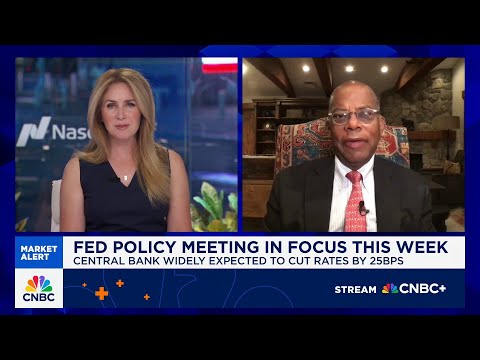
A 25 bps cut is a better choice than 50 this week, says Roger Ferguson
CNBC Television· 2025-09-15 11:01
Federal Reserve Policy - The market anticipates the Fed will cut rates this week, with debate centered on a 25 basis points cut versus a 50 basis points cut [1] - Data reinforcing labor market weakness and spillover into higher prices suggests a 25 basis points cut is more appropriate [2] - The Fed is expected to emphasize data dependence, making each meeting's decision independent [2][3] - There's a possibility of dissent within the FOMC regarding rate cuts, as inflation remains above the 2% target, around 28%-29% [16][17] - Structural factors in the labor force, such as immigration and the impact of AI, could influence the decision to cut rates [17][18] - The upcoming meeting will include the Summary of Economic Projections (SCP) and dot plots, revealing the committee's divisions based on incoming data [20] Inflation and Economic Data - Recent data showed a headline inflation number of 29% and core inflation around 3% annually [5] - Some consider the inflation data not "tame" enough for the Fed to definitively confirm movement towards the 2% target [6] Federal Open Market Committee (FOMC) Dynamics - Steven Myron's involvement raises questions about the Fed's independence [8] - The situation surrounding Lisa Cook's appointment and property disclosures adds uncertainty [8][9][10][11][12][13][14]

X @Bloomberg
Bloomberg· 2025-09-15 01:55
Monetary Policy - The Federal Reserve is expected to ease policy for the first time in nine months [1] - A "big cut" from the Federal Reserve was predicted this week [1]
Inside the troubling signs for Trump’s economy as inflation ticks up again
MSNBC· 2025-09-14 13:28
The economy took another hit this week. The Bureau of Labor Statistics released a report showing that consumer prices were up 2.9% in August from a year earlier. On top of that, revised numbers show that the US added almost a million fewer jobs than previously reported over the 12-month period ending in March. Should be pointed out that most of that period was during the Biden administration. And yet, President Trump continues to insist that all is well with the economy. In a post on Truth Social, he declar ...

Gold sizzles — really sizzles — before Fed decision
Yahoo Finance· 2025-09-14 12:12
Group 1: Gold Market Performance - Gold prices have increased by approximately 39% in 2025, closing at $3,649.40 per troy ounce, outperforming major stock indexes and bitcoin, which rose 24% [1] - In September alone, gold has risen nearly 5%, with speculation that it could reach $4,000 soon [1] - On an inflation-adjusted basis, gold has regained all losses since its peak of $850 per ounce in January 1980 [2] Group 2: Stock Market Trends - The Nasdaq Composite has surged 50% since the April low, indicating a strong correlation between stock performance and gold prices [3] - Futures trading suggests a modestly higher opening for stocks, with expectations of a Federal Reserve interest rate cut [3][4] Group 3: Market Indicators - The Federal Reserve is anticipated to cut the federal funds rate by 0.25%, potentially lowering it to a range of 4% to 4.25% [4] - Gold's relative strength index (RSI) was above 75, indicating it may be overbought, as it remained stagnant after reaching a record $3,715 [5] - The SPDR Gold Shares ETF (GLD) has been stable since hitting $338.31 per troy ounce, with an RSI of 76.8% [6] Group 4: Company-Specific Performance - Newmont (NEM) has seen a 113% increase with an RSI of 78.3 [7] - Kinross Gold (KCG) has risen by 151%, with an RSI of 81.6 [7] - Agnico Eagle Mines (AEM) has increased by 96%, with an RSI of 76 [7]
Fed's rate decision looms as markets hover near records: What to watch this week
Yahoo Finance· 2025-09-14 12:10
Group 1: Market Overview - Major stock indexes closed mixed on Friday but recorded solid weekly gains, with the Dow Jones Industrial Average rising nearly 1% for its first winning week in three weeks, and the S&P 500 and Nasdaq Composite achieving their best weekly performances since early August [2] - Treasury yields remained near recent lows, while gold prices reached new records as markets anticipated a potential Federal Reserve pivot [2] Group 2: Economic Indicators - Upcoming economic data includes a weekly update on jobless claims and fresh manufacturing data, which will provide insights into the strength of the economy [3] - Mortgage rates saw their largest weekly drop in a year, with the average 30-year fixed mortgage rate decreasing to 6.35% from 6.5% the previous week [3] Group 3: Earnings Reports - Earnings season is nearing its end, with key reports expected from FedEx, Lennar, General Mills, Darden, and Cracker Barrel, with FedEx's results being particularly significant as a proxy for global trade and the US economy [4] Group 4: Federal Reserve Decision - The Federal Reserve's interest rate decision and Chair Jerome Powell's press conference are anticipated to be the key economic events of the week, alongside the release of the quarterly "dot plot" indicating policymakers' interest rate projections [5] - In June, the Fed projected two rate cuts for 2025, but the committee showed division, with seven members opposing any cuts compared to four in March [6] Group 5: Tariffs and Inflation - Tariffs are contributing to inflation, with US customs duties reaching a record $29.5 billion in August due to new "reciprocal" levies implemented by President Trump [7]
X @Cointelegraph
Cointelegraph· 2025-09-14 05:00
🔥UPDATE: 3 days to FOMC.93.4% odds of 25bps cut, 6.6% of 50bps. https://t.co/SQXOzeJLvr ...
Bitcoin and Ethereum ETFs roar back adding nearly $3bn last week
Yahoo Finance· 2025-09-13 16:33
Group 1 - Bitcoin and Ethereum exchange-traded funds (ETFs) experienced significant inflows, with Bitcoin ETFs attracting nearly $2.4 billion and Ethereum ETFs adding approximately $640 million, totaling almost $3 billion in new capital [2][4] - Investor confidence is bolstered by expectations of interest rate cuts from the Federal Reserve, with a 94% probability of a rate cut at the upcoming FOMC meeting, which is seen as beneficial for risk assets like cryptocurrencies [3][4] - Bitcoin has reached a three-week high above $116,000, showing a decoupling from the Nasdaq, and analysts suggest that institutional inflows through ETFs could drive further price increases [4][5] Group 2 - Bitcoin is projected to rise to $140,000 by year-end, with potential to reach $250,000 if inflows remain strong, while Ethereum has outperformed Bitcoin with nearly 200% gains since mid-April [5][6] - Analysts highlight several structural factors supporting Ethereum's long-term growth, including the rise of staking, the growth of tokenized assets, and an impending generational wealth transfer favoring crypto adoption [6]
Dogecoin and BNB Rise as Bitcoin, Ethereum Hit Highest Prices This Month
Yahoo Finance· 2025-09-12 20:56
Market Overview - Crypto markets experienced significant gains, with BNB reaching a new all-time high above $926, marking a 3% increase over the last day [1] - BNB has surged nearly 9% over the past week and is up 70% year-over-year, having first breached the $800 mark this year [2] - Dogecoin saw a notable increase, trading over $0.27 after an 8% daily jump, and has risen 25% in the last week [2] Altcoin Performance - Solana, the fifth-largest cryptocurrency, hit its highest price since January at $240, reflecting a 6% increase in the last day [3] - The altcoin market surged due to gains in Bitcoin and Ethereum, with Bitcoin trading at $116,331 and Ethereum at $4,675 [4] - Bitcoin reached its highest price in a month, benefiting from positive inflows into spot ETFs [4] Investor Sentiment - Investor interest in digital assets increased following data indicating cooling inflation in the U.S., raising expectations for potential interest rate cuts by the Federal Reserve [5] - The launch of the first DOGE ETF in the U.S. was temporarily halted, yet Dogecoin remains the biggest winner in the market [3] Company Developments - Gemini, a digital assets exchange, began trading on Nasdaq with an initial valuation of approximately $4.4 billion, marking a significant public debut [5] - Gemini's stock opened at $37.01 per share, a 32% increase from its IPO price of $28, and closed at $32 per share [6]