Private Credit

Search documents
Citadel's Griffin Calls Rush to Gold as Safer Asset ‘Concerning'
Youtube· 2025-10-07 00:14
Economic Growth and Market Sentiment - The Trump administration is actively pursuing policies aimed at re-industrializing America and fostering economic growth, which has generated enthusiasm among American investors and corporate America [2][3][4] - Current fiscal and monetary stimulus measures are contributing to a sense of economic optimism, despite being in a period of near full employment [3][4] Inflation and Monetary Policy - There is a prevailing belief in the market that inflation issues, particularly high inflation related to tariffs, are being resolved, but this may be premature [5][6] - Inflation is currently above target levels, with a significant depreciation of the US dollar by approximately 10% in the first half of the year, marking the largest decline in 50 years [10] - The Federal Reserve's focus on the labor market over inflation management raises concerns about potential inflation re-acceleration in the future [9][53] Tariffs and Trade Policies - The market appears to have moved past tariff concerns, but the uneven impact of tariffs on small and medium-sized businesses, particularly those reliant on Asian goods, remains a significant issue [32][33] - The agricultural sector is also facing challenges due to changing trade dynamics, particularly with China seeking food products from other countries [33] Immigration Policies - The current immigration policies are seen as counterproductive, especially given the declining birthrate in the US, which necessitates a more open approach to immigration to sustain economic growth [34][35] - There is a call to attract skilled immigrants, particularly in STEM fields, to bolster the workforce and innovation in the US [36][39] Political Landscape and Fiscal Responsibility - The ongoing government shutdown reflects deeper dysfunction between political parties regarding budget resolutions, with both parties criticized for irresponsible spending [15][16][18] - The US is currently running a deficit of approximately 6-7%, which is deemed unsustainable given the economic growth phase [17][21] Future Economic Outlook - The need for fiscal reform is emphasized to ensure long-term sustainability and economic health, with concerns about potential future tax increases to address debt [27][28] - The current economic policies are viewed as pro-cyclical and may lead to adverse consequences in the long run if not managed properly [26][28]


"Private Equity Is Totally Screwed” - Chamath Palihapitiya
All-In Podcast· 2025-10-06 15:00
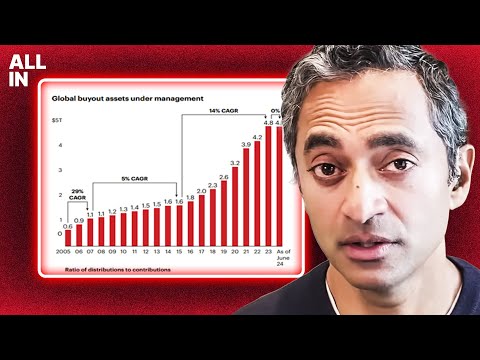
And if you look at private equity, pull up that chart I had there. This is just stunning how big this industry is getting. You know, $5 trillion is what we're up to here.And it just keeps growing. >> I I think private equity is totally screwed. I I don't think Silver Lake or Infinity or this deal are screwed, but I think private equity in general is totally hosed.>> All right. Well, it's gotten huge just since 2015 and tripling in size. So why is this I guess my question for the gentleman here and for the a ...
25 Wall Street Rising Stars and Executives to Watch
Business Insider· 2025-10-06 09:50
Core Insights - The article highlights the emergence of young dealmakers and investors who are shaping the future of finance, particularly in areas like private credit and data center deals [1][3][32]. Group 1: Rising Stars in Finance - Business Insider annually recognizes young professionals under 35 who are making significant impacts in investing, trading, and dealmaking [2]. - This year's list includes 25 individuals from prominent firms such as JPMorgan, Apollo, Citadel, and Bridgewater, showcasing their creativity and drive [3]. Group 2: Dealmaking Trends - After a slow start to the year due to various uncertainties, dealmaking is gaining momentum with significant IPOs, carve-outs, and buyouts being driven by bankers and private equity investors [4]. - The article features several notable dealmakers, including Jack Levendoski from JPMorgan, who has been involved in major technology transactions totaling over $300 billion in deal value [5][6]. Group 3: Sector-Specific Insights - The data center industry is highlighted as a multi-trillion-dollar opportunity, with Aman Mittal from Moelis & Company advising on over 15 data center-related transactions worth more than $25 billion [33][35]. - Infrastructure investments have surged, with private infrastructure fund assets increasing from $500 billion in 2016 to $1.5 trillion in 2024, driven by the AI boom and energy transition [32]. Group 4: Private Credit Evolution - The private credit sector is evolving, with Madelaine O'Connell from HPS leading innovative financing solutions for investment-grade companies, indicating a shift towards more customized loan structures [59][60]. - Knut Kirchoff from Blackstone has witnessed the rapid growth of private credit, with the firm's assets increasing from $80 billion to over $400 billion in recent years [64][66]. Group 5: Macro Insights - The article emphasizes the importance of macroeconomic understanding, with professionals like Adam Theriault-Shay at Citadel focusing on in-depth research and on-the-ground insights to inform trading strategies [92][95]. - Catherine Kress at BlackRock is positioned at the intersection of geopolitics and finance, reflecting the growing demand for insights on national security and economic resilience [97][100].


X @The Economist
The Economist· 2025-10-05 15:40
Private-credit investors must hope recent blow-ups are isolated events, rather than harbingers of worse to come. But they have reason to be pessimistic https://t.co/CA7lTRkTVk ...
Private credit socks fall following auto finance bankruptcies at Tricolor and First Brands
Youtube· 2025-10-03 20:18
Core Insights - The private credit sector is experiencing a significant sentiment shift, with firms like Apollo, Aries, Blue Owl, and KKR seeing notable declines [1] - In contrast, companies more exposed to private equity, such as TPG and Carile, have maintained stability [2] - Recent high-profile bankruptcies in the auto finance sector have triggered a broad selloff in publicly traded alternative firms, highlighting risks associated with overleveraged and subprime borrowers [2] Industry Analysis - Hedge fund manager Jim Chanos criticized the private credit market, drawing parallels to the subprime mortgage packaging during the 2008 financial crisis, suggesting that the $2 trillion private credit sector has similar vulnerabilities [3] - Chanos indicated that the structure of private credit, with multiple layers between the source and use of funds, poses risks, especially in bankruptcy scenarios where direct lenders are prioritized for repayment [3]


Private credit socks fall following auto finance bankruptcies at Tricolor and First Brands
CNBC Television· 2025-10-03 19:58
Hey Scott. Yeah, it's the private credit side of the business that has seen a real sentiment shift. Apollo, Aries, Blue Owl, and KKR seeing significant declines week to date.While those more exposed to private equity think TPG and Carile, they've held up okay. Two high-profile bankruptcies in the auto finance space leading to a broad-based selloff in the publicly traded alternatives firms. and First Brands bankruptcies, each within the last few weeks, have shed a new light on the risks of overlever and subp ...
X @Bloomberg
Bloomberg· 2025-10-03 17:05
The US Government Accountability Office is assessing the risks posed by private credit, in a sign that Washington is further scrutinizing the impact of the $1.7 trillion industry on the broader economy https://t.co/IkfF0nzeio ...
'We've Seen This Movie Before' | US Shutdown Impact
Bloomberg Television· 2025-10-03 13:29
Government Shutdown Impact - The fiscal impact of the government shutdown is expected to be minimal initially, but the focus is on the potential impact on the labor market [1] - Approximately 40% of federal workers, around 900,000, may face furlough, and all federal workers could experience pay delays [2] - Delayed employment information, initially expected on October 3rd, adds to the uncertainty [3] - Historically, shutdowns have had a limited effect on bonds and stocks, but stretched equity valuations could make this time different [3][4] Equity Market Concerns - The stock market's high price-to-earnings (P/E) ratio, around 22 times during the year, raises concerns about future returns [5][6] - Historically, buying into the S&P 500 with a forward P/E multiple of around 22 has resulted in muted returns of plus 2% to minus 2% over the next ten years [6] - Investors' patience may wane as the shutdown continues, potentially leading to a shift from stocks to credit [5][6] Private Credit Market Dynamics - Strong demand exists for alternatives in credit, particularly private credit, due to its contractual nature in a volatile market [7] - Rapid growth in private credit has raised concerns about the market overheating and attracted regulatory scrutiny in some European countries [8] - Increased demand from asset managers with private credit funds and private equity sponsors requires careful deal selection [9] - There has been a degradation in underwriting quality and covenant terms, along with compressing spreads, indicating a need for caution [10] - High yield bonds have seen significant issuance, reaching $60 billion this month, twice the normal monthly amount and levels not seen since 2021, indicating demand in both public and private markets [10] Economic Indicators - Soft data has recovered from April lows, but hard data, such as monthly spending, shows a bifurcation, with higher-income consumers still spending while lower-income consumers may be in a recession [13] - Relatively weak data for travel in August and hotel occupancy could signal that higher-end consumers are becoming more cautious [14]

X @Bloomberg
Bloomberg· 2025-10-03 09:06
Private credit firms are weighing up providing a debt package worth around £1.3 billion to finance a potential take-private deal for JTC https://t.co/lEhoq5R6gP ...
AI Optimism Propels Global Stocks to Records | Bloomberg: The Asia Trade, 10/03/25
Bloomberg Television· 2025-10-03 02:39
Market Trends & Opportunities - Bullish tech momentum saves Wall Street from losses, OpenAI's share sale boosts sector optimism [1] - Japan's equities rally continues, driven by optimism for political stability after elections and potential BOJ rate hike [1] - Private credit markets are booming, considered a $17 trillion industry, but Fitch indicates bubble-like attributes [5] - AI is expected to boost productivity, but evidence is skimpy, with U S productivity growth around 2% annualized, close to the long-term average [2] - Data centers are an interesting area for PIMCO, with big deals in the U S and Europe seen as the next frontier [38] Risks & Challenges - U S government shutdown risks revive steepener trade, potential impact on economic output is a few basis points of GDP [1] - Fiscal prudence is declining globally, with concerns about secular inflation and fiscal profligacy in the U S and Europe [2] - Japan's LDP does not have a majority in either block of parliament, raising concerns about cutting the consumption tax and increasing Japan's debt [3] - EU is considering hiking steel import tariffs to 50% to align with U S policy in response to cheaper alternatives from China [4] - Sloppy underwriting in dealmaking is a concern, with questions about collateral quality and the return of capital [48][49] Company Performance & Strategies - Tesla shares are green as investors bet a record quarter of sales will be hard to repeat [1] - Goldman Sachs is active in private credit in Asia for over 25 years, seeing renewed interest from private equity firms in Japan [6] - PIMCO is working alongside banks, taking some of their loans into private credit strategies, creating a more resilient credit market [25][26] - LG Energy will start sending South Korean workers back to the U S for essential business trips after detentions [8]