Volatility

Search documents
X @Unipcs (aka 'Bonk Guy') 🎒
Unipcs (aka 'Bonk Guy') 🎒· 2025-10-17 11:38
during today's flush:$USELESS just became the second most-traded memecoin on Coinbase for the first time ever!USELESS is currently doing more volume on Coinbase than every other memecoin except $DOGEit is leading $PEPE, $FARTCOIN, $PENGU, $TRUMP, $SHIB, $WIF, etc in volume on Coinbase at the moment$USELESS volume on Kraken is also close to ATHs on this flushAmericans seem to be aggressively bidding and positioning into USELESS on this dip relative to other regionsobserving...Unipcs (aka 'Bonk Guy') 🎒 (@theu ...
X @Crypto Rover
Crypto Rover· 2025-10-17 11:36
VIX just spiked to its highest level in 5 months.Big volatility ahead. 👀 https://t.co/WXXlWdiRWh ...
X @Unipcs (aka 'Bonk Guy') 🎒
Unipcs (aka 'Bonk Guy') 🎒· 2025-10-17 09:35
Market Volatility & Opportunity - The memecoin $USELESS exhibits extreme volatility compared to other major memecoins, experiencing amplified pumps during market bounces and steeper dips during market flushes [1] - The industry views the dip as a buying opportunity, especially for those who previously missed out on $USELESS [1] - A 25% dip is considered a short-term trading opportunity due to the favorable risk/reward ratio [1] On-Chain Metrics Validation - $USELESS holders reached new all-time highs (ATHs) as new investors accumulated during the dip [1] - On-chain volume for $USELESS remains strong, ranking second only to $TRUMP and nearly doubling the on-chain volume of $FARTCOIN [1] - Centralized exchange (CEX) volume for $USELESS is increasing aggressively during the dip [1] Market Sentiment & Future Outlook - The market believes $USELESS is a key memecoin to watch this quarter and throughout the cycle [1] - Investors who experienced FOMO (fear of missing out) at a $440 million market cap are likely capitalizing on the dip at $280 million [1]
X @Crypto Rover
Crypto Rover· 2025-10-17 06:42
💥BREAKING:$5,720,000,000 IN BITCOIN AND ETHEREUM OPTIONS EXPIRE TODAY.VOLATILITY INCOMING! https://t.co/6z4czu7VIz ...
Asian Stocks Fall With Wall St As US Credit Fears Add To Worries
International Business Times· 2025-10-17 02:57
Market Overview - Asian stocks declined, mirroring losses on Wall Street, driven by credit market fears, trade tensions, and a potential US government shutdown [1][5] - The VIX Volatility index reached its highest level since May, indicating increased investor anxiety [3] Banking Sector Concerns - The US banking sector is under scrutiny following bankruptcies of First Brands and subprime lender Tricolor, with First Brands owing billions [2][4] - Zions Bancorp reported a $50 million charge-off related to commercial loans, while Western Alliance faced issues with collateral delivery [2] Investor Sentiment - Investor optimism has been dampened by concerns over overvalued tech firms, with fears of a potential AI-fueled bubble [4] - The volatility in regional banks has raised questions about the overall health of US credit markets [4] Global Market Impact - Major Asian markets, including Hong Kong, Tokyo, and Shanghai, experienced significant declines [5][7] - Crude oil prices fell due to concerns over US-China tensions and geopolitical developments [7] Economic Indicators - The US government shutdown has delayed the release of key economic data, impacting Federal Reserve policy decisions [6] - Despite the shutdown, there are expectations for potential interest rate cuts from the central bank due to a deteriorating jobs market [6]


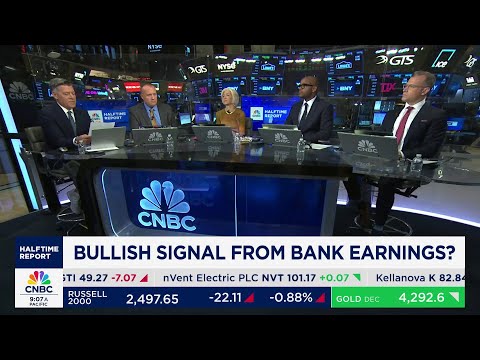
'Fast Money' traders talk recent spike in market volatility
CNBC Television· 2025-10-16 21:56
So, do these moves in volatility and rates signal deeper concerns lurking beneath the surface, guy. >> I think they should. I mean, yields are going lower because it's a a perceived flight to quality.We can probably all agree or disagree on that, but I think that's what's happening. But on a 40 point handle day, lowering the VIX, excuse me, on the S&P understanding that from high to low, it probably reversed about a 100 handles. There's no way the VIX should be at 25 in my opinion.So, it is clearly trying t ...

X @Bitcoin Archive
Bitcoin Archive· 2025-10-16 20:46
RT Bitcoin Archive (@BTC_Archive)Bitcoin is volatile.It’s also the fastest horse in the race. https://t.co/rxeso24bVK ...
X @Ash Crypto
Ash Crypto· 2025-10-16 17:34
Market Dynamics & Geopolitics - China is using the U_S_ stock market as a negotiation tactic in trade discussions with the U_S_, leveraging Trump's focus on market performance as a measure of his presidency's success [1] - Uncertainty created by delaying negotiations hurts markets, pressuring Trump to make deals that benefit both the U_S_ and China [1][2] - U_S_ midterm elections in April next year add pressure, as stock market performance influences voter sentiment and impacts Trump's strong economy narrative [2][3] Monetary Policy & Liquidity - The Federal Reserve is hinting at potential rate cuts of 25bps or even 50bps, and signaling the end of Quantitative Tightening (QT) [3] - The Treasury Secretary indicates readiness to take actions to stabilize the economy, implying increased liquidity [4] - Increased volatility is expected in the short term, followed by increased liquidity injections into the market [5] Crypto Market Analysis - Crypto assets are reacting to liquidity flows resulting from policy responses, not just tariffs or headlines [5] - Favorable conditions are emerging, including potential rate cuts, the end of QT, softening inflation data, and rising political pressure, similar to conditions preceding major rallies in 2019, 2020, and 2023 [5][6] - Crypto is now a recognized institutional asset class, integrated into the global liquidity narrative, potentially extending the current cycle beyond the typical November/December peak [6][7] - The current market volatility is viewed as a reset before the next phase of the bull market, driven by pressure leading to policy responses, liquidity injections, and subsequent expansion [7][8]
The Committee's volatility playbook: Here's what you need to know
CNBC Television· 2025-10-16 17:27
Market Trends & Retail Investor Behavior - Demand for call options has outpaced puts for 24 consecutive weeks, tying the longest streak ever recorded since 2020, indicating strong conviction among retail traders [1] - JP Morgan's retail radar shows robust imbalance with inflows exceeding outflows by 65 billion, surpassing the year-to-date average of 64% [3] - Crypto markets experienced a significant sell-off, reflecting risk appetite shifts, with recovery not fully realized, indicating a heat check mechanism [9][10][13] Investment Strategies & Portfolio Adjustments - Some investors derisked through the middle of the summer, trimming ETF baskets due to anticipated seasonal headwinds and potential Fed rate cut uncertainties [4][5] - Increased allocation to SPY (S&P 500 ETF) and IJR (small-cap ETF) after a market sell-off, viewing it as an opportunity to fully allocate ETF slices in portfolios [4][6][7][9] - Some firms trimmed positions in Amazon, Meta, and Alphabet due to their large size in portfolios (approaching 85%-9%), aiming to reduce risk amid expectations of slowing earnings growth [14][15][16] - Proceeds from selling positions were reinvested into other names, maintaining market exposure [17] Market Valuation & Economic Factors - The market rebounded on Monday after Friday's sell-off, influenced by reassurances regarding the trade war with China [9] - Relative valuations of the MAG 7 stocks are considered to be in the middle of their range over the last decade, suggesting they are not necessarily overvalued [8] - Fed Chair Powell's discussion of an endgame to quantitative tightening (QT) influenced market response, particularly in the Russell 2000 [7] Liquidity & Risk Pricing - The speed at which risk is priced and repriced has accelerated, with cycles that used to take weeks or months now occurring in a matter of hours [11] - Some firms still have 85% of cash to deploy in main portfolios, indicating a cautious approach and potential for further investment [12][13]
Investing 101 - Module 4.2
GuruFocus· 2025-10-16 16:50
Investment Strategy & Risk Management - Investment strategies should be tailored to individual goals and life circumstances, as a one-size-fits-all approach is not suitable [3] - Sticking to a well-defined investment plan is crucial, despite market volatility and inevitable downturns [3] - Panic selling during market downturns can lock in losses and prevent participation in subsequent recoveries [4][5][6] - Market crashes can present opportunities to buy stocks, as evidenced by insider buying activity during financial crises [7] - A long-term mindset, focusing on the fundamental value of companies, is essential for navigating market volatility [8][9] - Building a margin of safety into stock purchases allows for error and provides a buffer against market fluctuations [9][10] Investment Timing & Dollar Cost Averaging - Timing the market is less important than the investments themselves; even investing at the worst times can outperform not investing at all in the long run [10][11] - Dollar cost averaging, involving regular investments regardless of market conditions, is an effective long-term strategy [11]