
Monetary Policy

Search documents
Fed's Stephen Miran Sees Neutral ‘Quite a Ways Below' Current Policy
Youtube· 2025-11-03 13:04
Core Viewpoint - The Federal Reserve's current monetary policy is considered too restrictive, with a neutral rate that is believed to be significantly lower than the current policy stance [1][2][14]. Group 1: Monetary Policy and Economic Outlook - The argument for maintaining a less restrictive policy is based on a more optimistic view of inflation compared to other committee members, suggesting that prolonged restrictive policies could lead to an economic downturn [2][16]. - The concept of "passive tightening" is introduced, indicating that as neutral rates shift, the existing policy can become tighter without any active changes [14][15]. - The discussion highlights that financial market conditions may appear easier, but this does not necessarily reflect the true stance of monetary policy, as various factors influence market dynamics [4][7][8]. Group 2: Financial Conditions and Market Dynamics - Financial conditions affecting housing and private credit markets are noted to be tighter, contrasting with the perception of easier conditions in stock markets [8][31]. - The impact of alternative data on the labor market is acknowledged, suggesting that it indicates a decline in demand, which aligns with the view that current policy is too tight [28][30]. - Concerns are raised about the potential for unrecognized distress in private markets, which could signal broader issues related to the restrictive stance of monetary policy [31][33].

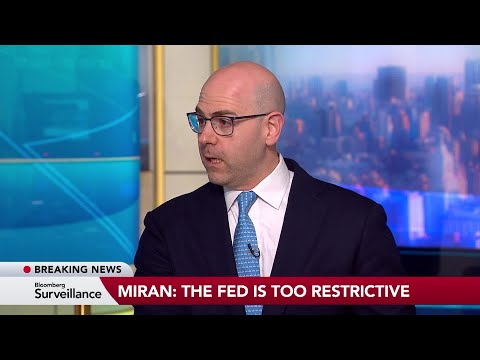
Fed’s Stephen Miran Sees Neutral ‘Quite a Ways Below’ Current Policy
Bloomberg Television· 2025-11-03 13:04
Monetary Policy Stance - The Fed is considered too restrictive, with neutral rates significantly below current policy [1] - Maintaining a restrictive policy for an extended period risks causing an economic downturn [2][16] - Financial markets are influenced by various factors beyond monetary policy, including technological advancements [4][5] - It's a mistake to automatically infer the stance of monetary policy solely from financial conditions [7] - Housing market conditions are tighter and have a greater impact on the economy's cyclical position than the stock market or credit spreads [8] - Policy passively tightened through 2025 due to shocks driven by economic policies outside the Fed, pushing neutral rates higher last year and lower this year [9][10][14] Neutral Rate and Economic Factors - Population growth rate is a major driver of neutral rates, experiencing 30 years' worth of change in only three years [11][12][13] - Changes in neutral rate accelerate over time, impacting the stance of monetary policy [14][15] Data Dependency and Economic Forecasts - Being excessively data-dependent makes the analysis backward-looking; forecasts should be prioritized [23] - Confidence in forecasts is high due to known shocks like population growth, minimizing the need for data dependency [24] - Alternative data on the labor market indicates a continual ebbing of demand, signaling that policy is too tight [27][28] Private Credit Market - Distresses in private markets suggest financial conditions have been tighter than perceived [9][31] - Uncorrelated credit problems can indicate a restrictive monetary policy [33][34]
Wall Street Aims To Open Marginally Higher
RTTNews· 2025-11-03 12:40
Investors continue to be concerned about the government shutdown. Earnings and geopolitical worries might be reflected on Monday's trade. Private reports on manufacturing and service sector activity and private sector employment might be the focus this week. In the Asian trading session, gold edged higher, while the dollar eased from a near three-month high. Oil prices rose after OPEC+ decided to hold production steady in early 2026.Asian shares finished positive, while European shares are trading mostly u ...

Fed dissenters & December doubts: Here's what to know
CNBC Television· 2025-11-03 12:38
Uh now to the Fed and uh what investors should expect from the central bank. We've been talking about the Fed all morning. Senior economics reporter Steve Leeman joins us with the latest.Hey Steve. Hey, good morning Andrew. Friday brought out a chorus of Fed hawks and some doves with Fed communications sounding increasingly chaotic.Beth Hammock from Cleveland. Uh Lori Logan from Dallas. Jeffrey Schmidt from Kansas City.All three opposed that October cut and cast doubt on whether they would support a Decembe ...
Stocks Set to Extend Rally as Investors Await Key Earnings and Fed Speak
Yahoo Finance· 2025-11-03 11:12
Economic Outlook - Kansas City Fed President Jeff Schmid expressed concerns that economic growth and investment could lead to inflationary pressures, voting against a recent 25 basis point rate cut [1] - Economic data indicated that the U.S. Chicago PMI rose to 43.8 in October, surpassing expectations of 42.3 [2] Corporate Earnings - Wall Street's major equity averages closed higher, with Amazon.com (AMZN) surging over +9% after positive Q3 results and solid Q4 guidance [3] - Twilio (TWLO) saw a +19% increase following better-than-expected Q3 results and above-consensus Q4 guidance [3] - Brighthouse Financial (BHF) jumped over +24% amid reports of Aquarian Holdings' advanced talks to take the company private [3] - In contrast, DexCom (DXCM) fell more than -14% after concerns about potential revenue growth shortfalls in 2026 [3] - The S&P 500 is expected to see an average +7.2% increase in quarterly earnings for Q3, marking the smallest rise in two years [6] Market Sentiment - December S&P 500 E-Mini futures are up +0.42%, and December Nasdaq 100 E-Mini futures are up +0.57%, indicating positive sentiment driven by strong tech earnings and easing U.S.-China trade tensions [5] - Investor focus is on upcoming corporate earnings reports from notable companies including Advanced Micro Devices (AMD) and Palantir (PLTR) [4][6] Federal Reserve Commentary - A range of Fed officials are scheduled to speak this week, with particular attention on their views regarding the economy and labor market [7] - Fed futures indicate a 69.3% probability of a 25 basis point rate cut in December [5] Government Shutdown Impact - The U.S. government shutdown has entered its 34th day, potentially delaying the publication of key economic data, including the U.S. jobs report for October [8] - Investors are focusing on private-sector data releases, such as the ADP employment report, due to the shutdown [8] International Market Developments - The Euro Stoxx 50 Index is up +0.62%, with automobile stocks leading gains following reports of resumed shipments from Dutch chipmaker Nexperia's China facilities [10] - Eurozone's October Manufacturing PMI came in at 50.0, in line with expectations, indicating stagnation in manufacturing activity [11]
The Truth About The Debasement Trade
Coin Bureau· 2025-11-01 14:01
Debasement Trade Overview - The debasement trade involves rotating out of fiat currencies into assets like stocks, gold, Bitcoin, and real estate due to concerns about the declining purchasing power of cash and government bonds [4] - The core idea is that investors prefer owning productive or scarce assets over holding fiat currencies that are perceived to be losing value [4] - Debasement doesn't necessarily mean hyperinflation or currency collapse, but rather persistent deficits and a policy bias towards managing debt [12] Asset Class Implications - US stocks benefit as owning businesses becomes more attractive when cash is perceived to be melting, particularly those driving economic growth [5] - Gold serves as a traditional hedge against money printing and a safe haven amid geopolitical uncertainty, recently reaching all-time highs [7][8] - Bitcoin is viewed as digital gold with a limited supply of 21 million, gaining mainstream acceptance through ETFs [9][10] - Real estate is considered a physical, scarce asset that provides essential shelter, maintaining high prices despite fluctuating mortgage rates [11] Drivers of the Debasement Trade - Fiscal dominance, where large government deficits and rising debt servicing costs constrain central bank monetary policy, is a key factor [14] - US net interest costs on debt are projected to exceed defense costs in 2025, signaling a significant burden [16] - Global debt stands at over 235% of GDP, driven by public borrowing, making the debasement trade feel rational [18] Bull Case for Continuation - History suggests governments tend to rely on policies that lower real rates to manage heavy debt, a concept known as financial repression [22] - Structural flows, such as US ETF flows projected at $14 trillion in 2025 and automatic enrollment in 401(k) plans, support equity markets [23][24] - Central banks' consistent gold purchases, exceeding 1,000 tons for three consecutive years, indicate a long-term reweighting [27] Counterarguments and Nuances - Market moves may be driven by market cycle exuberance and sentiment rather than solely by debasement concerns [35][37] - Concentration in a few mega-cap stocks can explain market highs without relying on a macro thesis [38] - Liquidity conditions, such as the Fed's pivot on rate hikes and potential end to quantitative tightening, may be a more significant factor [40]

Larry Summers on the Fed’s Cut and a Tariff Truce with China
Bloomberg Television· 2025-11-01 12:00
Federal Reserve Policy - The Federal Reserve's decision to cut rates for the second time was viewed as the right move, prioritizing inflation control over unemployment concerns [1][2] - The Fed signaled a return to data dependence, avoiding commitment to further rate cuts [2] - Losing credibility around inflation, especially with massive deficits and political pressure, poses a greater risk than a potential slowdown [3] - Disagreements within the Fed, reflected in dissents, highlight the confusion in the economic picture [9][10] - The Fed will stop the roll off of the balance sheet as of December 1st [11] Inflation and Tariffs - Arguments suggesting that inflation is near the 2% target if tariffs are excluded are viewed skeptically, reminiscent of the "transitory inflation" idea [6][7][8] - Cherry-picking components that have risen is not considered a sound method for analyzing inflation [9] US-China Relations - Avoiding a spiral into massive confrontation and economic conflict with China is a positive outcome [16] - The impact of US-China relations on the US economy will not be determined by soybean sales [17] - Technology, particularly competition in artificial intelligence, remains a key issue in US-China relations [17] - Export controls on advanced microchips between the US and China present a difficult set of issues, balancing national defense with technological development [19][20]
Here's Why Bitcoin Is Up 3% Today. It's Not What You Think.
Yahoo Finance· 2025-10-31 19:15
Group 1 - Bitcoin has experienced volatility, currently down over 1% for the week, but has surged 3.2% since yesterday's close [1][2] - The price movements of Bitcoin are significant due to its market capitalization, which rivals major tech stocks [4] - Central bank actions, particularly the recent 0.25% rate cut by the Federal Reserve, greatly influence Bitcoin's valuation [5][6] Group 2 - The Fed's recent guidance indicates uncertainty regarding future rate cuts, impacting expectations for the federal funds rate [6] - A potential divergence in monetary policy between the Fed and other global central banks could lead to U.S. dollar weakness or strength, affecting Bitcoin's price [7] - The DXY index has increased over the past five days, contributing to Bitcoin's current volatility [7][9] Group 3 - Macro factors are increasingly important for valuing Bitcoin compared to smaller altcoins, which may have independent catalysts [9] - There is an expectation that global central banks will eventually align their monetary policies, although divergence is currently observed [8]
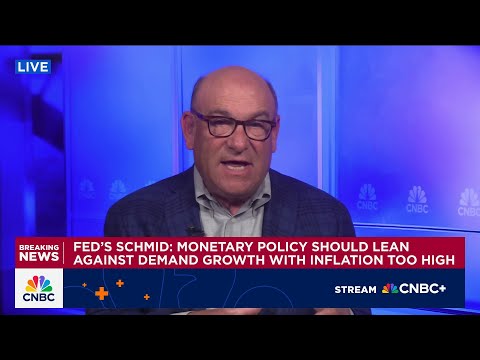
Fed's Schmid: Monetary policy should lean against demand growth with inflation too high
CNBC Television· 2025-10-31 15:59
Federal Reserve Policy & Dissent - Two Fed members dissented on the recent rate cut decision: Governor Myron favored a 05% cut, while Kansas City Fed President Schmidt preferred no change [1] - Schmidt dissented because he didn't see policy as restrictive and was concerned about inflation exceeding the Fed's 2% target [2] - Dallas Fed President Logan, a non-voting member, shared a hawkish view, suggesting it would be difficult to support another rate cut in December unless inflation falls faster or the labor market cools more than forecast [2][4] - The comments reveal resistance within the Fed regarding rate cuts, prompting Powell to caution that a December cut is not guaranteed [5] Economic Indicators & Market Conditions - Schmidt believes the labor market is imbalanced and the economy shows momentum, with inflation spreading across goods and services [3] - He noted easy financial market conditions, including record high equities and narrow bond spreads [3] - Logan believes inflation is taking too long to return to the 2% target, and stock market gains are fueling wealthier household demand [4][5] - The economy accelerated through the summer, according to Schmidt [4] Future Policy Outlook & Data Dependence - The market still anticipates a December rate cut with a 68% probability, despite the Fed's divided stance [7] - The focus is shifting to determining the Fed's default position: whether the economy must prove the need for a cut, or prove that a cut is not needed [10] - Future policy decisions will likely depend on jobs data, including alternative jobless claims reports and weekly ADP data [11][12]
Prediction: XRP (Ripple) Will Be Worth This Much by 2030
Yahoo Finance· 2025-10-31 08:45
Market Overview - The capital markets have experienced significant volatility over the past year, with the S&P 500 and Nasdaq Composite showing double-digit percentage gains in 2024 after an earlier sell-off driven by concerns over AI competition from China and new tariff policies from President Trump [2][3] - Despite the challenges, the S&P 500 is now trading at all-time highs, indicating resilience in the market [3] Cryptocurrency Performance - Major cryptocurrencies have also thrived in the current bull market, with Bitcoin and Ethereum increasing by approximately 61% and 55% respectively over the past year, while XRP has seen even greater returns of over 400% [4] XRP Analysis - XRP is currently trading at about $2.65, prompting investor interest in its future trajectory [5] - Wall Street analysts, including Standard Chartered's Geoff Kendrick, are optimistic about XRP, suggesting it could surpass Ethereum in value in the coming years due to macroeconomic factors such as lower interest rates and increased institutional adoption [6] - Lower borrowing costs may encourage investors to take on more risk, potentially leading to greater interest in cryptocurrencies if the Federal Reserve cuts rates [7] - The launch of XRP-themed funds could mirror the success of spot Bitcoin ETFs, further driving adoption among major financial institutions [8] Market Sentiment and Risks - XRP has gained popularity as a cryptocurrency investment opportunity, but its recent price surge raises concerns about potential declines in the near future [9]