
Credit

Search documents
X @Michael Saylor
Michael Saylor· 2025-09-19 21:38
Michael Saylor: A New Financial System of Credit Backed by Bitcoin on @YouTube https://t.co/k61K4zthny ...
See Positive Backdrop For Credit: BNP Paribas' Robson
Yahoo Finance· 2025-09-19 19:09
Core Viewpoint - BNP Paribas and Citi executives express optimism regarding the credit market and potential for increased M&A activity [1] Group 1: Credit Market Outlook - BNP Paribas Head of US Credit Strategy Meghan Robson identifies a positive backdrop for credit [1] - Citi Head of Debt Capital Markets Richard Zogheb emphasizes the desire for a pickup in M&A activity [1]
X @Bloomberg
Bloomberg· 2025-09-19 08:56
Market Trends - China is experiencing a lending slowdown despite improved market liquidity, a "credit paradox" [1] - BNP believes this paradox indicates improved confidence and financing conditions [1]
X @Bloomberg
Bloomberg· 2025-09-19 04:26
TLG Capital, an Africa-focused fund, plans to raise $200 million and use the proceeds to offer credit to small companies on the continent https://t.co/p0ic4kGabm ...
X @Bitcoin Magazine
Bitcoin Magazine· 2025-09-18 19:13
RT Frank Corva (@frankcorva)Let's not create $200 trillion in credit on top of bitcoin.Bitcoin was created to be a definancializing force, not a refinancializing one.https://t.co/2yt7ZhI9cF ...
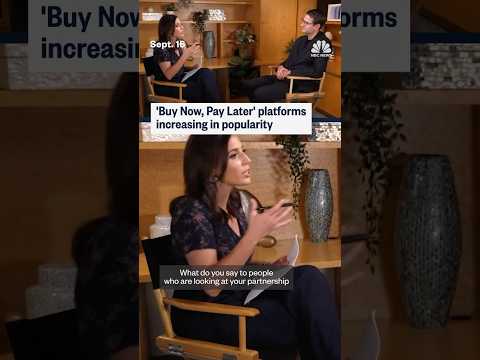
'Buy Now, Pay Later' platforms increase in popularity
NBC News· 2025-09-16 21:58
Business Model & Market Positioning - Klarna views itself as more than just a buy now pay later service, aiming to be a comprehensive payment solution similar to a PayPal wallet, with 20% of transactions being debit payments [1] - Klarna is expanding its services to include a new card and mobile phone plans, reflecting its ambition to diversify beyond buy now pay later [6] - Klarna believes it can offer more affordable and better products in the US market compared to existing options, leveraging its experience in the European market with lower rates [7] Risk & Customer Behavior - Concerns exist regarding the potential for customers to overextend themselves with buy now pay later services [2][4] - A recent survey indicates that 41% of buy now pay later users have paid late at least once in the past year, an increase from 34% the previous year [5] - Klarna states its losses are 20-30% lower than credit card companies, suggesting a healthier product despite being a form of credit [3] - Klarna's customers typically repay their loans in 50-60 days on average [5] Financial Performance & Valuation - Klarna's valuation is now over $16 billion after going public [6] Competitive Advantage - Klarna emphasizes its ability to adapt quickly to economic changes, positioning itself as nimble in uncertain economic times [6]

X @Andre Cronje
Andre Cronje· 2025-09-12 11:48
DeFi Lending Market - DeFi Lending 持续刷新历史新高 [1] - 当前未偿还债务余额为 304 亿美元 [1] - 未偿还债务余额比 2 年前增长 711% [1] - 市场对信贷的需求,特别是对稳定币信贷的需求,似乎是无法满足的 [1]
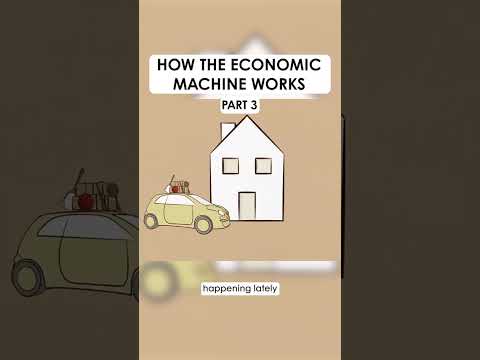
How The Economic Machine Works Part 3
Principles by Ray Dalio· 2025-09-05 14:37
Economic Cycles - The economy functions like a machine, driven by short-term and long-term debt cycles [4] - Short-term debt cycles, typically lasting 5 to 8 years, are primarily controlled by the central bank through interest rate adjustments [5] - These cycles involve expansion fueled by credit, leading to inflation, followed by contraction (recession) when the central bank raises interest rates [1][2][3] - Long-term debt cycles occur because debts rise faster than incomes over decades, leading to a debt burden [6] - The ratio of debt to income is called the debt burden, which remains manageable as long as incomes rise [7] Debt and Credit - Spending increases are fueled by credit, which can be created instantly [1] - When credit is easily available, there's an economic expansion; when it's not, there's a recession [4] - Rising incomes and asset values help borrowers remain creditworthy for a long time, even with accumulating debt [8] - At some point, debt repayments grow faster than incomes, forcing people to cut back on spending, leading to a reversal of the cycle [9] - Debt burdens become too big, leading to deleveraging, as seen in 2008 in the United States and Europe [10][11] Inflation and Deflation - Inflation occurs when spending and incomes grow faster than the production of goods, causing prices to rise [1] - The central bank raises interest rates to combat inflation [2] - Deflation occurs when people spend less, causing prices to go down, leading to a recession [3] Human Behavior - People have an inclination to borrow and spend more instead of paying back debt, pushing the economy [5] - Lenders freely extend credit because everyone thinks things are going great, focusing on rising incomes and asset values [6] - People borrow huge amounts of money to buy assets as investments, causing their prices to rise even higher, creating a boom and potentially a bubble [8][7]
Why Fed cuts won't save you
Yahoo Finance· 2025-09-03 13:39
Market Analysis & Investment Strategies - The market suggests that catching a falling knife (investing in a rapidly declining stock) is risky and requires patience, waiting for signs of stability rather than reacting impulsively to price drops [1] - The market emphasizes that a stock's cheapness alone doesn't make it a bargain; understanding the underlying reasons for the decline (earnings collapse, business model issues, etc) is crucial [1] - The market indicates that savvy investors wait for confirmation of a turnaround, such as a reset in earnings or technical stability, before investing in a distressed stock [1] Economic Trends & Fed Policy - The discussion suggests that the Federal Reserve (Fed) is overly focused on lagging indicators like tariffs and consumer prices, potentially missing the impact of AI on energy demand and the labor market [1] - The analysis points out that the utility sector's strong performance is linked to increased energy demand from AI, highlighting an overlooked driver of inflation [1] - The speaker suggests that the Fed's focus on inflation may lead to missed opportunities to lower interest rates and stimulate business lending for job creation [2] - The speaker believes that the availability of credit is a more significant issue than the cost of credit in slowing down economic growth [2] - The speaker suggests that a 25 basis point rate cut by the Fed is insignificant and that a cut of 75 basis points to a full point is needed to have a real impact [2] - The speaker believes that the Fed should cut rates by 75 basis points immediately, followed by another 50 basis points, to address the slowing economy [2][3] Housing Market Dynamics - The housing market is divided into existing homes and new homes, with national home builders keeping prices stable by building smaller houses [3] - The speaker believes that existing home prices are inflated due to sellers and realtors being unrealistic about market clearing prices [3] - The speaker suggests that realtors should price homes based on comparable sales to create bidding wars and achieve optimal prices [3]
X @Bloomberg
Bloomberg· 2025-09-02 12:04
Investment firms managing some of the biggest fortunes in the globe are making ever-bigger bets on stocks and credit https://t.co/DzaTDRQsSW ...