
Hedging

Search documents
X @Bloomberg
Bloomberg· 2025-09-24 12:28
Bullish investors should keep hedging their portfolios as more and more people chase this year’s stock market rally, according to Nomura cross-asset strategist Charlie McElligott https://t.co/GfLn1T9oKo ...
X @Bloomberg
Bloomberg· 2025-09-23 06:38
Market Trends - Some traders are already hedging for the next European natural gas stockpiling season [1] Trading Activity - There is a flurry of bets on European natural gas contracts [1]
Why the bull market for stocks may now hinge on the 10-year Treasury yield
MarketWatch· 2025-09-20 11:30
Core Viewpoint - With stock prices reaching record highs, there is a growing interest in hedging strategies to manage volatility, particularly as the cost of hedging remains low [1] Group 1 - Ron Albahary from Laird Norton is focusing on methods to hedge against market volatility [1]
Evolution Petroleum (EPM) - 2025 Q4 - Earnings Call Transcript
2025-09-17 16:02
Financial Data and Key Metrics Changes - Evolution Petroleum reported a net income of $3.4 million and adjusted EBITDA of $8.6 million, reflecting a material improvement driven by a balanced commodity mix and cost controls [4][16] - Total revenues for Fiscal Q4 2025 were $21.1 million, essentially flat year over year, with average production at 7,198 BOE per day [15][16] - Realized natural gas prices increased by 66% year over year, while oil prices declined by 20% and NGL prices declined by 12% [15][16] Business Line Data and Key Metrics Changes - The company closed a $9 million TexMex acquisition, adding approximately 440 net BOE per day of stable, low-decline production [4][5] - The largest minerals-only acquisition in company history was completed, adding approximately 5,500 net royalty acres with roughly 420 net BOE per day [5][6] Market Data and Key Metrics Changes - The demand for oil is expected to grow at a steady rate of over 1% per year, with OPEC Plus adding back supply [7][8] - Natural gas demand is anticipated to increase due to new LNG exports and industrial demand related to power generation [9][10] Company Strategy and Development Direction - The company aims to maximize shareholder returns through durable free cash flow, reliable dividends, and accretive low-decline opportunities [11][19] - The capital allocation framework remains unchanged, focusing on maintaining conservative leverage and positioning the balance sheet for future opportunities [11][19] Management's Comments on Operating Environment and Future Outlook - Management expressed confidence in the portfolio and future cash flows, highlighting the ability to adapt to market environments [11][19] - The company is well-positioned to accelerate growth with recent acquisitions and organic opportunities across its asset base [19] Other Important Information - A dividend of $0.12 per share was declared for Fiscal Q1 2026, marking the company's 48th consecutive quarterly dividend [18] - The company amended its senior secured reserve-based credit facility, establishing a $65 million borrowing base under a $200 million revolving credit facility [17] Q&A Session Summary Question: Current run rates for Scoop Stack, Barnett, and Shabbaroo - Management indicated that production rates are in line with previous quarters, with Shabbaroo wells expected to decline approximately 50% over the first year [21][22] Question: CapEx outlook for Fiscal 2026 - The budget for Fiscal 2026 is estimated at $4-6 million, primarily for Scoop Stack and maintenance CapEx [24][25] Question: LOE expectations for Scoop Stack and Barnett - Management expects a material improvement in LOE for Scoop Stack due to the minerals acquisition, while Barnett's LOE is anticipated to decrease slightly [28][34]

Gladstone Investment Corporation Opportunities
Seeking Alpha· 2025-09-16 22:30
Group 1 - The article focuses on Gladstone Investment Corporation (NASDAQ: GAIN) as a notable Business Development Company (BDC) and discusses its financial instruments and offerings [1] - The investing group Trade With Beta, led by Denislav, provides features such as frequent picks for mispriced preferred stocks and baby bonds, weekly reviews of over 1200 equities, IPO previews, and hedging strategies [2] - The article emphasizes the importance of active investor participation and the availability of a chat room for discussions among sophisticated traders and investors [1][2] Group 2 - The article does not provide specific financial data or performance metrics related to Gladstone Investment Corporation [1][2][3] - There is no mention of any recent news events or market trends affecting the BDC industry or Gladstone Investment Corporation specifically [1][2][3]



Wendel: Management of the Exchangeable Bond maturing in 2026: accelerated placement of approximately 23 million Bureau Veritas shares
Globenewswire· 2025-09-15 15:50
Core Viewpoint - Wendel is launching the accelerated placement of approximately 23.3 million Bureau Veritas shares to prepare for the settlement of an exchangeable bond maturing in March 2026, aiming to enhance financial flexibility and reduce its Loan-To-Value ratio ahead of the bond's maturity [1][4]. Group 1: Transaction Details - The exchangeable bond (EB) was issued in March 2023, raising €750 million with an annual coupon of 2.625%, which is lower than a straight bond due to its optional component [2]. - The transaction involves monetizing the underlying shares of the EB and implementing a symmetrical hedging protection to neutralize the optional component, with BNP PARIBAS and Goldman Sachs acting as hedging counterparties [3]. - Approximately 2.3 million shares will be ordered by the hedging counterparties as part of the placement, which will be fully allocated by Wendel [3]. Group 2: Financial Implications - The proceeds from the placement will help reduce Wendel's Loan-To-Value ratio, allowing the company to pursue its strategic plan more effectively [4]. - Following the placement, Wendel's stake in Bureau Veritas will decrease from 26.5% of the share capital and 41% of voting rights to approximately 21.4% of the share capital and 35% of voting rights [5]. Group 3: Market and Regulatory Context - The placement is reserved for qualified investors and international institutional investors, and it is not a public offering in any country, including France [7][10]. - The final terms of the placement will be announced after the completion of the bookbuilding process, which is expected to settle on September 18, 2025 [6].


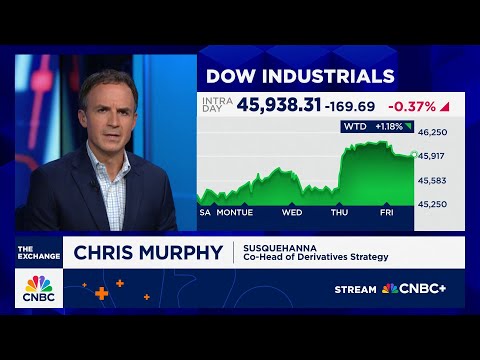
Susquehanna's Chris Murphy reads the options tea leaves
CNBC Television· 2025-09-12 17:58
Market Sentiment & Strategy - Investors were largely long ahead of the Fed meeting, with a near 100% expectation of a rate cut [1] - Put spread buying, particularly focused on the September 30th timeframe, was observed as a strategy to remain comfortable in the market despite potential uncertainties [2][3] - Low volatility has been beneficial to the market rally [3] Sector Focus - The "MAG 7" (Magnificent Seven) tech stocks continued to perform strongly [4][5] - Call spreads in MAG 7 names like Amazon and Google were attractive due to high demand for extreme upside [5][6] - Strong call spread buying was seen in China market ETFs (Kweb, Ashares), driven by demand for upside potential, particularly targeting the November timeframe and potential tariff deal [8][9] Hedging Activity - Consumer restaurant names like Sweet Green and Chipotle saw hedging activity, with put buying indicating caution about potential downside [10][11] - Recent activity suggests some investors are trying to pick the bottom in Sweet Green (January call buyer) and Chipotle (end of October put sale) [11]
CME Group CEO Terry Duffy reacts to record market gains
CNBC Television· 2025-09-10 22:14
Retail Trading Growth - CME Group's retail trading volume has been growing exponentially, with Robin Hood being the fastest-growing partner in the retail sector [2] - Retail participation is a component of CME Group's growth, but not the only driver [5] - By 2040, an estimated $85 trillion of wealth transfer to individuals aged 24-40 will influence how business is conducted, necessitating adaptation [6] Market Dynamics and Hedging - Markets are pricing in a potential Fed rate cut [8] - CME Group has 135 million open positions, indicating market participants are hedging their exposures [8] - Despite $37 trillion of US debt, equity markets remain high, driving institutional hedging at CME [10] Future Opportunities - Tokenization of cash markets is seen as important for efficiency [12] - New trading categories may emerge from crypto, blockchain, or restructured traditional products [12]
Rithm Capital’s Updated Sector Comparative Analysis – Part 1 (NYSE:RITM)
Seeking Alpha· 2025-09-10 15:30
Core Insights - The article focuses on analyzing Rithm Capital Corp.'s (RITM) recent performance compared to 17 mortgage real estate investment trust (mREIT) peers, highlighting key metrics such as investment composition, leverage, hedging coverage ratio, and economic returns [1][2][3]. Investment Composition and Performance - As of June 30, 2025, RITM's investment portfolio consisted of 20% fixed-rate agency MBS, 0% variable-rate agency MBS, 36% mortgage servicing rights (MSR), and 44% non-agency MBS and other mortgage-related investments [17][19]. - RITM's total MSR sub-portfolio had an unpaid principal balance (UPB) of $865 billion, reflecting a significant increase from $648 billion a year prior, largely due to acquisitions [37][38]. Leverage and Hedging - RITM's on-balance sheet leverage ratio was 2.5x, with an at-risk leverage ratio of 0.9x as of June 30, 2025, indicating a slight decrease in leverage compared to the previous quarter [19][20]. - The hedging coverage ratio for RITM was 44% as of June 30, 2025, which is geared towards lower mortgage interest rates, allowing the company to maintain stability in its book value (BV) during fluctuating interest rate environments [46][53]. Economic Returns - RITM achieved a trailing 24-month economic return of 20.97%, outperforming all covered mREIT peers, with the average returns for various classifications being significantly lower [51]. - The company's BV increased by 2.58% from Q1 to Q2 2025, driven by a minor increase in mortgage interest rates and a quarterly dividend of $0.25 per share, resulting in an economic return of 4.60% for Q2 2025 [20][21]. Valuation and Market Position - As of September 5, 2025, RITM's stock price was $12.62, trading at a 2.55% discount to the estimated current BV of $12.95, suggesting a slightly undervalued position compared to peers [48][49]. - RITM's diversified investment strategy, including MSR and other mortgage-related assets, positions it favorably to deliver attractive risk-adjusted returns across various interest rate scenarios [56].



X @Bloomberg
Bloomberg· 2025-09-04 07:18
Market Trends - Currency market hedging costs are increasing after a summer lull [1] - Traders are positioning for wider price swings around the US jobs report [1]