恐怖主义

Search documents
美军遭袭 特朗普:我们会报复!
Zhong Guo Ji Jin Bao· 2025-12-14 00:31
Group 1 - The assailant who attacked the US-Syrian joint patrol in Homs province is identified as a Syrian security personnel with possible extremist views [1] - There are over 5,000 security personnel affiliated with the Syrian Ministry of Interior in the eastern desert area, who undergo weekly evaluations [1] - The assailant was not in a leadership position within the security department and had no connections to the leadership [1] Group 2 - The Syrian transitional government has issued a strong condemnation of the terrorist attack, while US President Trump stated, "We will retaliate" [2] - Since the outbreak of the Syrian civil war in 2011, the US has deployed troops in Syria without the permission of the then-central government [2] - Following a political shift in December last year, the Syrian transitional government has improved relations with the US and signed a political cooperation declaration with the US-led coalition against ISIS [2]
美军遭袭 3人死亡!特朗普发声:将进行报复
Mei Ri Jing Ji Xin Wen· 2025-12-14 00:27
Core Viewpoint - The U.S. Department of Defense reported the death of two American soldiers and one civilian translator in Syria due to an attack by ISIS militants, with President Trump vowing retaliation against the extremist group [1][3]. Group 1: Incident Details - The attack occurred during a joint patrol between Syrian regime security forces and U.S. troops in the central province of Homs, specifically near the city of Palmyra [3]. - The injured personnel were evacuated by U.S. helicopters to the Tanf military base in southern Syria, and the road connecting eastern Deir ez-Zor province to the capital Damascus was temporarily closed [3]. - A spokesperson from the Syrian transitional government's interior ministry indicated that the assailant was a security personnel with possible extremist views, who had been under evaluation [3][4]. Group 2: Background and Context - The Syrian interior ministry is investigating whether the assailant had direct organizational ties to ISIS or merely held extremist views [4]. - Since the outbreak of the Syrian civil war in 2011, the U.S. has deployed troops in Syria without the permission of the then-central government, maintaining military bases in southern and northeastern Syria [4]. - Following significant political changes in Syria last December, the transitional government has improved relations with the U.S., signing a political cooperation declaration with the U.S.-led coalition against ISIS [4].

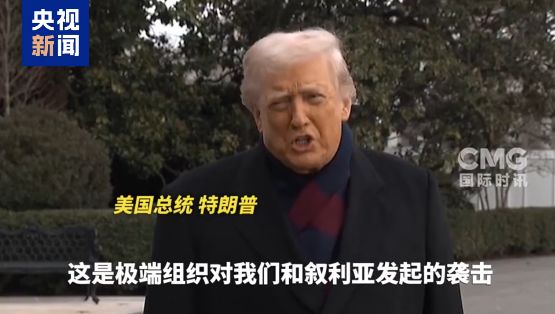
美军遭袭,特朗普:我们会报复!
中国基金报· 2025-12-14 00:15
Core Viewpoint - The attack on the US-Syrian joint patrol in Homs province was carried out by a Syrian security personnel with possible extremist views, highlighting ongoing security concerns in the region [3]. Group 1: Incident Details - The assailant was identified as a member of the Syrian security forces, specifically from the Ministry of Interior, and had undergone evaluations indicating potential extremist views [3]. - The attack resulted in the deaths of two US soldiers and one American civilian translator, with three additional US soldiers injured [3]. - The assailant was reportedly affiliated with the Islamic State and was killed during the exchange of fire [3]. Group 2: Government Response - The Syrian transitional government condemned the attack as a terrorist act and is conducting an investigation to determine the assailant's connections to extremist organizations [5]. - The US President responded to the attack by stating that there would be retaliation [4]. - Following a shift in the political landscape in Syria, the transitional government has improved relations with the US and signed a political cooperation declaration with the US-led coalition against the Islamic State [5].
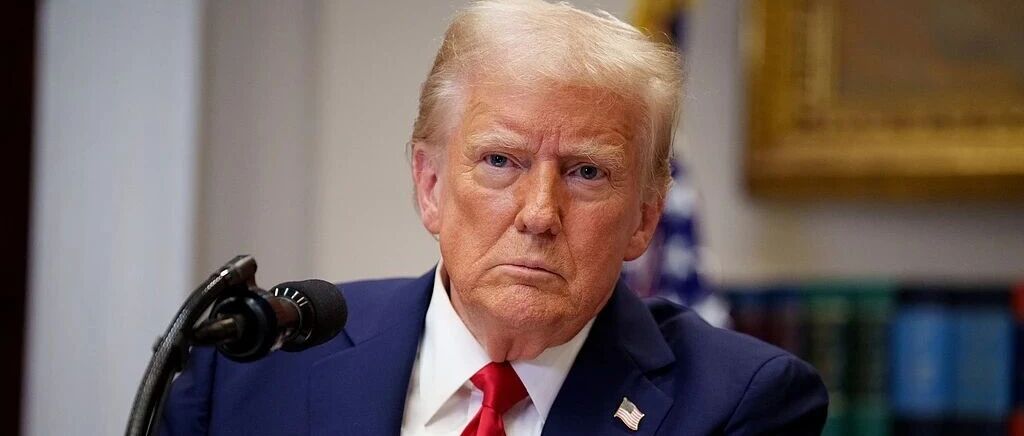
叙利亚过渡政府:袭击美军的枪手为叙安全人员
Yang Shi Xin Wen· 2025-12-13 23:21
Core Points - A gunman, possibly holding extremist views, attacked a joint Syrian-American patrol in Homs province, Syria, resulting in the death of two American soldiers and one American civilian translator, with three additional soldiers injured [1][2] - The Syrian Interior Ministry is investigating whether the gunman had direct organizational ties to ISIS or merely held extremist views [2] - The Syrian transitional government has improved relations with the U.S. since the political changes in December last year, signing a political cooperation declaration with the U.S.-led coalition against ISIS [2] Group 1 - The gunman involved in the attack was identified as a member of the Syrian security forces, with over 5,000 personnel in the eastern desert area undergoing weekly evaluations [1] - The Interior Ministry had previously issued warnings about potential attacks or infiltration by extremist organizations, which were reportedly ignored by the U.S. [1] - The gunman was not in a leadership position within the security department and had no connections to its leadership [1] Group 2 - The attack occurred during a joint patrol near Palmyra, approximately 100 kilometers from the Tanf military base, where U.S. forces are stationed [2] - U.S. President Trump stated that there would be retaliation for the attack [2] - The Syrian transitional government condemned the attack as a terrorist act [2]
阿根廷公布国家情报政策 重申对马岛等地主权
Xin Hua She· 2025-12-09 07:07
Core Viewpoint - The Argentine government has announced a national intelligence policy focusing on cybersecurity and counter-terrorism, reaffirming sovereignty over the Malvinas Islands and surrounding maritime areas [1] Group 1: National Security Goals - The national intelligence policy outlines five key security objectives: maintaining national sovereignty and autonomy, protecting territorial integrity, safeguarding citizens' lives, freedoms, and property, upholding democratic institutions, and ensuring the security of strategic resources [1] - The policy also includes ten guiding principles for national intelligence, addressing the impact of great power geopolitical competition on Latin America, and combating terrorism and organized crime [1] Group 2: Intelligence and Security Reforms - This is the first national intelligence policy published by the Argentine government in over 20 years, aimed at enhancing the intelligence community's ability to identify risks, threats, and opportunities [1] - In 2023, the Argentine government has made several adjustments to federal police, intelligence, and national security agencies, including the establishment of the Federal Investigation Department, National Counter-Terrorism Center, and National Immigration Bureau [1]
综述|阿富汗和巴基斯坦冲突再起
Xin Hua She· 2025-12-07 14:50
新华社伊斯兰堡/喀布尔12月7日电 综述|阿富汗和巴基斯坦冲突再起 新华社记者杨恺 张艺缤 此外,自今年10月巴基斯坦和阿富汗军队发生武装冲突后,巴基斯坦关闭了与阿富汗的边境口岸, 导致人员和货物流动陷入停滞。中断的贸易通道无疑使本已恶化的边境局势雪上加霜。 阿富汗政治分析人士瓦伊斯·纳塞里表示,巴基斯坦的核心诉求是,阿富汗政府将"巴基斯坦塔利 班"列为恐怖组织并停止对其支持。但这是阿方无法接受的。 巴基斯坦和阿富汗两国官员均证实,双方5日晚在边境地区再度爆发激烈交火。双方均指责对方 先"动手",己方被迫作出回应。阿方6日称,此次边境冲突造成阿方5名平民丧生、5人受伤。此前双方 在土耳其举行的会谈无果而终,但仍承诺会遵守停火协议。然而,这一协议并未对双方产生较强约束, 零星冲突仍时有发生。 巴基斯坦安全调查与研究中心负责巴阿区域经济互联互通的项目主任朱奈德·雅各布·汗认为,目前 巴阿边境关闭、签证暂停等,都让本已紧张的局势更为严峻,极易引发进一步冲突。当前,阿富汗境内 潜伏的恐怖分子有向周边其他国家扩散的趋势。希望巴阿双方保持理智,共同采取切实行动打击恐怖主 义,专注经济建设,使两国关系重回正轨。 今年10月 ...
萨赫勒地区恐怖主义威胁全球安全
Shang Wu Bu Wang Zhan· 2025-11-20 17:29
Group 1 - The core issue highlighted is the expansion of terrorist networks in West Africa and the Sahel region, leading to increased displacement and a collapse of basic services, which poses a growing global threat [1] - The Sahel region accounts for 19% of global terrorist attacks, with related casualties exceeding half of the global total, indicating a severe security crisis [1] - Approximately 4 million people are currently displaced in Burkina Faso, Mali, Niger, and surrounding countries, reflecting the humanitarian impact of the ongoing violence [1] Group 2 - UN Secretary-General Guterres proposed three measures to address the situation: establishing a unified regional counter-terrorism mechanism, ensuring sustained humanitarian funding, and developing strategies to address the root causes of terrorism [1] - The humanitarian aid for the Sahel and Lake Chad Basin has received less than a quarter of the required funding, with a fundraising target of $4.9 billion not yet met [1] - ECOWAS Chairman Toure warned that terrorism has transcended the Sahel and Lake Chad Basin, threatening the entire West African region, and announced the deployment of a standby force starting with 1,650 personnel, aiming to expand to 5,000 [1] Group 3 - Sierra Leone's President Bio advocated for a tripartite cooperation mechanism among ECOWAS, the UN, and the African Union to ensure sustained funding and institutional support for counter-terrorism efforts [2] - He emphasized the need to enhance regional democratic trust and take decisive actions to maintain security and stability [2]
印媒:巴基斯坦国防部长称,已做好与印度和阿富汗“两线作战准备”
Huan Qiu Wang· 2025-11-13 09:15
Core Points - Pakistan's Defense Minister Asif stated that the country is prepared for a two-front war against India and Afghanistan [1][3] - A suicide bombing in Islamabad resulted in 12 deaths, which Asif linked to Afghanistan, claiming that Kabul could prevent terrorism in Pakistan but has failed to do so [3][4] - Asif also commented on a recent explosion in New Delhi, accusing India of politicizing the incident and suggesting that India might blame Pakistan for it [3] Summary by Sections - **Pakistan's Military Preparedness** - Pakistan is ready for simultaneous confrontations on its eastern (India) and western (Afghanistan) borders [3] - **Recent Terrorist Incidents** - A suicide bombing in Islamabad on November 11 killed at least 12 people, with the Pakistani Taliban claiming responsibility [4] - An explosion near the Red Fort in New Delhi resulted in at least 13 deaths and over 20 injuries, which the Indian government condemned as a terrorist act [3][4] - **Political Reactions** - Indian officials accused Asif of attempting to divert attention from the investigation into the New Delhi explosion [3]

印度遭恐袭
Zhong Guo Ji Jin Bao· 2025-11-13 04:25
Core Points - The Indian government condemned the recent car explosion in New Delhi as a "horrific terrorist incident" [1][2] - The explosion occurred near the popular tourist site Red Fort, resulting in at least 13 fatalities and over 20 injuries [2] - A high-level cabinet security meeting was chaired by Prime Minister Modi, attended by key ministers, where a strong statement was issued reaffirming India's "zero tolerance" policy towards all forms of terrorism [2] Government Response - The Indian government expressed deep condolences to the victims and their families, thanking countries for their support [2] - The government committed to swiftly identifying the perpetrators and their accomplices, ensuring they are brought to justice [2]
印度遭恐袭
中国基金报· 2025-11-13 03:38
Group 1 - The Indian government condemned the recent car explosion in New Delhi as a "horrific terrorist incident" [2] - The explosion occurred near the popular tourist site Red Fort, resulting in at least 13 fatalities and over 20 injuries [2] - A high-level cabinet security meeting was chaired by Prime Minister Modi, attended by key ministers, and a strong statement was issued reaffirming India's "zero tolerance" policy towards all forms of terrorism [2] Group 2 - The government expressed deep condolences to the victims and their families, thanking countries for their support [2] - The Indian government pledged to swiftly identify the perpetrators and their accomplices, ensuring they are brought to justice [2]