
Federal Funds Rate

Search documents
X @Bloomberg
Bloomberg· 2025-09-23 17:00
Market Trends - The effective federal funds rate experienced a slight increase on Monday, an uncommon occurrence [1] - This increase triggered selling activity in futures linked to the benchmark rate [1] - The rate hike potentially indicates a tightening of financial conditions in the near future [1]
X @Bloomberg
Bloomberg· 2025-09-22 20:19
Monetary Policy & Banking - The effective federal funds rate could edge higher [1] - This increase may indicate that excess bank reserves are dwindling faster than expected [1] - The effective federal funds rate has remained near the bottom of the Fed's target range for its benchmark over the past two years [1]
Fed Chair Jerome Powell Just Implemented a 'Risk Management' Rate Cut. Will This Push the S&P 500 Index to 7,000 or Is It a Sell-the-News Event?
Yahoo Finance· 2025-09-22 12:01
Core Points - The Federal Open Market Committee (FOMC) lowered the federal funds rate by a quarter point, bringing it to a range of 4% to 4.25% [1] - The FOMC's dot-plot indicates expectations for future rate trends, with members anticipating two more cuts in 2025 and one in 2026, differing from market expectations [6] - Fed Chair Jerome Powell described the rate cut as a "risk management cut" to hedge against potential economic slowdown [5][7] Economic Context - The Fed is facing challenges with its dual mandate of stable prices and maximum employment, as unemployment has increased and inflation is rising above the 2% target [4] - The impact of President Trump's tariffs on inflation remains uncertain, complicating the Fed's decision-making process [4] Market Reactions - Following the FOMC meeting, the stock market experienced volatility, with questions about whether the S&P 500 index will reach 7,000 or if it is a "sell-the-news" event [2] - The stock market has been anticipating interest rate cuts, which have contributed to the rise in the S&P 500 index [7]
Treasury Yields Snapshot: September 19, 2025
Etftrends· 2025-09-19 22:09
Group 1: Treasury Yields Overview - The yield on the 10-year Treasury note ended at 4.14% on September 19, 2025, while the 2-year note was at 3.57% and the 30-year note at 4.75% [1] - A long-term view of the 10-year yield shows significant historical context, starting from 1965, highlighting the impact of events like the 1973 oil embargo [2] - The inverted yield curve, where longer-term yields are lower than shorter-term ones, is a reliable leading indicator for recessions, with the 10-2 spread turning negative before recessions [2][3] Group 2: Recession Indicators - The average lead time to a recession based on the first negative spread date is approximately 48 weeks, while using the last positive spread date yields an average of 18.5 weeks [4][6] - The 10-3 month spread also indicates a lead time to recessions ranging from 34 to 69 weeks, with similar patterns observed as in the 10-2 spread [5] - The most recent negative spread for the 10-2 occurred from July 5, 2022, to August 26, 2024, while the 10-3 month spread was negative from October 25, 2022, to December 12, 2024 [3][5] Group 3: Mortgage Rates and Federal Funds Rate - The Federal Funds Rate influences borrowing costs for banks, which typically leads to higher mortgage rates when the FFR increases; however, recent trends show mortgage rates declining despite steady FFR [7] - The latest Freddie Mac survey reported the 30-year fixed mortgage rate at 6.35%, the lowest since October 2024 [7] Group 4: Market Behavior and Federal Reserve Influence - Federal Reserve policy has significantly influenced market behavior, particularly in relation to Treasury yields and the S&P 500 [8] - ETFs associated with Treasuries include Vanguard 0-3 Month Treasury Bill ETF (VBIL), Vanguard Intermediate-Term Treasury ETF (VGIT), and Vanguard Long-Term Treasury ETF (VGLT) [9]


Where Next for the Fed’s Rate Path? | Presented by CME Group
Bloomberg Television· 2025-09-19 13:18
Monetary Policy - The FOMC lowered the federal funds rate by 0.25% to a target range of 4% to 4.25% [1] - This marks the first rate cut in 2025 after a pause since December 2024 [1] - The updated dot plot projections signal a more dovish outlook, with a median forecast of two additional 25 basis point cuts by year-end [1] - There is divergence among officials regarding future rate cuts; nine expect two more cuts, six anticipate no further action, and one projects up to six cuts [1] Market Reaction & Fed's Stance - The market reaction underscores relief at the expected rate cut, but weariness over the Fed's balancing act between jobs and inflation [2] - Fed Chairman Jerome Pal characterized the 25 basis point rate reduction as a measured risk-management action [2] - The rate cut is intended to bolster a moderating labor market while avoiding excessive stimulation of inflation [2] - The Fed's tone started somewhat reassuring on jobs, but shifted hawkish, stressing careful navigation amid uncertainties [2]

Fed's Powell on Rate Cut: 'Risks to Inflation Are Tilted to the Upside' | WSJ News | WSJ News
WSJ News· 2025-09-17 19:34
At today's meeting, the committee decided to lower the target range for the federal funds rate by a quarter percentage point to four to four and a quarter percent and to continue reducing the size of our balance sheet. In the near term, risks to inflation are tilted to the upside and risks to employment to the downside. A challenging situation when our goals are intention like this.Our framework calls for us to balance both sides of our dual mandate. With downside risks to employment having increased, the b ...

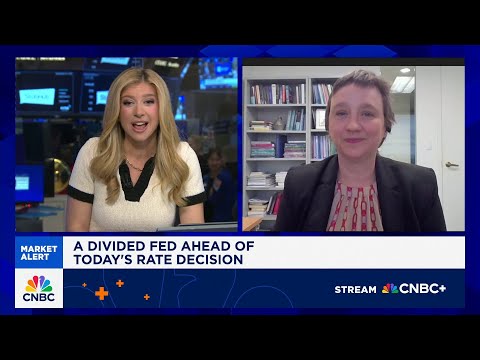
New Century Advisors' Claudia Sahm: Things are 'not normal' at the Fed right now
CNBC Television· 2025-09-17 17:13
like a. >> Big I can't tell you how excited I am. >> When was the last time we talked about the dynamics.>> I'm in. I'm I'm on the edge of my seat. >> Exactly.All right. Let's talk more about it. Joining us is Claudia Sardine, New Century Advisors chief economist and a former fed economist.Claudia, that that will be interesting, right. We'll see who dissents. We'll see how divergent the dot plots are.What are you looking for. >> Yeah. And I want to underscore that even in normal times, like we would expect ...
Mortgage and refinance interest rates today, September 16, 2025: Falling before the Fed rate cut
Yahoo Finance· 2025-09-16 10:00
Mortgage Rates Overview - Mortgage rates are trending lower ahead of an anticipated Federal Reserve rate cut, with the current 30-year mortgage rate at 6.16%, down 12 basis points since Friday [1] - The 15-year fixed interest rate has decreased by three basis points to 5.46% [1] Current Mortgage Rates - Current national average mortgage rates include: - 30-year fixed: 6.16% - 20-year fixed: 5.68% - 15-year fixed: 5.46% - 5/1 ARM: 6.65% - 7/1 ARM: 6.58% - 30-year VA: 5.78% - 15-year VA: 5.29% - 5/1 VA: 5.94% [4] Refinance Rates - Refinance rates are generally higher than purchase rates, with the current national average for 30-year fixed refinance at 6.20% [15] Impact of Federal Reserve Decisions - The trajectory of future mortgage rates is closely tied to the Federal Reserve's decisions, with a 96% chance predicted for a rate decrease at the upcoming meeting [13] - Mortgage rates have been falling since early September, but their reaction to a potential Fed rate cut remains uncertain [14] Long-term Outlook - Economists do not expect significant drops in mortgage rates before the end of 2025, with any potential decreases in 2026 likely to be modest [16][17]
Treasury Yields Snapshot: September 12, 2025
Etftrends· 2025-09-12 20:31
Group 1: Treasury Yields Overview - The yield on the 10-year Treasury note was 4.06% as of September 12, 2025, while the 2-year note was at 3.56% and the 30-year note at 4.68% [1] - A long-term view of the 10-year yield shows significant historical context, starting from 1965, including the impact of the 1973 oil embargo [2] Group 2: Inverted Yield Curve and Recession Indicators - An inverted yield curve occurs when longer-term Treasury yields are lower than shorter-term yields, with the 10-2 spread being a reliable leading indicator for recessions [2] - The average lead time to a recession from the first negative spread date is approximately 48 weeks, while using the last positive spread date yields an average lead time of 18.5 weeks [4][6] Group 3: Mortgage Rates and Federal Funds Rate - The Federal Funds Rate influences borrowing costs for banks, which typically affects mortgage rates; however, recent trends show mortgage rates declining despite the Fed holding rates steady [7] - The latest Freddie Mac survey reported the 30-year fixed mortgage rate at 6.35%, the lowest since October 2024 [7] Group 4: Treasury ETFs - ETFs associated with Treasuries include Vanguard 0-3 Month Treasury Bill ETF (VBIL), Vanguard Intermediate-Term Treasury ETF (VGIT), and Vanguard Long-Term Treasury ETF (VGLT) [9]

Best money market account rates today, September 10, 2025 (secure up to 4.41% APY)
Yahoo Finance· 2025-09-10 10:00
Core Insights - The article discusses the current state of money market account (MMA) rates, highlighting the importance of finding competitive rates as interest rates decline following recent Federal Reserve cuts [1][4]. Group 1: Current MMA Rates - The national average interest rate for money market accounts is 0.59%, while top rates can exceed 4% APY, comparable to high-yield savings accounts [2]. - TotalBank currently offers the highest MMA rate at 4.41%, which is over seven times the national average [7]. Group 2: Impact of Federal Reserve Actions - Money market account rates are closely linked to the federal funds rate, which influences deposit account rates [3]. - The Federal Reserve maintained a target range of 5.25%–5.50% until September 2024, after which it cut the federal funds rate by 50 basis points, followed by two additional cuts of 25 basis points each in November and December [4]. Group 3: Considerations for Savers - Money market accounts are attractive for savers due to their combination of safety, liquidity, and better returns compared to traditional savings accounts [5]. - Factors influencing the decision to invest in an MMA include liquidity needs, short-term savings goals, and risk tolerance [6].