Economic Growth

Search documents
X @Ivan on Tech 🍳📈💰
Ivan on Tech 🍳📈💰· 2025-07-29 20:40
Debt & GDP Ratio - UK government debt stands at 101% of GDP [1] - Government spending accounts for 45% of GDP [1] - Government borrows to cover interest payments, indicating unsustainable fiscal policy [1] Doom Loop Mechanism - Increased taxes to fund debt reduces economic growth [2] - Reduced growth leads to decreased investment [2] - Decreased investment causes wealth creators (the 1% who pay 30% of taxes) to leave the system [2] - Wealth creators leaving necessitates even higher taxes [2] Potential Solutions - Government needs to cap spending at 35% of GDP [3] - Creation of special economic zones or tax breaks to attract wealth creators and investment [3] - Implementation of fiscal responsibility, ceasing money printing and further borrowing [3]
X @The Economist
The Economist· 2025-07-29 19:20
What should you do if you think an AI-fuelled explosion in economic growth is coming? The advice that leaps out from the models is simple https://t.co/K6blXX4CO8 ...
The Secrets of the Financial System | Richard Werner | TEDxAISB Youth
TEDx Talks· 2025-07-29 15:41
Macroeconomic Critique - Macroeconomics has made little progress in a century, struggling with economic growth, fiscal, and monetary policy determinants [2] - Economists were surprised by the inflation of late 2021 and 2022, and recurring banking crises, due to misinterpreting central bank policies [3] - Economic models often lack banks, leading to failures in understanding banking crises [5] Money Creation and Banking - Most people incorrectly believe the government or central bank creates the majority of money [8] - Banks create most of the money supply through credit creation, not by lending deposits [9][10] - Banks create money by issuing loans, which legally establish an accounts payable liability to customers, represented as customer deposits [11] Banking System Structure and Economic Impact - A banking system dominated by a few mega-banks can lead to asset price inflation and boom-bust cycles [12] - Decentralized banking systems with small local banks lending to small firms can foster growth without inflation and asset bubbles [13] - East Asian economies achieved high growth through decentralized banking systems focused on productive business investment [14] Growth and Sustainability - Economic growth is a statistical fiction, not a physical reality, and is not inherently harmful to the environment [17] - The concept of economic growth is used by bankers to maximize interest charges on national debt [19] Central Bank Policies and Inflation - Quantitative easing (QE) policies have different effects depending on implementation; QE1 cleans up bank balance sheets, while QE2 boosts the economy [20][21] - Implementing QE2 in 2020, when demand was reasonable but supply was restricted, led to inflation [22][23] Policy Recommendations - Advocates for preventing centralized systems like central bank digital currencies, which could lead to less growth and prosperity [24] - Encourages the establishment of many small banks to decentralize the financial system and promote economic growth [24] - Decentralizing the financial system can create job opportunities in rural areas and support government policies to increase fertility [25][26][27]


X @Bloomberg
Bloomberg· 2025-07-29 13:19
Britain will grow faster than any other major European economy this year and next but continue to lag behind the US and Canada among G-7 industrialized nations, according to the IMF https://t.co/fd8wGkZocz ...
X @Investopedia
Investopedia· 2025-07-29 12:00
Economic Growth - U S economic growth is expected to have rebounded in the second quarter [1] - The report on the Gross Domestic Product may not say much about the economy's actual health [1]
全球宏观策略:从减速带到坑洼Global Macro Strategist From Speed Bump into Pothole
2025-07-29 02:31
Summary of Key Points from the Conference Call Industry Overview - The discussion primarily revolves around the **US economy** and its interaction with **tariff policies** and **central bank strategies**. Core Insights and Arguments 1. **Economic Forecast**: Economists predict that tariffs will initially cause a temporary inflation spike in Q3 2025, followed by a significant economic slowdown in Q4 2025, referred to as a "growth pothole" [16][13][41]. 2. **Tariff Impact**: The tariffs are viewed as a tax burden that will eventually affect consumers, although the full impact may not be felt immediately as importers have not fully passed on costs to consumers yet [23][28]. 3. **Customs Duties**: The customs duties collected in July 2025 are projected to reach **$340 billion**, which is **1.10% of nominal GDP**, significantly higher than the historical average of **0.25%** [29]. 4. **CEO Confidence**: There is a noted relationship between CEO confidence and economic performance, with current CEO confidence not indicating immediate threats to the economy despite tariff concerns [30][41]. 5. **Market Complacency**: Investors appear complacent regarding the potential impacts of tariffs, as evidenced by current market pricing and performance [15][62]. 6. **Inflation Projections**: Core PCE inflation is expected to peak in May 2026, with current pricing suggesting a transitory impact from tariffs [72][47]. 7. **Central Bank Decisions**: Central banks, particularly the **Swiss National Bank (SNB)**, have surprised markets with their decisions more frequently than others, such as the **Federal Reserve (Fed)** and **Bank of Japan (BoJ)** [73][45]. Additional Important Content 1. **Treasury Market Dynamics**: The Treasury market is expected to see stable coupon sizes until February 2027, with a tailored approach to liquidity management [5][65]. 2. **Equity Market Correlation**: The equity market and real economy often diverge until a recession occurs, at which point they tend to align [31][36]. 3. **Future Projections**: The economists' baseline view suggests that while inflationary pressures are anticipated, the growth slowdown may catch both the Fed and investors off guard, potentially leading to a stall in the equity market [47][41]. 4. **Currency Movements**: The analysis indicates that currency reactions are closely tied to central bank decisions, with notable movements observed in currencies like the **GBP** and **AUD** following unexpected policy changes [54][90]. This summary encapsulates the critical insights and projections discussed in the conference call, highlighting the interplay between tariffs, economic forecasts, and central bank strategies.

X @The Economist
The Economist· 2025-07-29 01:20
We imagine the consequences if advances towards artificial superintelligence cause economic growth to explode. Wealth could accumulate at unprecedented speed https://t.co/nj6hpJXYwr ...
X @The Economist
The Economist· 2025-07-28 15:20
What should you do if you think an AI-fuelled explosion in economic growth is coming? The advice that leaps out from the models is simple https://t.co/VSCg48R69b ...
X @Bloomberg
Bloomberg· 2025-07-28 11:18
Indonesia pledged to use its fiscal and monetary firepower to ensure economic growth maintains its 5% pace this year. https://t.co/Txaku2lmUQ ...
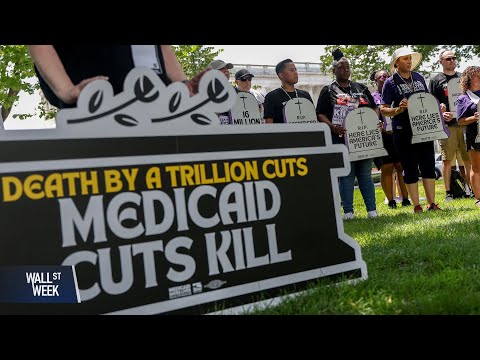
Summers: 'This is The Biggest Cutback in the US Social Safety Net in History'
Bloomberg Television· 2025-07-27 12:05
Fiscal Policy & Social Safety Net - The Trump administration's tax cuts, while benefiting some, are funded by reducing support for programs like Medicaid, impacting vulnerable populations [1] - These tax cuts represent the largest cutback in the U S social safety net in history relative to GDP, exceeding Reagan's 1981 cuts and Clinton's welfare reform [2] - An estimated 10 million to 12 million people could lose Medicaid benefits, affecting access to ancillary services like transportation to hospitals and rehab facilities [3] - Reduced government support may lead to increased healthcare costs for everyone, as people seek care later and in more critical conditions [5] - The bill shifts wealth from the poorest to the wealthiest, raising concerns about its macroeconomic impact and long-term growth [7] Economic Impact & Investment - Deficits resulting from the bill could damage the economy by cutting back on R&D, education, and infrastructure investments [8] - A proposed $1,000 savings account for newborns may be too small to significantly impact families' lives, with administrative costs potentially outweighing benefits [9][10] - The US invests a lower percentage of its GDP in early care and education compared to other developed countries [11] - Market forces alone cannot solve the childcare crisis, necessitating government intervention and public support [12][13] Generational & Societal Concerns - Younger families face greater economic strain due to debt, housing costs, and healthcare expenses that have outpaced inflation [14][15] - Borrowing to fund the bill poses risks to the economy that may outweigh the benefits of new programs, potentially harming future generations [17]