
Interest Rates

Search documents
Reviewing My 2025 Market Predictions
Million Dollar Journey· 2025-12-21 02:00
Group 1: Trade Policies and Economic Impact - The newly elected U.S. president's potential implementation of large tariffs on Canadian imports is a significant concern for Canadian businesses in 2025 [2][6] - Trump's focus on trade deficits may lead to substantial changes in global trade dynamics, with tariffs being used to fund corporate tax cuts [3][10] - A targeted 10-15% tariff on non-energy products is anticipated, which could disrupt Canadian manufacturing and lead to retaliatory tariffs from Canada [6][7] Group 2: Inflation and Interest Rates - Inflation concerns are expected to persist in 2025, driven by tariff-induced price increases and a booming U.S. stock market, potentially pushing inflation above 3% [12][13] - The U.S. Federal Reserve is likely to maintain higher interest rates, impacting both U.S. and Canadian monetary policies [14][18] - Canadian inflation remained closer to target at around 2.2%, but the Bank of Canada held its overnight rate at 2.25% due to economic resilience and trade uncertainties [18] Group 3: Stock Market Predictions - The first half of 2025 may experience gains due to post-election optimism, but the second half could see declines due to tariffs and stretched valuations impacting corporate earnings [20][21] - High expectations for earnings growth could lead to skepticism among investors if projections begin to decline [22][23] - Overall, markets are expected to be up in 2025, with positive news on tariffs and inflation benefiting stock and commodity markets [23] Group 4: Canadian Housing Market - Canadian housing prices are projected to face downward pressure, with average home prices declining by about 6% in 2025, contrary to CREA's forecast of a 6.6% rise [32][35] - Fixed mortgage rates did not decrease significantly, maintaining high borrowing costs and limiting buyer activity [36][37] - The condo market is particularly vulnerable, with high inventory levels and cooling investor demand leading to downward price pressure [37] Group 5: Oil Market Dynamics - The global oil market is expected to remain below USD $75 per barrel due to rising U.S. production and OPEC's reluctance to cut supply [38][40] - Despite a brief peak, crude oil prices spent the majority of the year below the anticipated ceiling, with demand growth from China failing to materialize [40] Group 6: Electric Vehicle Market - Tesla's market valuation is questioned, with concerns about its sustainability compared to traditional car manufacturers and increasing competition from companies like BYD [41][45] - Despite a significant drop in Tesla's stock price earlier in the year, it rebounded, raising questions about the long-term viability of its high P/E ratio [46][48]



Inflation Drops to 2.7% | Bitcoin, Altcoins, Stocks
Benjamin Cowen· 2025-12-20 22:23
Hey everyone and thanks for jumping back into the macroverse. Today we're going to talk about the most recent CPI report. We're going to discuss how it has dropped to 2.7% and expectations that we might have based on further rate cuts and of course how it affects markets like Bitcoin.If you guys like the content, make sure you subscribe to the channel, give the video a thumbs up, and also check out the sale on into the cryptoverse premium at into the cryptoverse. com. Link is in the description below.Again, ...

Twenty-five Years of Economic Upheaval
Bloomberg Television· 2025-12-20 13:01
Economic Overview - The US experienced a period of prosperity and social progress with low unemployment and a booming economy [1] - A serious financial crisis emerged, with overvalued houses and potential mortgage problems [2] - The economic recovery proceeded at a moderate pace, slower than expected, with a manufacturing recession due to the collapse in oil prices [3] - The COVID-19 pandemic caused a rapid shutdown of the economy and the largest unemployment rate since the Great Depression [5] - Inflation started to take hold, leading to nervousness and unhappiness about economic situations [5] Monetary Policy and Fiscal Spending - Interest rates are surprisingly low despite high budget deficits and debt [7] - The US spent too little during the financial crisis and too much during COVID-19 [9] - Running $2 trillion deficits in a growing economy is not advisable [9] - The benefits of economic stimulus tended to favor those with capital [10] - The Federal Reserve focused on getting inflation up by 01%-02% before realizing inflation was not dead [13] Inflation and Globalization - Globalization, particularly China's entry into the WTO, and increased immigration kept inflation down for two decades after 2000 [15][16] - COVID-19 and restrictions on immigration have put upward pressure on goods prices and wage inflation [17] - De-globalization and immigration restrictions could drive wages up, while AI's impact remains uncertain [17][18] European Economy - The Eurozone crisis, triggered by imbalances, led to painful adjustments in countries like Portugal, Greece, Spain, and Ireland, but also some convergence [24] - The EU is slowly moving towards fiscal coordination, but politics lags behind economics [25][26] - Brexit has negatively impacted the UK economy, potentially reducing GDP by 5%-7% [27][28] - Europe's growth rate is projected to be no more than 1%, possibly around 05% per year [30]

全球宏观展望与策略-全球利率、大宗商品、汇率及新兴市场-Global Macro Outlook and Strategy_ Global Rates, Commodities, Currencies and Emerging Markets
2025-12-20 09:54
Summary of Key Points from the Conference Call Industry Overview - The conference call primarily discusses the macroeconomic outlook, focusing on global rates, commodities, currencies, and emerging markets, with insights from J.P. Morgan Securities. Core Insights and Arguments US Rates - Hawkish developments across developed market (DM) central banks have led to underperformance in the intermediate sector, aligning with a forecast for modestly higher yields in 2026 as easing cycles wind down [3][14] - The Federal Reserve (Fed) is expected to ease rates in January 2026, with the effective funds rate projected to be 3.40% by mid-2026 [11][12] - Treasury yields are forecasted to reach 3.60% for 2-year and 4.25% for 10-year by mid-2026, with slight increases expected by year-end [9][11] International Rates - DM rates have generally sold off due to a hawkish shift in central bank tones and strong data momentum, leading to a lightening of risk in portfolios [4][39] - The Fed's recent actions have not met more hawkish market expectations, contributing to a bearish outlook for the USD [6][80] Commodities - Cocoa's re-inclusion in the Bloomberg Commodity Index (BCOM) is expected to drive significant buying, accounting for 22% of total open interest, overshadowing more modest buying in other commodities like corn and wheat [6] - Natural gas storage withdrawals in North West Europe (NWE) have exceeded forecasts, despite weaker demand trends [6] Currencies - The USD is under pressure due to a dovish Fed stance compared to hawkish developments in other G10 countries [75][79] - Event risks are elevated with upcoming US payroll releases, and a bearish outlook for the USD is contingent on data performance [79][80] Emerging Markets - The outlook for emerging markets (EM) in 2026 is positive, with lower macro volatility expected to support local markets. The recommendation is to stay overweight (OW) on EM FX and rates [6][11] - Growth and inflation are projected to remain stable, with limited central bank easing anticipated [6] Additional Important Insights - The Fed's policy path is now more aligned with J.P. Morgan's forecasts, indicating limited scope for further bearish impulses in the near term [14] - A significant funding gap is expected to emerge in 2027, with coupon size increases anticipated starting in November 2026 [22] - The demand for Treasuries is expected to remain stable, with mutual funds and ETFs likely absorbing 50% of net T-bill supply [32] - The anticipated cuts from the Fed and other central banks are expected to create a more favorable environment for high-yield currencies [68] This summary encapsulates the key points discussed in the conference call, providing a comprehensive overview of the macroeconomic landscape and its implications for various asset classes.
CNBC anchor who blasted Trump’s ‘insane’ tariffs is now shocked by ‘very, very low’ inflation. How to capitalize in 2026
Yahoo Finance· 2025-12-19 22:03
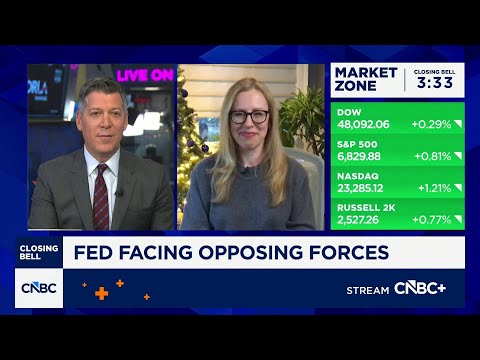
Core Insights - The latest Consumer Price Index (CPI) report showed a year-over-year increase of 2.7% in November, down from 3.0% in September, indicating a cooling inflation trend [2] - Core CPI, which excludes food and energy prices, also decreased to 2.6% year-over-year in November from 3.0% in September, suggesting positive economic signals [2][4] - The stock market reacted positively to the CPI report, with the Nasdaq Composite rising 1.4% and the S&P 500 increasing by about 0.8% on December 18, followed by further gains on December 19 [4][5] Economic Indicators - The seasonally adjusted index for all items, excluding food and energy, rose by 0.2% over two months, translating to a low monthly rate of 0.1% [1] - The Federal Reserve has already cut its benchmark interest rate three times in 2025, and continued cooling of inflation may allow for additional cuts in 2026, creating a favorable environment for investors [5] Market Reactions - Following the CPI report, stocks rebounded sharply after a four-day decline, indicating investor optimism regarding potential interest rate cuts [4] - CNBC senior economics reporter Steve Liesman expressed surprise at the better-than-expected CPI numbers, highlighting the positive sentiment in the market [3]
AI will still be a tailwind in 2026, says NB Private Wealth's Shannon Saccocia
CNBC Television· 2025-12-19 21:40
Market Trends & Investment Themes - The market is experiencing ebbs and flows, with a resurgence in the AI sector [1] - The engagement of the US consumer and the performance of the holiday season are key factors to watch in early January [2] - AI is expected to remain a significant tailwind, contingent on capex investments from companies beyond the technology sector, including industrials and financials [4] - Healthcare sector price cuts may provide a tailwind [4] Small Cap vs Large Cap - Small caps are favored entering the year, particularly if economic growth strengthens, rates decrease, and liquidity is infused around tax time in April and May, potentially leading to strong performance in the first half of 2026 [5] - The recent rally in small caps has been primarily in lower-quality companies with low or no earnings [5] Interest Rates & Monetary Policy - At least one more interest rate cut is anticipated in the first quarter [6] - The Fed's actions in the second half of the year remain uncertain [6] - The potential for inflation to decrease may lead the Fed to adopt an easier monetary policy in the second half of the year [7] Global Markets - The US market continues to show significant strength [8] - Optimism surrounds the Japanese market, making developed markets excluding the US (Developed XUS) attractive [8] - Emerging markets (EM) are becoming more appealing, despite concerns about the Chinese consumer and real estate [8][9] - Korea is seen as offering opportunities in the next phase of the AI trade [9] - When considering EM exposure, diversification beyond China is recommended [10]
Cooling Inflation, Weak Confidence: What the Michigan Consumer Data Means for Bitcoin
Yahoo Finance· 2025-12-19 20:30
Group 1 - Fresh US economic data indicates easing inflation pressures, but consumers are still under strain, suggesting improving macro conditions with potential near-term volatility for Bitcoin and the broader crypto market [1] - US consumer sentiment increased to 52.9 in December, which is nearly 30% lower than a year ago, while short-term inflation expectations dropped to 4.2% and long-term expectations eased to 3.2% [2][3] - Falling inflation expectations suggest households believe price pressures are easing, supporting the Federal Reserve's goal of cooling inflation without maintaining restrictive policies for too long [3][4] Group 2 - Lower inflation expectations reduce the necessity for high interest rates, leading markets to price in earlier or deeper rate cuts, which is significant for risk assets like crypto [5] - Historically, Bitcoin has responded more to liquidity conditions than to consumer confidence or economic growth, indicating a potential positive outlook for the crypto market as financial conditions loosen [5][6] - Lower interest rates typically reduce returns on cash and bonds, leading to a gradual loosening of financial conditions [6]
'Developing a Consensus' Key for Incoming Fed Chair
Youtube· 2025-12-19 20:07
Core Viewpoint - The discussion revolves around the potential candidates for the next Federal Reserve chair, highlighting the fluctuating preferences and the implications of each candidate's policies on interest rates and the economy. Candidate Analysis - Kevin Hassett is viewed as favorable to the president regarding interest rates, but there are concerns about his ability to navigate the Fed's structure [3] - Kevin Warsh is seen as a candidate who might disrupt traditional Fed operations, aligning more closely with the president's desires [3][6] - Chris Waller is considered a more conventional choice, likely to adhere to established Fed protocols, which the markets might prefer [5][6] Market Reactions - The bond market appears to have a preference for Chris Waller due to his predictable approach, while there are mixed feelings about Kevin Warsh and Kevin Hassett [5][6] - Concerns exist that Hassett may be too aligned with presidential interests, potentially complicating his effectiveness at the Fed [6] Skills Required for Fed Chair - The next Fed chair should possess skills similar to those of Jay Powell, particularly the ability to remain unflappable under pressure and manage criticism from the president [7][9] - Consensus-building is highlighted as a crucial skill for the Fed chair, allowing for dissent without causing significant economic turmoil [9] Importance of the Role - The Fed chair position is described as a pinnacle role for economists, carrying significant responsibility for both U.S. and global markets [10][12] - The role is characterized by the challenge of balancing the expectations of the president and the broader economic implications of monetary policy [14]

Yields rise after latest CPI data
CNBC Television· 2025-12-19 19:52
Let's check in on the bond markets now. While the US is cutting rates, the Bank of Japan raised interest rates to 30-year highs. And that has yields on the move globally, pushing its 10 and 30-year to multi-deade highs, as you can see there.Rick Santelli is tracking all the action in the bond report. Rick, what can you tell us. >> Absolutely.And we'll get to the foreign global interest rates in a second, but you know, this morning, University of Michigan sentiment, it was definitely weak. current uh situati ...

X @Bloomberg
Bloomberg· 2025-12-19 18:22
Monetary Policy - Colombia's central bank held interest rates steady [1] Economic Factors - The strong peso is helping to control inflationary pressure [1]