Hedge Funds

Search documents
X @Bloomberg
Bloomberg· 2025-10-14 14:22
Banks could suffer a “significant” hit to their capital if cracks appear in other parts of the global financial system such as hedge funds and alternative asset managers, the International Monetary Fund warned on Tuesday https://t.co/bN75Butu6k ...
X @Bloomberg
Bloomberg· 2025-10-14 06:00
Market Expansion - Davidson Kempner Capital Management 正在扩张到阿布扎比 [1] - 大量对冲基金正在阿布扎比开设办事处 [1]
X @The Economist
The Economist· 2025-10-13 21:40
Investment Strategy - The report suggests that hedge funds, quant shops, or short-sellers are not the answer [1]
X @The Economist
The Economist· 2025-10-12 21:20
Investment Strategy - The report suggests that hedge funds, quant shops, or short-sellers are not the answer [1]
Ray Dalio on Life, Debt & Global Crisis | Leaders with Francine Lacqua
Bloomberg Originals· 2025-10-12 08:00
Ray Dalio's Career and Bridgewater Associates - Ray Dalio founded Bridgewater Associates in 1975 and ran it for 47 years, selling his remaining stock and leaving the board in 2025 [11] - Bridgewater Associates grew to manage $4 billion in assets by the mid-1990s and $90 billion by 2024 [10] - Bridgewater made money during the 2008 global market crash [11] - In 1979, a near collapse of Bridgewater became a pivotal learning experience for Dalio [13][16] Investment Philosophy and Principles - Dalio emphasizes the importance of learning from mistakes and problems as part of the investment process [3] - Dalio advocates for an "idea meritocracy" with "believability weighted decision making," using data to assess individual strengths [19] - Dalio implemented a culture of radical transparency at Bridgewater, encouraging open and honest critiques among employees [20][21] - Dalio believes in understanding historical patterns to anticipate financial crises, citing his research on the Great Depression as key to predicting the 2008 financial crisis and the European debt crisis from 2010 to 2015 [39] - Dalio identifies five forces shaping the world: money/debt/markets/economy, internal order/disorder conflict, geopolitics, acts of nature, and man's learning/technology [42][43][44][45] Current Focus and Perspective - Dalio is still "addicted to the markets" and closely monitors them daily [33] - Dalio is now focusing on ocean exploration through the OceanX initiative with his son, using submersibles capable of reaching depths of 1,000 meters (3,300 feet) and remotely operated vehicles that can reach 6,000 meters (18,000 feet), covering 98% of the ocean floor [27][28] - Dalio sees parallels between the current period and 1937-38, noting debt issues, internal conflicts, and challenges to democracies [46]

X @The Economist
The Economist· 2025-10-08 01:40
The answer is not hedge funds or quant shops or short-sellers https://t.co/0tsKLlH6gb ...
X @The Economist
The Economist· 2025-10-07 00:20
The answer is not hedge funds or quant shops or short-sellers https://t.co/wWYoaE5c55 ...
"Private Equity Is Totally Screwed” - Chamath Palihapitiya
All-In Podcast· 2025-10-06 15:00
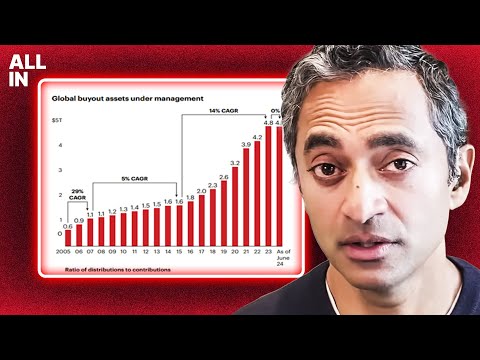
And if you look at private equity, pull up that chart I had there. This is just stunning how big this industry is getting. You know, $5 trillion is what we're up to here.And it just keeps growing. >> I I think private equity is totally screwed. I I don't think Silver Lake or Infinity or this deal are screwed, but I think private equity in general is totally hosed.>> All right. Well, it's gotten huge just since 2015 and tripling in size. So why is this I guess my question for the gentleman here and for the a ...
X @Bloomberg
Bloomberg· 2025-10-05 16:07
Hedge funds speculating on wildfire insurance claims in California were just dealt a legal blow, after the state adopted new legislation designed to stifle such bets https://t.co/pAyuhgeyJD ...
Chamath: “Private equity in general is totally hosed.” 🏢🚨
All-In Podcast· 2025-10-04 17:58
private equity in general is totally owed. I think the history of this is important. There was a long-standing belief that the best way to generate the best risk adjusted return was to have what's called a 60/40 allocation.60% to bonds and 40% to equities. Over many years, especially when we artificially suppressed rates at zero, a lot of people started to move their allocations away from 60/40 and they started to make more and more investments further out on the risk curve. The biggest beneficiaries of tha ...