Monetary Policy

Search documents
Instant View: Fed lowers rates by a quarter of a point; Powell says was a risk management cut
Yahoo Finance· 2025-09-17 18:28
"In addition to the political jabs aimed at them, the Fed is in a tough spot. They expect stagflation, or higher inflation and a weaker labor market. That is not a great environment for financial assets. One could call the Fed's move a risk management-style rate cut. It shows the Fed is putting more emphasis on the softening in the labor market as they trimmed rates while forecasting more cuts in 2025.""We believe that diversifying portfolios across geographies and currencies and sectors, following a decade ...
Mortgages, Crypto And Bonds: Here’s How Consumers May Benefit From Lower Interest Rates
Forbes· 2025-09-17 18:13
Core Viewpoint - The Federal Reserve has decided to lower interest rates for the first time in months, which is expected to lead to lower mortgage rates, bond yields, and potentially boost cryptocurrency prices in the coming weeks [1]. Interest Rate Changes - The Federal Reserve's policymaking panel has reduced interest rates from a range of 4.25% to 4.5% to a new range of 4% to 4.25% [2]. Impact on Mortgage Rates - Average 30-year fixed-rate mortgage rates decreased to 6.35% from 6.5%, marking the lowest level since October 2024. The 15-year fixed-rate mortgage rates also fell to 5.5% from 5.6% [3]. - Historical data shows that when the Fed lowered rates to near zero during the pandemic, 30-year mortgage rates reached record lows between 2.7% and 3% by the end of 2020 [3]. - Consumers who refinanced their mortgages in 2020 saved approximately $5.3 billion annually due to lower rates [3]. Treasury Bonds Response - Long-term Treasury yields are expected to decline as interest rates are lowered, which typically results in lower borrowing costs for consumers across various loan types [4]. - During the pandemic, 10-year Treasury yields fell to an all-time low of 0.5% when the Fed pushed rates to near zero [4]. Cryptocurrency Market Reaction - Lower interest rates may encourage investment in riskier assets like cryptocurrencies, as traditional savings accounts and bonds yield less [5]. - Historical trends indicate that the price of bitcoin surged from about $5,000 in March 2020 to around $69,000 by November 2021 as interest rates fell [5]. - The impact of new rate cuts on cryptocurrencies remains uncertain, especially as the industry has recently benefited from looser regulations [5]. Background Context - The decision to ease monetary policy follows pressure from President Donald Trump, who criticized Fed Chair Jerome Powell for being "TOO LATE" in implementing significant rate cuts [6]. - Wall Street had anticipated this interest rate reduction due to stronger-than-expected jobs data and rising inflation, which remains above the Fed's 2% target [6]. - The Fed's dual mandate includes maintaining full employment and stabilizing inflation, with recent signals indicating a potential adjustment in policy stance due to shifting economic risks [6].


Federal Reserve issues FOMC statement_2025.0918
FOMC· 2025-09-17 18:00
For release at 2:00 p.m. EDT September 17, 2025 Recent indicators suggest that growth of economic activity moderated in the first half of the year. Job gains have slowed, and the unemployment rate has edged up but remains low. Inflation has moved up and remains somewhat elevated. The Committee seeks to achieve maximum employment and inflation at the rate of 2 percent over the longer run. Uncertainty about the economic outlook remains elevated. The Committee is attentive to the risks to both sides of its dua ...
Economy does not warrant a 50 basis point rate cut in September, says Morgan Stanley's Michael Gapen
Youtube· 2025-09-17 17:50
Economic Outlook - The Federal Reserve is expected to recalibrate its stance due to shifting risks towards a weaker labor market, suggesting that restrictive policy is not justified [3][12] - There is a consensus that a series of rate cuts, potentially totaling 75 to 100 basis points, is warranted by the current economic conditions, particularly the weak labor market data [4][7][5] Labor Market Analysis - The labor market is showing signs of weakness, with job creation stagnating outside of the healthcare sector, prompting concerns about broader economic implications [5][6] - The Fed aims to preempt further labor market deterioration by moving towards a neutral policy stance [6][12] Tariff Impact - Companies are adjusting to higher tariff rates by absorbing costs rather than increasing hiring, which contributes to labor market weakness [7][8] - The anticipated economic stimulus from tax cuts is expected to materialize in the future, but is not currently impacting the economy [8] Federal Reserve's Strategy - The Fed is not advocating for an easy monetary policy but rather seeks to transition from a restrictive stance to a neutral one to better respond to economic developments [12][13] - The timing of the Fed's actions is critical, as immediate adjustments are necessary to sustain economic expansion into 2026 [9]
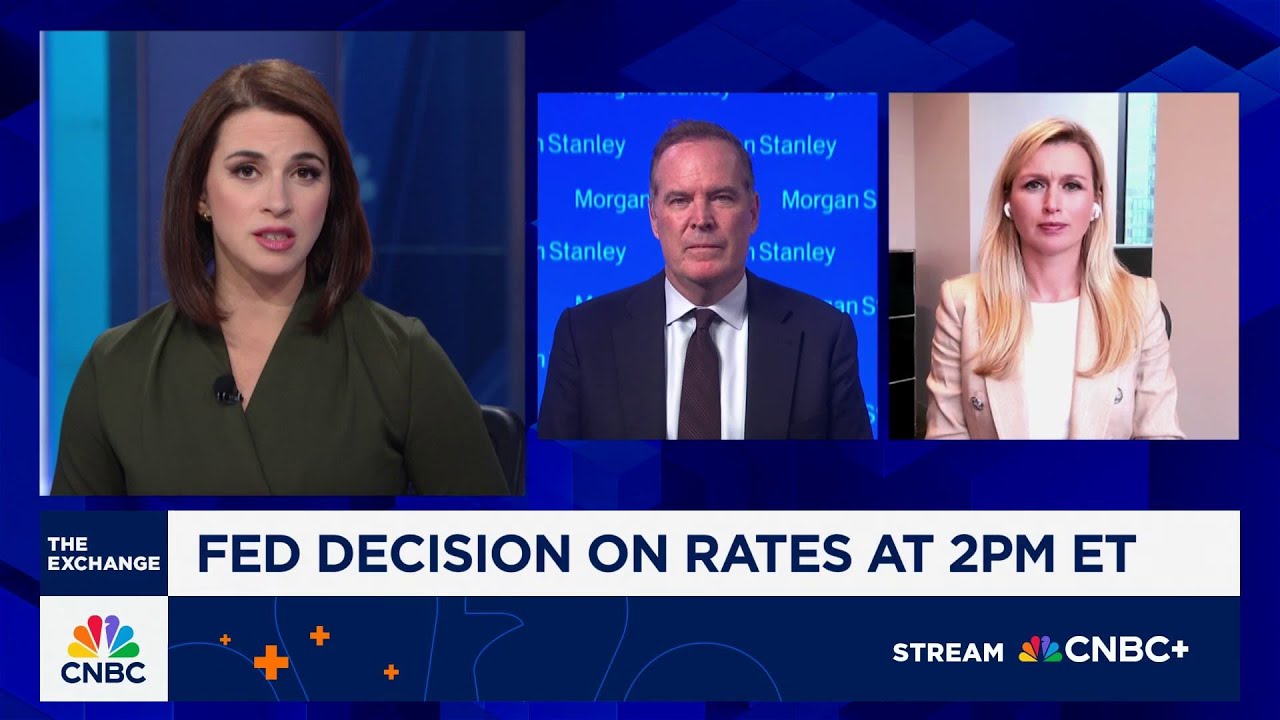
New Century Advisors' Claudia Sahm: Things are 'not normal' at the Fed right now
CNBC Television· 2025-09-17 17:13
like a. >> Big I can't tell you how excited I am. >> When was the last time we talked about the dynamics.>> I'm in. I'm I'm on the edge of my seat. >> Exactly.All right. Let's talk more about it. Joining us is Claudia Sardine, New Century Advisors chief economist and a former fed economist.Claudia, that that will be interesting, right. We'll see who dissents. We'll see how divergent the dot plots are.What are you looking for. >> Yeah. And I want to underscore that even in normal times, like we would expect ...
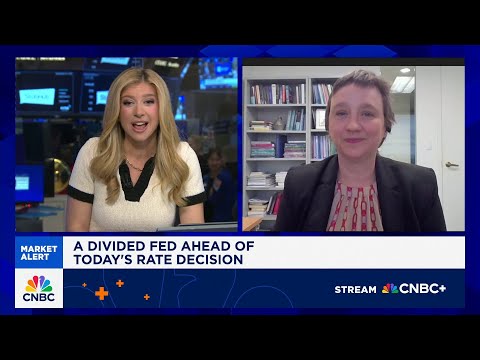
Fed Rate Decision: BofA Wouldn't 'Rule Out' Miran Voting for a 100 Point Cut
Youtube· 2025-09-17 15:36
We actually think that the Fed will be delivering a hawkish cut today simply because the market is pricing in almost 70 basis points of rate cuts excuse me, this year about 150 basis points for the cycle. And we think the Fed at most is going to send a signal that they'll be cutting twice this year and only twice next year. So in relation to where the market is priced, we do think that that's going to come across as somewhat hawkish.Now, we don't think that Powell is going to tell the market that it's wrong ...

Cook, Miran Present as Fed Meets to Consider Cutting Rates
Youtube· 2025-09-17 13:56
Core Viewpoint - The Federal Reserve is expected to implement a quarter-point interest rate cut due to significant deterioration in the labor market and rising unemployment rates, particularly among black workers, which indicates a struggling economy [2][4][19] Labor Market Analysis - The labor market has shown prolonged softness, with job openings falling below the number of job seekers for the first time in several years, suggesting a need for monetary policy adjustments [3] - A spike in the black unemployment rate is concerning and may signal further labor market weakening, prompting the Fed to consider loosening monetary policy [4] Monetary Policy Implications - The anticipated rate cut is complicated by persistent inflation, which is influenced by the current administration's tariff policies, creating uncertainty in the market [4][10] - There are concerns that undermining the Fed's independence could lead to market fears about inflation control, complicating the Fed's ability to lower long-term interest rates effectively [5][10] Housing Market Concerns - The steepening yield curve indicates a narrowing gap between short-term borrowing costs and long-term rates, which could hinder efforts to reduce mortgage interest rates [7][8] - The Fed's ability to influence long-term interest rates is critical for addressing housing market challenges, which are a focus of the current administration [8][10] Tariff Policy Effects - The chaotic nature of tariff policies creates uncertainty that complicates investment decisions and may lead to delayed consumer price increases [12][13] - Despite higher tariffs, the U.S. economy has shown resilience, but the impact on consumers remains a concern, particularly for those with lower income levels [11][19] Consumer Impact - Working-class individuals are facing financial pressure from both a weakening labor market and rising consumer prices, particularly in essential areas like groceries and housing [19] - Elevated savings and reduced debt burdens may provide some cushion for consumers, but the overall economic environment remains challenging [16][17]
X @Anthony Pompliano 🌪
Anthony Pompliano 🌪· 2025-09-17 13:47
Bitcoin's monetary policy is the only predictable monetary policy in the world. ...
Global Markets React to Policy Shifts, Corporate Actions, and Economic Outlooks
Stock Market News· 2025-09-17 08:09
Corporate News - Moody's Ratings has upgraded SoftBank Group Corp.'s debt outlook to positive from stable, affirming its Ba3 corporate family rating due to improved credit fundamentals, including a reduction in market value-based leverage to approximately 26% as of September 2024, down from 41% a year prior [3][8] - SoftBank has expressed strong disagreement with Moody's rating, considering it unsolicited and is exploring legal options to address what it views as potentially misleading information for investors [3][8] - PwC UK is cutting around 175 auditor jobs and implementing lower pay increases for its staff due to a sharp slowdown in revenue growth, with broader job cuts affecting approximately 1,800 positions across its U.S. operations anticipated in late 2024 [4][8] Economic Policy - German Chancellor Friedrich Merz emphasized the urgent need for pension system reforms in response to changing demographics, with projections indicating a significant imbalance by 2036 as 19.5 million baby boomers retire against only 12.5 million new workers entering the labor market [5][6] - Proposed reforms include encouraging private savings, potentially raising the statutory retirement age, and discouraging early retirement to mitigate future labor shortages [5] - Chancellor Merz announced plans to seek new trade partners outside the trans-Atlantic region, highlighting opportunities in South America, Asia, and Africa, while also expressing a desire to revive talks on a trans-Atlantic free trade agreement with zero percent tariffs [6] Central Bank Policy - European Central Bank (ECB) Vice President Luis de Guindos stated that the ECB is maintaining a flexible stance on interest rates, keeping all options open due to ongoing uncertainty in the global economic landscape [9] - De Guindos noted a "remarkable services inflation deceleration" but observed that consumption as a driver of growth has not materialized, with expected growth for the second and third quarters being "almost flat" [9]