上市公司实控人离婚分割股权

Search documents
2025年A股上市公司实控人离婚“分手费”全景 近60亿元财富被分割!
Mei Ri Jing Ji Xin Wen· 2026-01-26 00:34
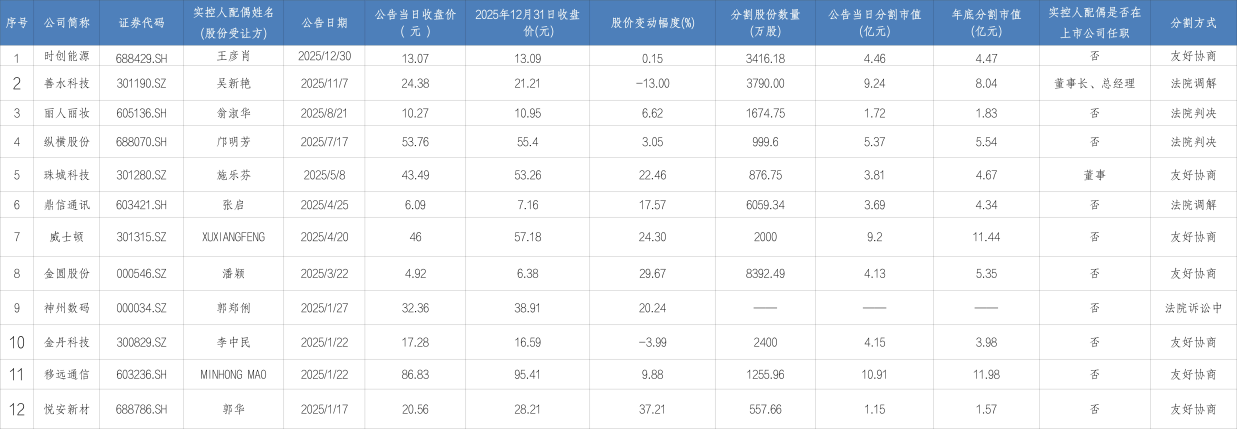
Core Viewpoint - The recent trend of equity division due to the divorce of controlling shareholders in A-share companies has raised concerns among investors, but the actual impact on stock prices has been less severe than expected [1][10]. Group 1: Overview of Equity Division Events - In 2025, a total of 12 A-share companies experienced equity division due to the divorce of their controlling shareholders, with the total market value of these divisions increasing from 5.783 billion to 6.321 billion yuan by the end of the year [1][4]. - The highest single division value was 1.198 billion yuan from Yiyuan Communication, while the lowest was 157 million yuan from Yuenan New Materials [4][7]. Group 2: Methods of Equity Division - The majority of equity divisions (58.33%) were resolved through amicable agreements, while 2 cases were settled through court rulings and 2 through court mediation [7]. - In the case of Shanshui Technology, the ex-spouse became the new controlling shareholder and CEO after the divorce, marking a unique instance among the 12 companies [7]. Group 3: Stock Price Performance Post-Division - Among the 12 companies, 10 saw their stock prices increase from the announcement date to the end of 2025, with an overall increase of 83.33% [8]. - The highest stock price increase was 37.21% for Yuenan New Materials, while only Shanshui Technology and Jindan Technology experienced declines, with a maximum drop of 13% [8]. Group 4: Investor Sentiment and Market Reaction - Historically, investor concerns about stock price declines following equity divisions due to divorce have been prevalent, but the 2025 cases showed a more muted reaction, with no significant sell-offs by ex-spouses [8][10]. - The separation of ownership and management in listed companies means that equity division does not necessarily impact operational strategies, leading to a consensus among ex-spouses on key business decisions despite personal conflicts [10].


2025年A股上市公司实控人离婚“分手费”全景,近60亿元财富被分割!
Sou Hu Cai Jing· 2026-01-26 00:28
Core Viewpoint - The recent trend of divorce-related equity division among controlling shareholders in A-share companies has raised investor concerns, with significant market implications observed in 2025 [1][3][4]. Group 1: Overview of Divorce-Related Equity Division - In 2025, a total of 12 A-share companies announced equity divisions due to the divorce of their controlling shareholders, with the total market value of these divisions increasing from 5.783 billion yuan to 6.321 billion yuan by the end of the year [4][8]. - The highest single division value was recorded at 1.198 billion yuan for Yiyuan Communication, while the lowest was 157 million yuan for Yuenan New Materials [5][6]. Group 2: Methods and Outcomes of Equity Division - The majority of equity divisions were settled amicably, with 58.33% of cases resolved through negotiation, while 2 cases were decided by court rulings and 2 through court mediation [7]. - Notably, in the case of Shanshui Technology, the ex-spouse became the new controlling shareholder and CEO after the divorce, marking a unique instance in 2025 [6][7]. Group 3: Market Reactions and Shareholder Behavior - Despite concerns about potential stock sell-offs by ex-spouses, 10 out of the 12 companies saw their stock prices increase from the announcement date to the end of 2025, with an average increase of 83.33% [8]. - The stock price of Yuenan New Materials experienced the highest increase at 37.21%, while only two companies, Shanshui Technology and Jindan Technology, saw declines, with the largest drop being 13% [8]. Group 4: Analysis of Investor Sentiment - The perception of divorce-related equity divisions as a negative signal has weakened, attributed to the separation of ownership and management in listed companies, which suggests that such divisions do not necessarily impact operational strategies [10]. - Even in cases of personal conflict, controlling shareholders may maintain aligned interests in business operations, reducing the likelihood of adverse market reactions [10].