专利竞争

Search documents
断崖式专利差!6G技术美国占了35.2%,日本9.9%,中国是多少?
Sou Hu Cai Jing· 2026-02-21 15:23
Core Insights - The global mobile data volume is expected to exceed 5000EB by 2030, indicating that 5G bandwidth will be insufficient, necessitating the transition to 6G [2] - 6G is characterized by transmission speeds in terabits per second, microsecond-level latency, and integration with AI, making it a complex technological upgrade and a strategic asset for nations [4] Patent Landscape - The total number of global 6G patent applications has surpassed 38,000, covering the entire value chain from base stations to chips and applications [6][11] - The distribution of patents is crucial for establishing international technical standards, with the U.S. holding 35.2% of patents, Japan 9.9%, and China leading with 40.3% [4][25] U.S. Patent Advantages - The U.S. benefits from a strong patent position due to deep government and corporate collaboration, having allocated $450 million for 6G research [10] - However, the U.S. faces challenges with patent concentration among a few major companies, limiting participation from smaller firms [13] Japan's Focus - Japan concentrates its R&D resources on specific areas like terahertz communication and precision devices, aiming for specialized expertise [17] - Notable advancements include NTT Docomo's 280GHz terahertz device achieving a transmission rate of 100Gbps, significantly surpassing 5G capabilities [19] China's Leading Position - China holds the highest share of 6G patents at 40.3%, surpassing the U.S. and Japan, attributed to collaborative efforts across academia and industry [25] - Key players like Huawei and ZTE are making significant strides in core technologies, with Huawei holding 13,000 6G invention patents [26] Research and Development Achievements - Chinese research institutions have made critical breakthroughs in terahertz technology, with notable achievements in integrated communication systems [28] - China has completed the first phase of 6G technical trials and is advancing to the second phase, demonstrating a synchronized approach to technology development and application [30] Challenges Ahead - Despite leading in patent numbers, China still faces gaps in terminal chips and high-end precision devices compared to the U.S. and Japan, which are areas for future improvement [34] - The industry must address the cost of 6G base station construction and the conversion of laboratory technologies into affordable products for consumers [35]


硅谷观察:发布全景相机挑战影石?大疆真正的障碍唯有叹息
Xin Lang Ke Ji· 2025-08-17 23:28
Core Insights - DJI and Insta360 are competing in each other's core product areas, creating new competitive pressures in the consumer imaging market [2] - DJI holds an 80% market share in the global consumer drone market, while Insta360 has a 67.2% share in the consumer 360 camera market [4][6] - Both companies have established themselves as leaders in their respective fields, leveraging unique technological advantages and rapid product iteration [5][7] Market Dynamics - DJI's dominance in the drone market is supported by its comprehensive ecosystem, patent portfolio, and brand strength [5] - Insta360 has rapidly ascended in the portable 360 camera market, outperforming traditional competitors like Ricoh and GoPro in technology and product updates [6][7] - The global action camera market is increasingly competitive, with GoPro's market share declining from over 50% five years ago to just above one-third [10][12] Competitive Landscape - GoPro has struggled to compete with DJI and Insta360, facing significant market share losses and operational challenges [12][18] - GoPro's attempts to diversify into drones and 360 cameras have largely failed, leading to a focus on its traditional action camera market [12][13] - Insta360's revenue grew by 53.3% year-over-year, reaching $780 million, while GoPro's revenue has been declining [17][18] Legal and Regulatory Challenges - GoPro has initiated multiple patent infringement lawsuits against Insta360, but recent rulings have favored Insta360, allowing it to maintain its position in the U.S. market [20][21] - DJI faces significant barriers in the U.S. market, including supply chain disruptions and potential exit due to regulatory challenges [22][28] - DJI's products have been largely unavailable in the U.S. market, leading to substantial revenue losses estimated at around $1 billion [28][29] Future Outlook - The U.S. market remains critical for both companies, with DJI's absence potentially costing it a significant portion of its revenue [28] - Insta360 is expected to continue its growth trajectory, potentially surpassing GoPro in market share [17][18] - The competitive landscape is likely to evolve further as both companies innovate and respond to market demands [7][10]


华为二次状告传音侵权,涉及图像显示专利
Xin Lang Cai Jing· 2025-08-06 11:09
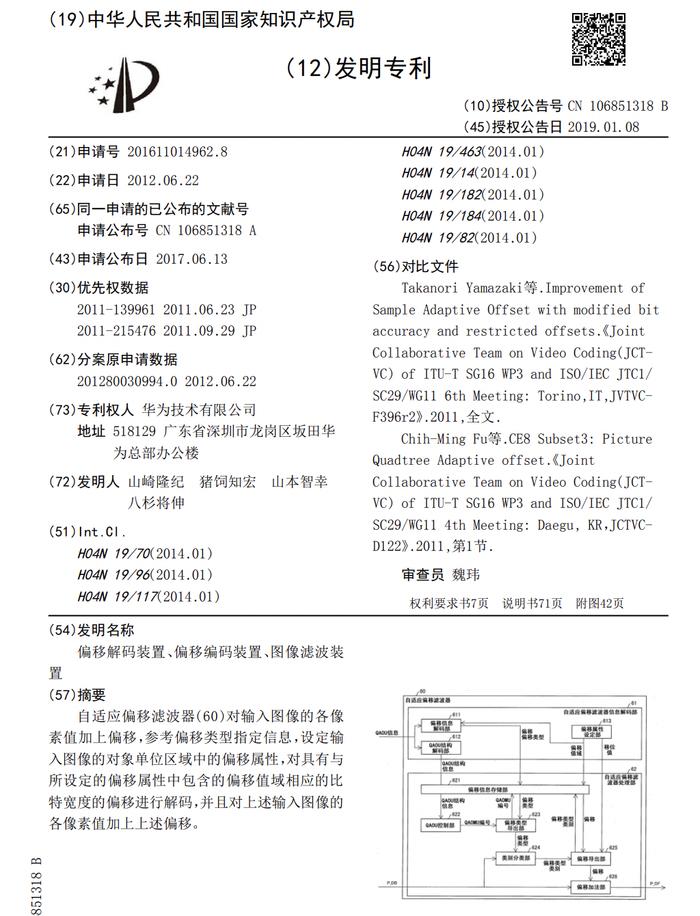
Core Viewpoint - Huawei has filed a lawsuit against Transsion Holdings for patent infringement related to a European patent concerning "offset decoding devices, offset encoding devices, and image filtering devices" [1][2] Group 1: Legal Actions - Huawei initiated legal action against Transsion on June 20, 2023, in the European Patent Court in Munich [1] - This lawsuit marks Huawei as the fourth entity to pursue patent rights against Transsion regarding HEVC patents [1] - Transsion has previously faced lawsuits from NEC, JVC, and Sun Patent Trust over HEVC patents in both the UPC and Brazil [1] Group 2: Patent Details - The patent in question (CN106851318B) addresses issues of memory efficiency in adaptive offset filters by limiting offset bit depth and range [2] - The technology is widely used in smartphone image display modules, enhancing encoding efficiency and reducing memory usage, which improves device performance and lowers hardware costs [2][11] Group 3: Company Background - Transsion Holdings, established in 2013, is a significant player in the emerging mobile phone market, with brands like TECNO, itel, and Infinix, and operates in over 70 countries [11] - Transsion was recognized as the "King of African Phones" upon its debut on the STAR Market in September 2019, with a 14.0% global market share projected for 2024, ranking third overall [12] - However, Transsion reported a revenue decline of 25.45% year-on-year in Q1 2025, marking a significant drop in net profit by 69.87% [12] Group 4: Competitive Landscape - Huawei holds over 150,000 effective patents globally, with more than 90% being invention patents, showcasing its leadership in patent technology [12] - In contrast, Transsion has 3,882 patents, with only 995 being invention patents, indicating a substantial gap in patent holdings between the two companies [12] - The ongoing legal disputes highlight the increasing importance of patents as a competitive factor in the global mobile phone market [12]