个性化视觉生成

Search documents
比LoRA更快更强,全新框架LoFA上线,秒级适配大模型
具身智能之心· 2025-12-19 00:05
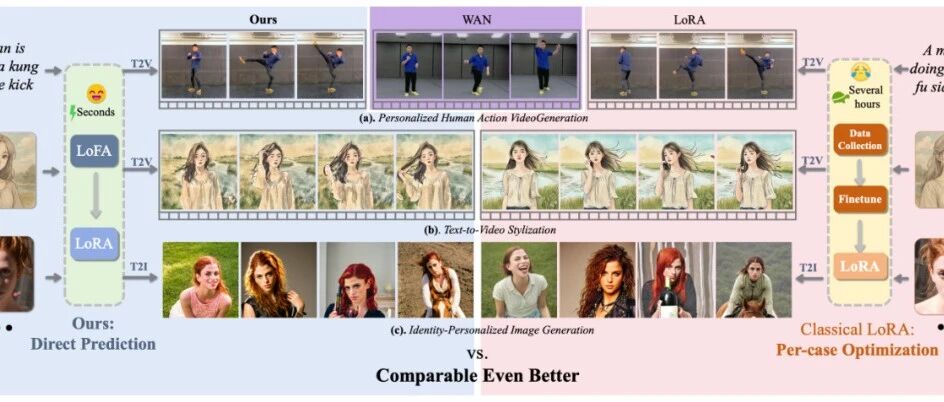
Core Insights - The article discusses the limitations of existing visual generative models in meeting personalized user demands, particularly in generating precise outputs based on fine-grained instructions [5][6] - It introduces a new framework called LoFA, which allows for rapid adaptation of large models to personalized tasks without lengthy optimization processes, achieving results comparable to traditional methods [24] Group 1: Background and Challenges - The demand for creative media and visual content has led to the development of powerful visual generative models trained on large datasets, but these models struggle with specific user instructions [5][6] - Traditional methods like parameter-efficient fine-tuning (PEFT) require extensive optimization for each personalized task, making them impractical for real-time applications [6][10] Group 2: LoFA Framework - LoFA is designed to predict personalized LoRA parameters directly from diverse user instructions, enabling fast adaptation of visual generative models [8][10] - The framework incorporates a novel guiding mechanism within a hypernetwork to predict complete, uncompressed LoRA weights, avoiding information loss [11][12] Group 3: Methodology - The learning process in LoFA is divided into two phases: first predicting a simplified response map and then using this knowledge to guide the final LoRA weight prediction [10][11] - This structured approach allows the network to focus on key adaptation areas, enhancing stability and efficiency [11] Group 4: Experimental Analysis - The effectiveness of the LoFA framework was evaluated through systematic experiments in video and image generation tasks, demonstrating superior performance compared to baseline methods [13][14] - In video generation, LoFA was tested on personalized human action video generation and style transfer tasks, while in image generation, it focused on ID personalization [13][14] Group 5: Conclusion and Future Outlook - LoFA overcomes key limitations of existing personalization techniques by eliminating lengthy optimization processes and achieving comparable or superior performance to individually optimized models [24] - Future developments aim to create a unified hypernetwork capable of zero-shot learning for various specific instructions, expanding the framework's applicability [24]

比LoRA更快更强,全新框架LoFA上线,秒级适配大模型
机器之心· 2025-12-18 00:03
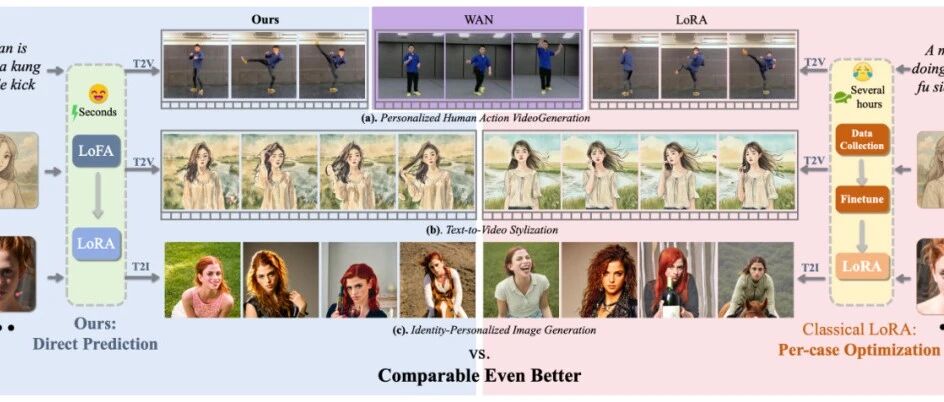
Core Insights - The article discusses the limitations of traditional visual generative models in meeting personalized user demands, particularly in generating precise outputs based on fine-grained instructions [6][7] - It introduces a new framework called LoFA, which allows for rapid adaptation of large models to personalized tasks without lengthy optimization processes, achieving results comparable to or better than traditional methods like LoRA [2][24] Group 1: Problem Statement - There is a growing demand for creative media and visual content, leading to the development of powerful visual generative models trained on large datasets [6] - Existing methods for personalizing these models, such as parameter-efficient fine-tuning (PEFT), require extensive optimization time and specific task data, making them impractical for real-time applications [6][7] Group 2: Proposed Solution - LoFA is designed to predict personalized LoRA parameters directly from user instructions, enabling fast adaptation of visual generative models [9][12] - The framework incorporates a novel guiding mechanism within a hypernetwork to predict complete, uncompressed LoRA weights, avoiding information loss associated with compression techniques [9][12] Group 3: Methodology - The learning process in LoFA is divided into two phases: first predicting a simplified response map and then using this knowledge to guide the final LoRA weight prediction [11][12] - This structured approach allows the model to focus on key adaptation areas, enhancing the stability and efficiency of the learning process [12] Group 4: Experimental Results - The effectiveness of the LoFA framework was evaluated through systematic experiments in both video and image generation tasks, demonstrating its ability to handle diverse instruction conditions [14][15] - LoFA outperformed baseline methods and achieved performance comparable to independently optimized LoRA models, significantly reducing adaptation time from hours to seconds [15][24] Group 5: Conclusion and Future Directions - LoFA addresses critical limitations in existing personalization techniques by eliminating lengthy optimization while maintaining high-quality generation results [24] - Future work aims to develop a unified hypernetwork with strong zero-shot capabilities to handle various specific instructions across different domains [24]