中药2025业绩

Search documents
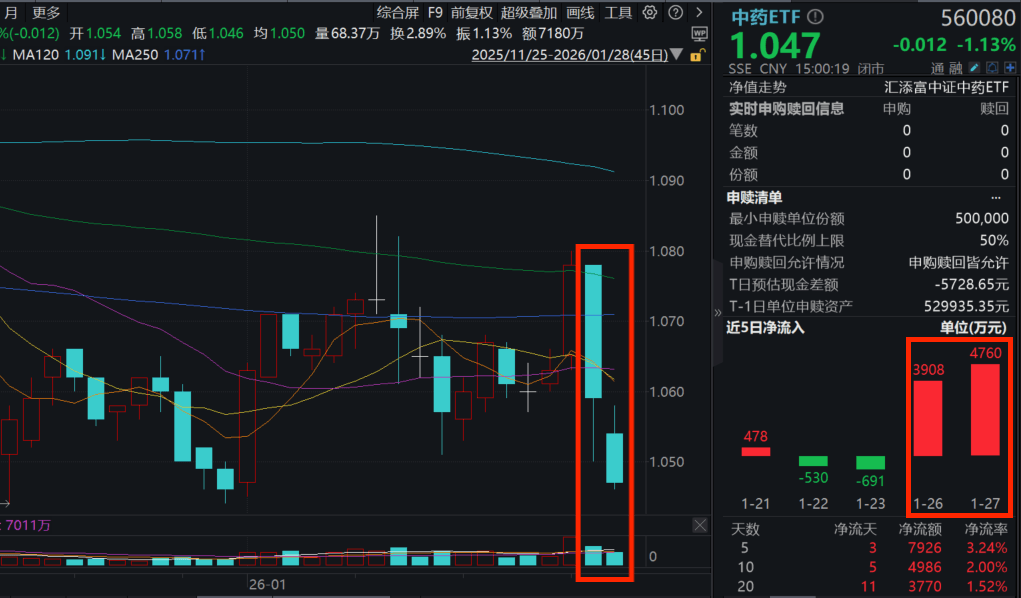
片仔癀连跌9日,再度刷新2020年6月以来新低!中药ETF(560080)跌超1%,近2日吸金超8600万元!关注中药2025业绩及基药目录调整进展
Xin Lang Cai Jing· 2026-01-28 08:58
Core Viewpoint - The traditional Chinese medicine (TCM) sector is experiencing a second consecutive day of decline, with the TCM ETF (560080) dropping by 1.13% and a total trading volume exceeding 71 million yuan, indicating a potential buying opportunity as it has attracted over 86 million yuan in the last two days [1][3]. Group 1: Market Performance - The TCM ETF (560080) has seen a decline in key constituent stocks, with Yunnan Baiyao and China Resources Sanjiu both falling over 1%, while Yiling Pharmaceutical dropped over 3%. Conversely, Jilin Aodong rose over 1% [3]. - The TCM ETF's tracked index has a current price-to-earnings (PE TTM) ratio of 24.22, which is below 83.72% of the time since its inception in May 2015, indicating a favorable valuation [6]. Group 2: Earnings Forecasts - As of January 25, 2026, 11 TCM listed companies have released their 2025 annual reports and earnings forecasts, with 6 companies showing positive year-on-year net profit growth. Notably, 3 companies have growth rates exceeding 100% [7]. - The primary drivers for the earnings growth include the establishment of a "hospital + external" collaborative development model, with a focus on enhancing external market channels, particularly e-commerce [7]. Group 3: Policy and Structural Changes - The basic drug catalog has completed preliminary expert selection, with significant adjustments expected in 2026. The current catalog, last updated in 2018, includes 685 varieties, of which 268 are traditional Chinese medicines [7]. - The upcoming adjustments to the basic drug catalog are anticipated to enhance the accessibility of grassroots medications and promote a "1+X" medication model, potentially leading to rapid market expansion [7]. Group 4: Investment Themes - Three main investment themes in the TCM sector are highlighted: 1. Price governance, focusing on price reductions and market share in the context of centralized procurement and insurance negotiations [8]. 2. Consumption recovery, driven by macroeconomic improvement and increased health awareness among the aging population, benefiting TCM sales [9]. 3. State-owned enterprise reform, which is expected to yield performance improvements and investment opportunities in the TCM sector [9].