人工智能+最低工资监测监管体系

Search documents
涨工资,落地!
Zhong Guo Xin Wen Wang· 2025-10-27 03:41
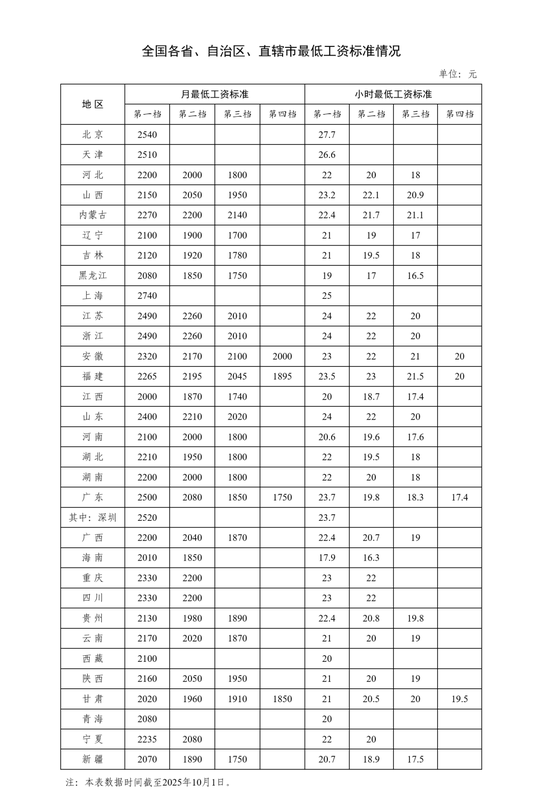
Core Points - The latest report from the Ministry of Human Resources and Social Security indicates that the minimum wage standards across all 31 provinces, autonomous regions, and municipalities in China have surpassed 2000 yuan [1][3] - At least 18 provinces have adjusted their minimum wage standards compared to October of the previous year, with many regions seeing increases of over 10% [2][3] - The adjustments are influenced by various factors including living costs, social insurance contributions, average wages, economic development levels, and employment conditions [3][7] Summary by Sections Minimum Wage Adjustments - Inner Mongolia's minimum wage standard has been raised to 2270 yuan, reflecting a 14.65% increase [3] - Provinces such as Guizhou, Anhui, Fujian, Chongqing, Sichuan, Qinghai, and Guangxi also reported increases exceeding 10% [3] - Shanghai leads with a minimum wage of 2740 yuan, while Beijing, Tianjin, Guangdong, Zhejiang, Jiangsu, and Shandong have standards of 2400 yuan or more [3] Future Adjustments - Jiangxi province plans to adjust its minimum wage standards from December 1, 2025, with the first-class area increasing from 2000 yuan to 2240 yuan [4] - Tibet's minimum wage will rise from 2100 yuan to 2360 yuan, effective November 1, 2025 [4] Regional Coordination - Sichuan and Chongqing have synchronized their minimum wage standards, reflecting a collaborative effort to enhance regional policy coordination [5][6] - The Ministry of Human Resources and Social Security has proposed establishing cross-regional standards for public services in key economic areas [6] Mechanism for Adjustments - The adjustment of minimum wage standards is crucial for protecting labor rights and reducing income disparity [7] - Recommendations include linking minimum wage adjustments to local GDP, average wages, and social security contributions [7][8] - There is a push to extend minimum wage coverage to all urban employment groups, particularly in the digital economy [8]