
人工智能与实体经济深度融合

Search documents
为什么和晶泰合作的企业都能大涨?揭开“晶泰赋能方程式”
Ge Long Hui· 2026-01-23 10:41
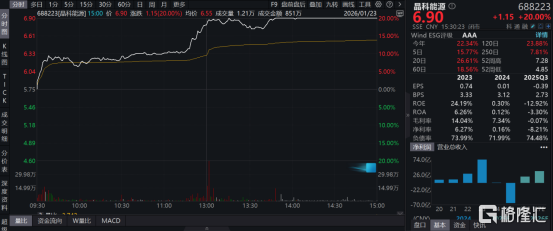
Core Insights - SpaceX and Tesla are collaborating on a solar energy storage project aiming for 100 GW of solar power manufacturing capacity annually in the U.S. within three years, while also exploring space solar energy utilization [1] - JinkoSolar's stock surged by 20% after announcing a partnership with Jingtai to develop AI perovskite tandem Topcon solar cells for space photovoltaic applications, igniting market enthusiasm [1] - The "Jingtai Effect" is observed across various sectors, with companies like JinkoSolar and Ganli Pharmaceutical seeing stock price increases after announcing collaborations with Jingtai, indicating a systematic model of empowerment in the market [1][2] JinkoSolar Collaboration - JinkoSolar announced a partnership with Jingtai to develop AI perovskite tandem Topcon solar cells for space photovoltaic applications, leading to an 11.65% stock price increase on the announcement day [3] - The collaboration aligns with Elon Musk's vision for future energy, highlighting the potential of space solar energy to provide nearly unlimited clean energy [3] - Jingtai's AI technology accelerates material research and engineering optimization in this field, creating a shared future revenue model with JinkoSolar [3] Ganli Pharmaceutical Collaboration - Ganli Pharmaceutical entered a strategic partnership with Jingtai to develop next-generation peptide drugs, resulting in a 14.84% stock price increase since the announcement [6][7] - Ganli's extensive resources and Jingtai's AI peptide platform PepiX create a complementary relationship, enhancing drug stability and bioavailability [6][7] - This collaboration positions Ganli as an "AI-driven metabolic disease innovation platform," tapping into the global multi-billion dollar market for GLP-1 drugs [7] National Strategy Support - The Chinese government has shown support for Jingtai's model, with the Prime Minister visiting Jingtai to emphasize the importance of AI integration into the real economy [10] - Jingtai's business model exemplifies the national strategy of "AI + industry," showcasing its ability to generate significant value through technological advancements [10] Jingtai's Empowerment Model - Jingtai's "Jingtai Effect" is based on a replicable system of "technology + capital + market" empowerment, addressing core innovation challenges for companies [12] - The first layer of empowerment focuses on using AI to optimize research and development processes, significantly reducing time and uncertainty in traditional methods [13] - The second layer involves deep capital integration in partnerships, ensuring shared benefits and reduced risks for all parties involved [15] - The third layer positions Jingtai to help traditional companies enter new, high-potential markets, such as space solar energy and peptide drugs, enhancing their competitive edge [16] Conclusion - Jingtai Technology is emerging as a key driver of value creation for Chinese tech companies, with its model of "technological breakthroughs, capital symbiosis, and strategic positioning" addressing essential growth challenges [18] - The collaboration with JinkoSolar in the space solar sector represents a significant move in the trillion-dollar renewable energy market, with potential for expansive future value [18] - Jingtai's approach is becoming a crucial variable in shaping industry valuation logic and innovation ecosystems, as more companies seek its empowering capabilities [19]


一、二、三产全要素智能化转型发展路径、布局智能原生新模式新业态……这份关于“人工智能+”的新文件带来新提法
Mei Ri Jing Ji Xin Wen· 2025-08-26 16:15
Core Viewpoint - The State Council's "Opinions on Deepening the Implementation of 'Artificial Intelligence+' Action" outlines six key actions to accelerate the integration of AI across various sectors, marking a significant shift in China's approach to AI development and its application in the economy [1][2]. Group 1: Key Actions and Goals - The "Opinions" propose a three-stage goal: by 2027, achieve widespread integration of AI in six key areas with over 70% application rate of new intelligent terminals and significant growth in the AI core industry [4] - By 2030, AI is expected to fully empower high-quality development, with over 90% application rate of new intelligent terminals, making the AI economy a crucial growth driver for China's economy [5] - By 2035, China aims to enter a new stage of intelligent economy and society, providing strong support for the realization of socialist modernization [5] Group 2: Integration of AI Across Industries - The "Opinions" introduce a comprehensive path for the intelligent transformation of primary, secondary, and tertiary industries, leveraging China's complete industrial system and large market scale [7] - AI is expected to drive productivity improvements across all core elements, including technology, organization, processes, talent, and data, enhancing overall production efficiency [8] Group 3: Global Cooperation and Competitive Advantages - The "Opinions" propose a global cooperation model for "Artificial Intelligence+", highlighting China's advantages such as a vast market, leading data production, and a robust industrial ecosystem [9][10] - China's systemic capabilities, driven by policy, data empowerment, and ecological collaboration, are expected to enhance its competitiveness in AI industrialization and cross-industry penetration [10] Group 4: Philosophical and Educational Aspects - The "Opinions" creatively incorporate philosophical and social science research methods into the AI domain, emphasizing the importance of AI in advancing scientific research and societal development [11][12] - There is a call for enhanced AI education to improve public understanding and application of AI technologies, ensuring that AI benefits various aspects of life, including work, education, and healthcare [13][14]