人类放屁图谱

Search documents
每天放屁32次才正常?科学家发明「智能内裤」,要建「人类放屁图谱」,3500人已排队
机器人大讲堂· 2026-03-22 04:04
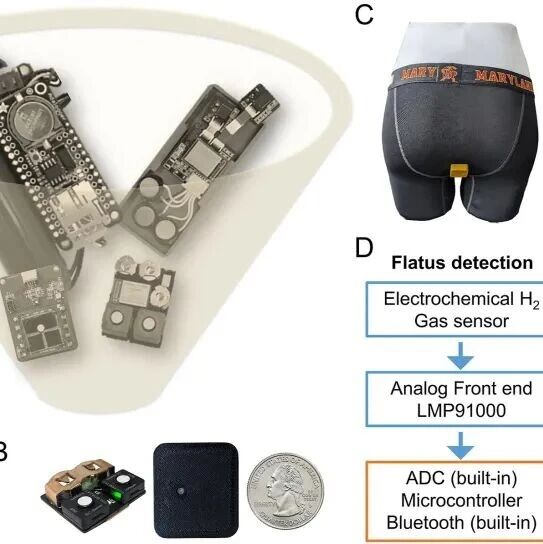
Core Insights - The article discusses a groundbreaking invention, "smart underwear," developed by scientists at the University of Maryland, which can monitor gas emissions from the human body, specifically flatulence, in real-time [3][8][12] - Initial findings reveal that healthy adults average 32 flatulence occurrences per day, significantly higher than the previously accepted range of 10-20 [6][15] - The research aims to create a "Human Flatus Atlas," establishing a baseline for gut health and microbiome activity [21][33] Group 1: Invention and Technology - The smart underwear is equipped with gas sensors and can connect to smartphones via Bluetooth for data transmission [5][12] - It was designed to be comfortable and reliable, with a compact size of 29 × 29 × 9 mm, and can capture gas emissions effectively [5][12] - The device operates on low power, allowing for a week-long battery life, and can detect hydrogen gas concentrations as low as 17.1 ppm [12][18] Group 2: Research Findings - A user experience study with 19 participants showed an average of 32 flatulence occurrences per day, with individual variations ranging from 4 to 59 [15][18] - The "GUMDROP study" demonstrated that the smart underwear could accurately detect increases in hydrogen gas after participants consumed fiber supplements, with a sensitivity of 94.7% [17][18] - A new metric, the Microbiome Activity Index (MAI), was introduced to assess not just the frequency of flatulence but also the concentration of hydrogen gas produced [18][21] Group 3: Future Implications - The research aims to establish a comprehensive understanding of gut health, potentially leading to personalized health management and dietary interventions [21][31] - The "Human Flatus Atlas" project will recruit a diverse population for extended monitoring to analyze dietary impacts on gut microbiota [21][23] - The smart underwear represents a novel approach to health monitoring, providing continuous physiological data that could inform future health diagnostics and interventions [31][33]