代理式购物

Search documents
亚马逊电话会:2000亿开支吓崩股价!卫星项目单季烧10亿,CEO辩护“产能即变现”,AWS订单激增40%
硬AI· 2026-02-06 06:44
Core Viewpoint - Despite a 40% surge in AWS backlog orders to $244 billion, the market reacted negatively to Amazon's projected capital expenditure of $200 billion for 2026, leading to an 11% drop in stock price. The CFO warned of an additional $1 billion cost from the low Earth orbit satellite project, which would significantly impact profit guidance. However, the CEO defended the substantial investment, asserting that AI capacity can be monetized quickly and betting on AI agents to transform the e-commerce experience [2][5][14]. Group 1: Capital Expenditure and AWS Growth - The projected $200 billion capital expenditure for 2026 is primarily allocated to AWS, especially for AI infrastructure, with the CEO stating that demand far exceeds supply, alleviating concerns about overcapacity [6][34]. - AWS reported a 24% year-over-year revenue growth in Q4, reaching $35.6 billion, with an annualized run rate of $142 billion. The backlog of orders surged to $244 billion, indicating high revenue certainty for the future [22][56]. - The CEO emphasized that the investment in AWS is not a reckless pursuit of revenue but is based on years of experience in forecasting demand signals, ensuring strong capital returns [6][63]. Group 2: AI and Chip Development - The CEO highlighted the high costs of AI chips in the market, indirectly criticizing competitors for their lack of urgency in reducing prices, which justifies Amazon's push for its custom chips, Trainium and Graviton, which have seen significant revenue growth [7][8]. - Amazon's self-developed chips have surpassed $10 billion in annual revenue, growing at triple-digit percentages, with Trainium 2 being the fastest ramping chip in Amazon's history [8][40]. - The CEO introduced the concept of "agentic shopping," suggesting that consumers will prefer retailers' AI agents over general AI models, as they provide better selection, pricing, and delivery [23][25]. Group 3: Satellite Project and Cost Implications - The CFO disclosed that costs associated with the Amazon Leo satellite project are expected to increase by approximately $1 billion year-over-year, impacting Q1 profit guidance [15][57]. - Amazon plans over 20 satellite launches in 2026 and 30 in 2027, with costs primarily expensed as incurred, leading to immediate profit pressure [15][57]. Group 4: Workforce and Legal Expenses - The CFO confirmed that a total of $2.4 billion in special expenses, including $730 million for severance costs, impacted operating profit, reflecting ongoing workforce restructuring [16][52]. - Additional costs include $1.1 billion related to tax disputes and litigation settlements, further straining profitability [18][52]. Group 5: E-commerce and Customer Experience - The CEO praised the AI shopping assistant Rufus, which has been used by over 300 million customers, resulting in a 60% higher conversion rate for users [24][47]. - Amazon's grocery business has become a significant revenue driver, with daily essentials growing at nearly double the rate of other categories, making Amazon a leading grocery destination for over 150 million Americans [43][54]. - The company continues to innovate in delivery services, achieving record speeds and expanding same-day delivery options, which have significantly increased customer shopping frequency [44][46].



亚马逊宣布“天量”资本支出:公司2026年的资本支出将达2000亿美元,主要用于AWS业务
Xin Lang Cai Jing· 2026-02-06 06:11
Core Insights - Amazon reported a revenue of $213.4 billion for Q4 of FY2025, marking a 12% year-over-year growth, but the stock price fell over 11% post-announcement [1] - The company anticipates capital expenditures to reach $200 billion in 2026, primarily for AWS, driven by high demand for cloud services [1] Group 1: Financial Performance - AWS revenue for Q4 was $35.6 billion, a 24% increase year-over-year, with an operating profit of $12.5 billion [2] - For the full year, AWS generated $142 billion in revenue [2] - Amazon's backlog orders reached $244 billion, a 40% year-over-year increase and a 22% quarter-over-quarter increase [2] Group 2: Cloud and AI Services - The growth in AWS is attributed to modernization of infrastructure and migration of workloads to the cloud, driven by core and AI services [2] - Amazon's AI shopping assistant, Rufus, has 300 million users, with a 60% higher conversion rate for users [2] - Concerns about external AI services impacting e-commerce traffic were addressed by proposing the concept of "agent-based shopping" [2] Group 3: Satellite Project Progress - Amazon's low Earth orbit satellite project, Amazon Leo, is making rapid progress, aiming to provide connectivity to underserved areas [3] - The Leo Ultra terminal offers up to 1 Gbps download and 400 Mbps upload speeds, with plans for over 20 launches in 2026 and over 30 in 2027 [3] - Amazon has signed multiple commercial agreements, including partnerships with AT&T and JetBlue [3] Group 4: Custom Chip Development - The company is developing its own custom AI chips, Trainium, to address high costs in the AI chip market [4] - Trainium 2 has seen rapid deployment with over 1.4 million chips produced, while Trainium 3 offers a 40% improvement in cost-performance ratio [4] - Supply for Trainium 3 is expected to be nearly fully booked by mid-2026 [4]
利空突袭!科技巨头,暴跌
证券时报· 2026-02-06 04:29
Core Viewpoint - Amazon's significant capital expenditure plan for 2026, projected at $200 billion, has raised concerns among investors, leading to a notable decline in its stock price despite exceeding revenue expectations for Q4 2025 [1][6]. Financial Performance - In Q4 2025, Amazon reported total revenue of $213.39 billion, surpassing analyst expectations of $211.33 billion, while earnings per share (EPS) were $1.95, slightly below the forecast of $1.97 [4]. - Amazon Web Services (AWS) revenue reached $35.58 billion, marking a 24% year-over-year growth, the fastest in 13 quarters [4]. - Advertising revenue was $21.32 billion, exceeding expectations and growing 23% year-over-year [4]. - North America sales grew 10% to $127.1 billion, while international sales increased 17% to $50.7 billion, with a growth rate of 11% when excluding currency fluctuations [4]. Capital Expenditure Plans - Amazon's capital expenditure for 2026 is expected to reach approximately $200 billion, significantly higher than the $131 billion spent in 2025 and exceeding analyst expectations of $146.6 billion [5]. - CEO Andy Jassy attributed the large investment to strong demand for existing services and opportunities in AI, chips, robotics, and low Earth orbit satellites, primarily focusing on AWS infrastructure [5]. - The company has initiated a $11 billion AI data center project, "Project Rainier," to support workloads for Anthropic [5]. Market Reaction - Following the earnings report, Amazon's stock fell 4.56% during regular trading and dropped over 11% in after-hours trading due to concerns about short-term profit pressures and the long-term return on the substantial investment [6]. Future Outlook - For Q1 2026, Amazon expects sales between $173.5 billion and $178.5 billion, indicating a year-over-year growth of 11% to 15%, slightly above analyst expectations [8]. - The company is focusing on integrating AI technology across its business segments, with its AI shopping assistant, Rufus, having 300 million users and a 60% higher conversion rate for users [8]. - Jassy introduced the concept of "Agentic shopping," suggesting that retailers with extensive product offerings and customer trust will have a competitive edge in the AI era [8]. Strategic Initiatives - Amazon is promoting its self-developed chips to address high costs in the AI chip market, with the Trainium series showing rapid deployment and significant revenue growth [10]. - The company is also optimizing its cost structure through workforce reductions, announcing layoffs of approximately 16,000 employees following a previous reduction of 14,000 [12].

亚马逊电话会全文&详解:2000亿开支吓崩股价!卫星项目单季烧10亿,CEO辩护“产能即变现”,AWS订单激增40%
美股IPO· 2026-02-06 01:08
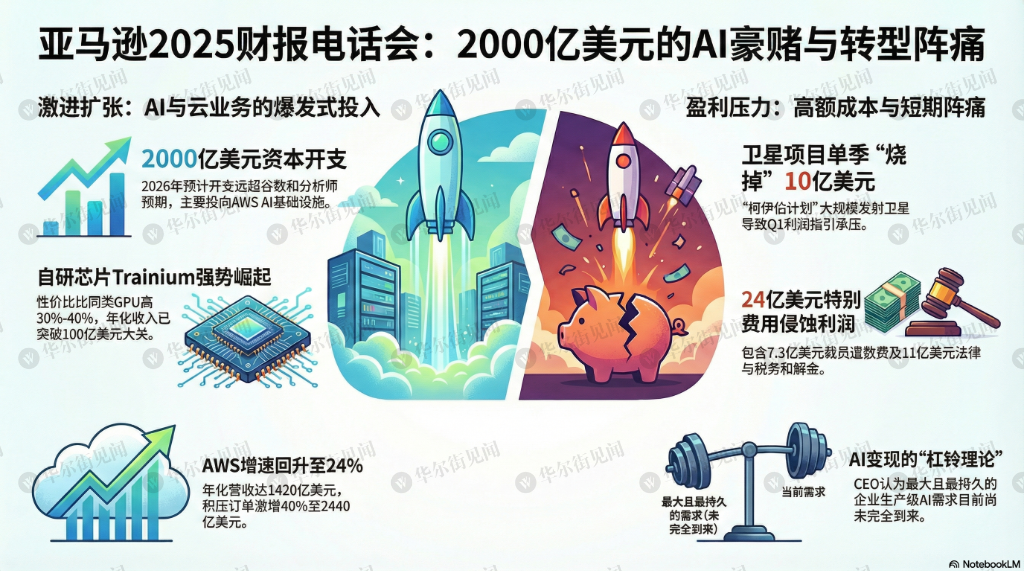
Core Viewpoint - Amazon's stock dropped 11% after announcing a projected capital expenditure of $200 billion for 2026, which was 40% higher than analysts' expectations, despite AWS backlog orders increasing by 40% to $244 billion [1][4][17]. AWS Performance - AWS reported a revenue growth of 24% year-over-year, reaching $35.6 billion, with an annualized run rate of $142 billion [17][48]. - The backlog for AWS increased to $244 billion, indicating high future revenue certainty [17]. - AWS's operating profit margin reached 35%, up 40 basis points year-over-year, despite anticipated depreciation and AI investment headwinds [18][48]. Capital Expenditure Insights - CEO Andy Jassy stated that the majority of the $200 billion capital expenditure will be allocated to AWS, particularly for AI infrastructure, citing high demand and no concerns about overcapacity [5][6]. - Jassy emphasized that the investments are not a "quixotic topline grab" and expressed confidence in achieving strong returns on invested capital (ROIC) [6][56]. AI and Chip Development - Amazon's self-developed chips, including Graviton and Trainium, have surpassed an annualized revenue run rate of $10 billion, growing at triple-digit percentages [7][30]. - Trainium chips have been delivered in over 1.4 million units, marking the fastest ramp-up in Amazon's history, with Trainium 3 expected to be 40% more cost-effective than its predecessor [8][9][33]. - The collaboration with Anthropic on Project Rainier is progressing well, utilizing 500,000 Trainium chips for their next large model [10][59]. Short-Term Profit Pressures - The CFO warned that the low Earth orbit satellite project (Project Kuiper) will incur an additional $1 billion in costs in Q1, impacting profit guidance [11][12]. - Special expenses totaling $2.4 billion, including severance costs and legal settlements, have also affected profitability [13][14][46]. E-commerce and AI Integration - The AI shopping assistant Rufus has been adopted by over 300 million customers, with a 60% higher conversion rate for users [19][40]. - Jassy introduced the concept of "agentic shopping," suggesting that consumers will prefer retailers' AI agents over general AI models for shopping [20][21]. Future Outlook - Amazon anticipates that the majority of AI demand is yet to come, with significant opportunities in enterprise-level workloads [22][56]. - The company is committed to investing in its fulfillment network to enhance productivity and customer experience, aiming for faster delivery times and improved inventory management [46][49].
亚马逊电话会:2000亿开支吓崩股价!卫星项目单季烧10亿,CEO辩护“产能即变现”,AWS订单激增40%
Hua Er Jie Jian Wen· 2026-02-06 01:04
Core Insights - Amazon's AWS reported its fastest growth in three years, but the projected capital expenditure of approximately $200 billion for 2026 shocked the market, exceeding analyst expectations by nearly 40% and surpassing Google's announced cap of $185 billion [2][3] - The aggressive investment strategy, particularly in AI infrastructure, was defended by CEO Andy Jassy during the earnings call, emphasizing the high demand for AWS services [3][4] AWS Growth and Investment - The majority of the $200 billion capital expenditure will be allocated to AWS, focusing on AI infrastructure, with Jassy stating that demand far exceeds supply [3][4] - AWS revenue grew by 24% year-over-year in Q4, reaching $35.6 billion, with an annualized run rate of $142 billion [9][36] - Backlog orders for AWS increased by 40% year-over-year to $244 billion, indicating strong future revenue certainty [9] AI and Chip Development - Amazon's self-developed chips, including Graviton and Trainium, have surpassed $10 billion in annualized revenue, growing at triple-digit percentages [4][17] - Trainium 2 has already delivered over 1.4 million chips, marking the fastest ramp-up in Amazon's history, while Trainium 3 has been launched with a 40% improvement in cost-effectiveness [4][22] Partnerships and Ecosystem - The collaboration with Anthropic on Project Rainier is progressing well, with Anthropic using Trainium 2 for their next large model, involving the use of 500,000 chips [5][46] - Jassy confirmed the ongoing partnership with OpenAI, highlighting that the AI movement will not be limited to a few companies but will involve thousands over time [5] Satellite Project and Financial Impact - The Project Kuiper satellite initiative is expected to incur an additional $1 billion in costs in North America, impacting Q1 profit guidance [6][7] - Special expenses totaling $2.4 billion, including $730 million for layoffs, have reduced operating profit [8][12] E-commerce and AI Integration - Amazon's AI shopping assistant, Rufus, has been adopted by over 300 million customers, significantly increasing conversion rates [10][28] - The company is focusing on "agentic shopping," where consumers will prefer retailers' AI agents for better selection, pricing, and trust [10][11] Future Outlook - The company anticipates that the majority of AI value will be derived from agents, with ongoing investments in AI infrastructure to maintain a competitive edge [23][24] - Amazon's commitment to capital expenditure of around $200 billion is primarily aimed at AWS, driven by high customer demand for core and AI workloads [24][43]
Wayfair(W) - 2025 Q3 - Earnings Call Transcript
2025-10-28 13:02
Financial Data and Key Metrics Changes - Revenue grew by 8% year-over-year on a reported basis and 9% year-over-year, excluding the impact of the exit from Germany [26][29] - Adjusted EBITDA increased by more than 70% year-over-year, achieving a margin of 6.7%, the highest level outside of the pandemic period [6][29] - Contribution margin improved to 15.8%, up 150 basis points year-over-year, marking the best result since 2021 [27][29] Business Line Data and Key Metrics Changes - U.S. business revenue increased by 9% year-over-year, while international revenue grew by 5% [26] - Active customers saw sequential growth for the first time since 2023, with orders growing over 5% year-over-year [9][29] - Average Order Value (AOV) rose approximately 2% in Q3, driven by a mix shift towards higher-end brands and B2B [9] Market Data and Key Metrics Changes - The overall category has moved past a multi-year trend of double-digit declines, inching closer to flat growth in 2025 [8][9] - Existing home sales remain at multi-decade lows, but the category is showing signs of stabilization [7][8] Company Strategy and Development Direction - The company is focused on driving share capture and profitability through strong execution and technology advancements [6][11] - Investments in AI and machine learning are aimed at enhancing customer experience and operational efficiency [12][15] - The strategy includes a dual-prompt approach to integrate the catalog into leading AI platforms while maintaining a strong presence on its own site [24][25] Management's Comments on Operating Environment and Future Outlook - Management believes that the current sluggish housing market does not significantly impact their growth strategy, which is driven by company-specific factors [8][9] - The company anticipates continued top and bottom line growth, with EBITDA growth expected to outpace revenue growth in 2026 [43][45] - There is optimism about the industry backdrop improving, with expectations for a gradual recovery in purchasing behavior [64][65] Other Important Information - The company ended the quarter with $1.2 billion in cash and short-term investments, and $1.7 billion in total liquidity [29] - Free cash flow improved by over $100 million compared to the same quarter last year, reaching $93 million [29] Q&A Session Summary Question: How is the company anticipating consumer behavior for the holiday season? - Management does not expect significant changes in consumer behavior due to tariffs and believes holiday shopping will follow traditional patterns [40][41] Question: What are the expectations for 2026 regarding share gains and gross margin? - The company aims for EBITDA growth to outpace revenue growth, driven by improvements in core offerings and new programs [42][43][46] Question: Is the business at an inflection point for growth? - Management remains optimistic about continued growth momentum and believes benefits from technology investments will contribute positively [50][52] Question: How does the company view the impact of Amazon's advertising changes? - The company does not see a significant impact from Amazon's advertising changes, as it already holds a strong market position [66][70] Question: What drove revenue acceleration in the later part of the quarter? - Revenue growth was attributed to structural business initiatives rather than pull forward effects, with strength noted in higher-end brands [75][78]