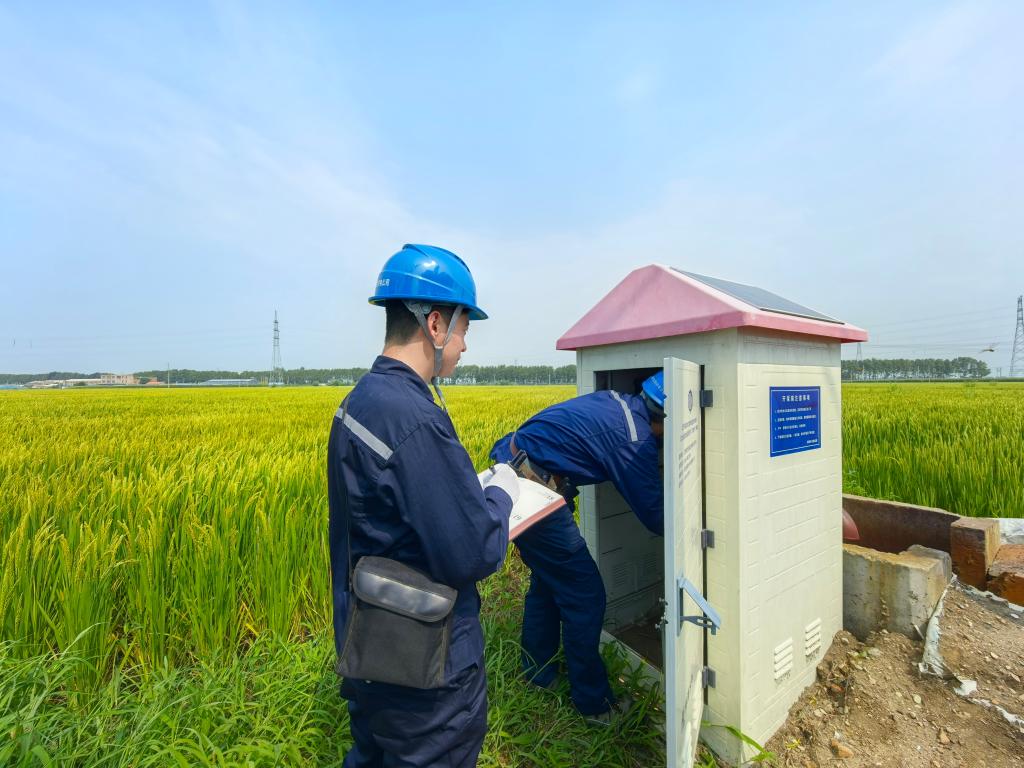
以电折水

Search documents
辽宁重点区域压减地下水提前“达标”
Xin Lang Cai Jing· 2025-12-28 22:35
Group 1 - The core focus of the news is the significant reduction of groundwater extraction in the province, achieving early targets set for 2025 in the "14th Five-Year Plan" [1] - From 2019 to 2024, the province has cumulatively reduced industrial and urban groundwater extraction by 364 million cubic meters and increased water-saving irrigation area by 800,800 acres [1] - The province has implemented comprehensive management of groundwater over-extraction, with a central water development fund of 80.15 million yuan supporting key projects [1] Group 2 - Agricultural water use is the largest sector, with an annual consumption of approximately 7 billion cubic meters, prompting the province to enhance management of groundwater resources [2] - From 2022 to 2025, the province plans to establish 2,639 "electricity-to-water" sample wells and match 62,000 wells with water-electricity records to improve agricultural water efficiency [2] - The province is conducting investigations into seawater intrusion, aiming to define 22 groundwater restriction areas covering a total of 5,424 square kilometers by 2030 [2]
“以电折水”促农业灌溉节水增效
Liao Ning Ri Bao· 2025-12-22 01:04
Core Insights - The project "Electricity to Water" has been recognized as a typical case for data circulation security governance by the National Data Bureau, highlighting its significance in agricultural water management [1] Group 1: Project Overview - The initiative involves linking agricultural irrigation wells' water usage with electricity consumption, addressing the challenge of water resource management in a water-scarce province [1] - The province has completed the registration of nearly 60,000 agricultural irrigation wells, contributing positively to the establishment of a water measurement system [1] Group 2: Implementation Details - Since 2022, the province has constructed 2,639 sample wells for online water measurement, taking into account crop types and irrigation methods to calculate water quotas [2] - The use of sample wells allows for significant cost savings in facility construction and maintenance while achieving efficient water management [2] Group 3: Data Sharing and Future Applications - A data sharing mechanism has been established between water and electricity departments, enabling cross-industry data exchange [2] - The data resources have potential applications in various agricultural projects, such as transforming dry fields into irrigated ones and optimizing irrigation network designs [2]
电表读数算水账——辽宁试点“以电折水”促节水增效
Xin Hua She· 2025-08-19 05:47
Core Viewpoint - The article discusses the implementation of the "electricity to water" monitoring system in Liaoning Province, aimed at improving water resource management for agricultural irrigation in a region facing severe water scarcity [1][4]. Group 1: Background and Context - Liaoning Province is one of the most water-scarce regions in China, with agricultural water usage accounting for over half of the total water consumption [1]. - Over 90% of existing agricultural irrigation wells lack water measurement facilities, making it challenging to manage water resources effectively [1]. Group 2: Implementation of the Monitoring System - The "electricity to water" system estimates water usage based on electricity consumption, allowing for a more efficient management of irrigation resources [1][4]. - The system involves selecting representative "sample wells" for monitoring, rather than installing measurement devices on every well, which would be financially burdensome [3][4]. - As of now, over 1,600 monitoring stations have been established in Liaoning Province to support the "electricity to water" initiative [4]. Group 3: Technological Features - The monitoring stations are equipped with devices that measure electrical parameters and water flow, enabling real-time data collection and analysis [3]. - The data collected can be used to create a comprehensive water usage map for the entire province, allowing for timely alerts on unusual water usage patterns [3]. Group 4: Benefits and Future Applications - The "electricity to water" system supports the precise management of irrigation water, particularly in water-scarce areas, promoting water conservation [4]. - It also provides data for optimizing irrigation system layouts and high-standard farmland construction, moving away from reliance on traditional experience-based methods [4].