伯克霍夫定理

Search documents
45年数论猜想被GPT-5.2 Pro独立完成证明,陶哲轩:没犯任何错误
猿大侠· 2026-01-21 04:18
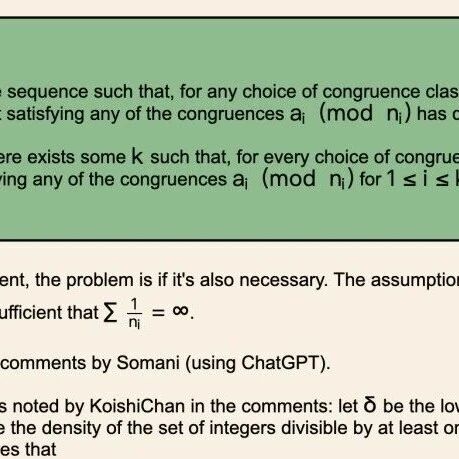
Core Insights - The article discusses the successful proof of an Erdős conjecture by OpenAI's latest model, GPT-5.2 Pro, marking a significant achievement in the intersection of AI and mathematics [2][3]. - The proof was validated by Fields Medalist Terence Tao, who described it as "the clearest first-class result contributed by AI to date" [3]. Group 1: The Proof and Its Validation - The conjecture, known as problem number 281 in the Erdős problem collection, was proposed in 1980 by mathematicians Paul Erdős and Ronald Graham, relating to deep connections between congruence covering systems and natural density [4][5]. - The proof utilized the infinite Adèle ring, employing Haar measure and pointwise ergodic theorems, transitioning from pointwise convergence to uniform convergence [9][10]. - Tao confirmed the proof's validity by translating the ergodic argument into combinatorial language, using the Hardy-Littlewood maximal inequality instead of the Birkhoff theorem [16]. Group 2: Alternative Solutions and Historical Context - An unexpected discovery emerged when a user named KoishiChan pointed out that a simpler solution to the problem exists, utilizing two theorems established in 1936 and 1966 [18]. - The first theorem is the density convergence theorem co-proven by Harold Davenport and Erdős in 1936, and the second is Rogers' theorem, first published in 1966 [19]. - Tao noted that Erdős himself was unaware of this simpler solution when he proposed the problem in 1980, raising questions about the problem's formulation [20]. Group 3: AI's Performance and Future Implications - Following the announcement, various AI models were tested for cross-validation, with Gemini 3 Pro confirming the proof's correctness [24]. - However, Tao cautioned about the statistical bias in evaluating AI's success rates, highlighting that negative results are often underreported [27]. - Current data suggests that the real success rate of these tools on Erdős problems is approximately 1% to 2%, which still indicates a significant number of non-trivial contributions from AI [31][32].