组合数学

Search documents
45年数论猜想被GPT-5.2 Pro独立完成证明,陶哲轩:没犯任何错误
猿大侠· 2026-01-21 04:18
Core Insights - The article discusses the successful proof of an Erdős conjecture by OpenAI's latest model, GPT-5.2 Pro, marking a significant achievement in the intersection of AI and mathematics [2][3]. - The proof was validated by Fields Medalist Terence Tao, who described it as "the clearest first-class result contributed by AI to date" [3]. Group 1: The Proof and Its Validation - The conjecture, known as problem number 281 in the Erdős problem collection, was proposed in 1980 by mathematicians Paul Erdős and Ronald Graham, relating to deep connections between congruence covering systems and natural density [4][5]. - The proof utilized the infinite Adèle ring, employing Haar measure and pointwise ergodic theorems, transitioning from pointwise convergence to uniform convergence [9][10]. - Tao confirmed the proof's validity by translating the ergodic argument into combinatorial language, using the Hardy-Littlewood maximal inequality instead of the Birkhoff theorem [16]. Group 2: Alternative Solutions and Historical Context - An unexpected discovery emerged when a user named KoishiChan pointed out that a simpler solution to the problem exists, utilizing two theorems established in 1936 and 1966 [18]. - The first theorem is the density convergence theorem co-proven by Harold Davenport and Erdős in 1936, and the second is Rogers' theorem, first published in 1966 [19]. - Tao noted that Erdős himself was unaware of this simpler solution when he proposed the problem in 1980, raising questions about the problem's formulation [20]. Group 3: AI's Performance and Future Implications - Following the announcement, various AI models were tested for cross-validation, with Gemini 3 Pro confirming the proof's correctness [24]. - However, Tao cautioned about the statistical bias in evaluating AI's success rates, highlighting that negative results are often underreported [27]. - Current data suggests that the real success rate of these tools on Erdős problems is approximately 1% to 2%, which still indicates a significant number of non-trivial contributions from AI [31][32].

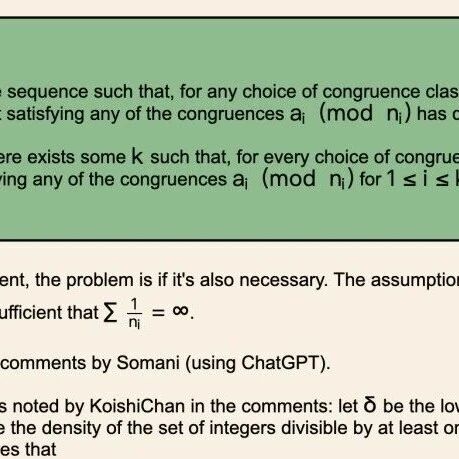
45年数论猜想被GPT-5.2 Pro独立完成证明,陶哲轩:没犯任何错误
3 6 Ke· 2026-01-19 07:29
Core Viewpoint - OpenAI's latest model, GPT-5.2 Pro, has independently proven a conjecture from the Erdős problem set, marking a significant achievement in AI's capability in mathematical reasoning [1][2]. Group 1: The Proof and Its Validation - The conjecture, known as the 281st problem in the Erdős problem library, was proposed in 1980 and remained unsolved for 45 years until a researcher named Neel Somani presented it to GPT-5.2 Pro [2]. - The proof utilized the infinite Adele integer ring and involved the Haar measure and pointwise ergodic theorem, transitioning from pointwise convergence to uniform convergence [3]. - The proof has been validated by Fields Medalist Terence Tao, who noted that GPT-5.2 Pro did not make common errors typically seen in previous AI models, such as mistakes in limit exchanges or quantifier order [8]. Group 2: Alternative Solutions and Historical Context - An unexpected discovery revealed that the problem has a simpler solution using two theorems established in 1936 and 1966, namely the density convergence theorem and Rogers' theorem [9]. - Terence Tao communicated with mathematician Tenenbaum, who confirmed that the problem could be solved using these classical results, suggesting that the problem's statement might have been altered at some point [10]. Group 3: AI's Performance and Statistical Insights - Following the announcement, various AI models were tested for cross-validation, with Gemini 3 Pro confirming the proof's validity [11]. - However, Tao cautioned that the true success rate of AI in solving mathematical problems is likely skewed due to reporting bias, as negative results are less likely to be shared [11]. - Current data indicates that AI tools have a real success rate of approximately 1% to 2% on Erdős problems, which, despite being low, still represents a significant number of non-trivial contributions given the existence of over 600 unsolved problems in the library [12].
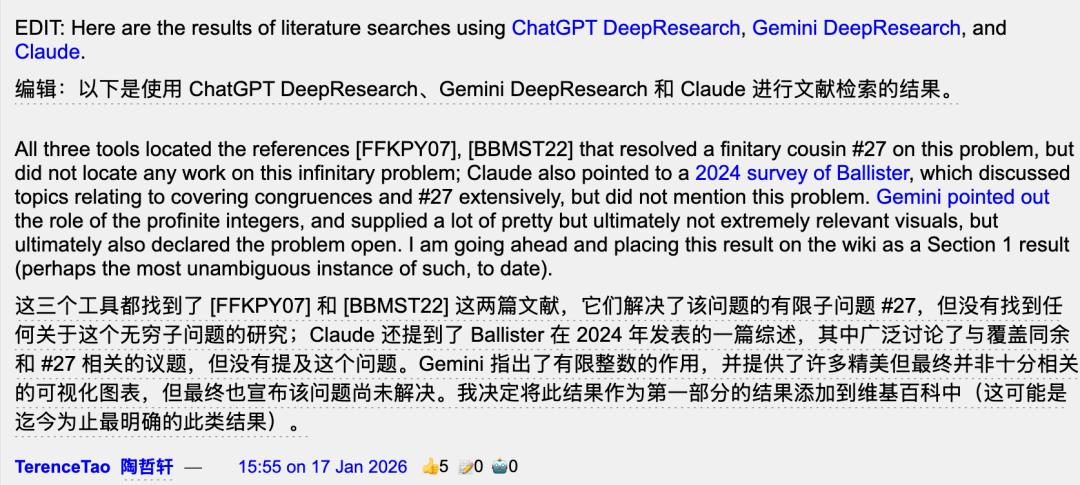
45年数论猜想被GPT-5.2 Pro独立完成证明,陶哲轩:没犯任何错误
量子位· 2026-01-19 07:00
Core Viewpoint - The article discusses the significant achievement of OpenAI's GPT-5.2 Pro in independently proving a mathematical conjecture known as the Erdős problem, specifically the 281st problem from the Erdős problem collection, which had remained unsolved for 45 years [2][4][5]. Group 1: Proof and Validation - The proof was verified by Fields Medalist Terence Tao, who described it as "the clearest first-class result contributed by AI to date" [3]. - The proof utilized concepts from ergodic theory and combinatorial mathematics, specifically leveraging the Birkhoff theorem and avoiding common pitfalls such as limit exchanges and quantifier order errors [9][15][12]. - Tao translated the proof into combinatorial language, confirming its validity and establishing that the proof is indeed correct [16][17]. Group 2: Alternative Solutions - An unexpected discovery was made by a user named KoishiChan, who pointed out that a simpler solution to the problem exists, utilizing two theorems established in 1936 and 1966 [18]. - The first theorem is the density convergence theorem co-proven by Harold Davenport and Paul Erdős in 1936, and the second is Rogers' theorem from a 1966 publication [19]. - This raises questions about why Erdős himself did not recognize the proximity of the solution when he proposed the problem in 1980 [20]. Group 3: AI's Success Rate and Future Implications - Following the announcement, various AI models were tested for their ability to validate the proof, with Gemini 3 Pro confirming its correctness [24]. - However, Tao cautioned that the true success rate of AI tools in solving such problems is likely skewed due to reporting biases, with only about 1% to 2% of attempts yielding positive results [30]. - Despite this low success rate, the existence of over 600 unsolved problems in the Erdős collection suggests that AI contributions could still be significant [31].
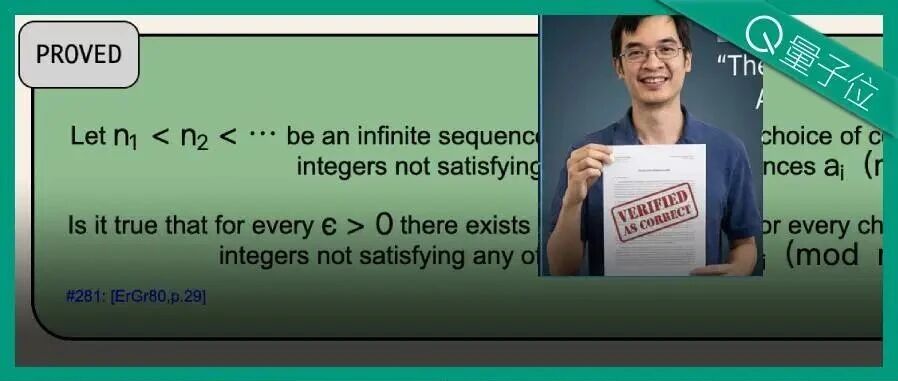
30年数学难题,AI仅6小时告破,陶哲轩:ChatGPT们都失败了
3 6 Ke· 2025-12-01 08:56
Core Insights - The AI mathematician "Aristotle" developed by HarmonicMath has independently solved the Erdős problem 124, a mathematical challenge that remained unsolved for 30 years, in just 6 hours, marking a significant milestone in the field of mathematics [1][7][9]. Group 1: AI Breakthrough - The AI completed the proof using the Lean proof system, taking only 1 minute for verification, with no human assistance involved [2][15]. - This achievement has been likened to a "moon landing" moment for the mathematics community, indicating a transformative era in mathematical proofs through AI [2][4]. Group 2: Problem Details - The core of Erdős 124 involves determining whether any large number can be represented in binary form under extreme constraints, a question that delves into the depths of combinatorial mathematics [9][11]. - The problem was originally proposed in the paper "Complete sequences of sets of integer powers" and has significant symbolic value in the mathematical community, often seen as a badge of honor for mathematicians [7][9]. Group 3: Community Response - Notable mathematician Terence Tao praised the AI's accomplishment, highlighting the shift in the mathematical landscape towards automation and AI-driven solutions [5][16]. - The success of "Aristotle" contrasts with other AI tools like ChatGPT and Gemini, which failed to provide new insights on the problem [15]. Group 4: Future Implications - The current trend suggests that many unsolved mathematical problems are within reach of AI, particularly those that have been overlooked due to limited human resources [18][20]. - The automation of solving simpler problems could lead to a significant increase in new mathematical results, as AI tools can efficiently tackle issues that have not received adequate attention from human mathematicians [18][20].

GPT-5通过“哥德尔测试”!独创性解决博士生都得花几天时间的开放数学问题
量子位· 2025-09-25 13:00
Core Viewpoint - GPT-5 has demonstrated the ability to solve complex mathematical optimization problems, achieving success in three out of five challenges presented by researchers, showcasing its advanced mathematical reasoning capabilities [2][21]. Group 1: GPT-5's Performance - In a recent study, GPT-5 was tasked with solving five unsolved optimization conjectures, successfully solving three of them [2][21]. - The challenges required a level of mathematical understanding typically expected from PhD-level researchers, rather than high school students [3][21]. - GPT-5's performance included generating a novel proof for one problem that differed from the researchers' expectations but was still valid [2][21]. Group 2: The Gödel Test - The researchers referred to their assessment as the "Gödel Test," which involved problems that required deep reasoning and could not be easily found in existing literature [10][11]. - The problems primarily focused on submodular maximization, a concept in combinatorial mathematics characterized by diminishing returns [12][13]. Group 3: Problem-Solving Details - For the first problem, GPT-5 was required to maximize a function composed of both monotonic and non-monotonic submodular functions under specific constraints, and it provided a performance guarantee [23][24]. - In the second problem, GPT-5 was tasked with maximizing a monotonic submodular function while adhering to complex constraints, yielding a solution that was more reasonable than initially anticipated [39][40]. - The third problem involved maximizing a continuous monotonic function under convex constraints, where GPT-5's response was generally correct but contained minor issues [59][60]. Group 4: Limitations and Challenges - GPT-5 struggled with the fourth and fifth problems, which required integrating insights from multiple sources, highlighting its limitations in comprehensive reasoning [26][73]. - In the fourth problem, GPT-5 failed to provide a valid solution and merely restated known information, while in the fifth problem, its output was deemed unreliable and unusable [70][81]. Group 5: Overall Assessment - Overall, GPT-5 exhibited significant improvements in basic mathematical capabilities compared to earlier models, particularly in combinatorial optimization [26][41]. - The model's performance was influenced by the prompts provided, with more detailed requests leading to more complete and coherent answers [26][62].
速递|斯坦福90后中国数学博士的AI公司,未出产品先融资5000万美元,B Capital正洽谈领投
Z Potentials· 2025-06-04 02:42
Core Viewpoint - The article discusses the emergence of AI startups focused on solving complex mathematical problems, highlighting the efforts of Carina Hong and her company Axiom, which aims to develop AI capable of formal mathematical proofs and is currently seeking $50 million in funding at a valuation of $300 million to $500 million [2][3]. Group 1: Company Overview - Axiom, founded by Carina Hong, is in discussions to raise $50 million to develop AI for solving mathematical problems, targeting a valuation between $300 million and $500 million [2][3]. - The company plans to sell its final product to hedge funds and quantitative trading firms that require quick solutions to complex mathematical issues related to asset valuation and stock markets [3]. Group 2: Market Context - Despite warnings from investors about the timing for developing autonomous models, there remains a willingness to invest in AI-related business concepts at high valuations [3]. - Other AI companies, such as Harmonic, founded by Vlad Tenev, are also pursuing similar goals of creating models capable of solving higher-level mathematics, indicating a competitive landscape in this niche [6]. Group 3: AI Performance and Challenges - OpenAI's o4-mini has recently outperformed human mathematicians in a math assessment, while Google's AI has shown significant potential in solving complex geometry problems [4]. - However, leading AI developers still struggle with basic mathematical tasks, indicating limitations in current AI capabilities despite advancements [3][4].