伽利略计划

Search documents
欧洲阿丽亚娜6型火箭首次发射伽利略导航卫星
Xin Hua She· 2025-12-18 01:48
Core Viewpoint - The successful launch of the Ariane 6 rocket marks a significant milestone for the European Space Agency's Galileo program, enhancing global navigation capabilities [1] Group 1: Launch Details - The Ariane 6 rocket successfully launched from the Guiana Space Centre on the 17th, delivering two Galileo navigation satellites into orbit [1] - This mission, designated VA266, is the fifth flight of the Ariane 6 rocket and its first mission for the Galileo program [1] - The launch occurred at 2:01 AM local time, with the satellites SAT 33 and SAT 34 separating approximately 3 hours and 55 minutes after launch [1] Group 2: Satellite and System Information - The two Galileo satellites were placed into a medium Earth orbit at an altitude of approximately 22,922 kilometers [1] - The European Space Agency announced that the satellites are in good condition and are undergoing initial operations and in-orbit testing [1] - These satellites are expected to join the Galileo navigation system in about three months, providing greater coverage and higher reliability [1] Group 3: Galileo Program Overview - The Galileo program is a global satellite navigation system led by the European Union, which began operations in 2016 and started providing high-precision services in 2023 [1] - The deployment of these satellites will further enhance the system's capability to offer all-weather navigation services [1]
哈佛著名教授再发奇谈,他的论文都说了什么,真相究竟如何?
Hu Xiu· 2025-09-26 03:38
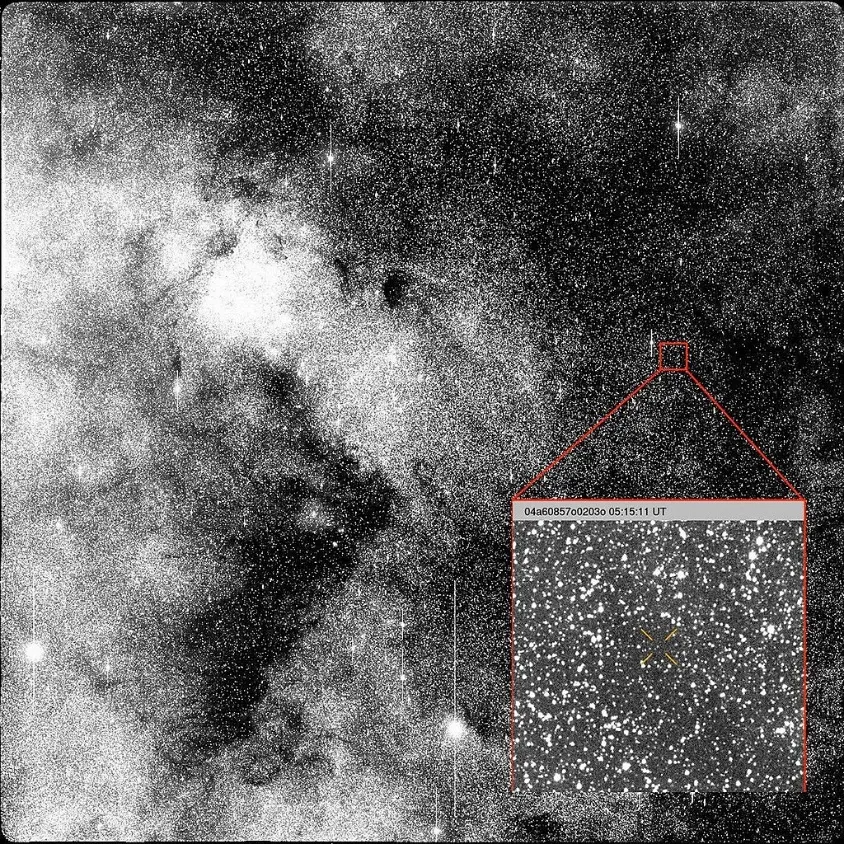
Core Viewpoint - The celestial object "3I/ATLAS" has garnered significant attention due to claims by Harvard professor Abraham Loeb and collaborators that it may be an alien spacecraft, although subsequent evidence suggests it is likely a natural interstellar comet [1][12][52]. Discovery and Characteristics - "3I/ATLAS" was discovered on July 1, 2025, by the Asteroid Terrestrial-impact Last Alert System (ATLAS) in Chile, with a visual magnitude of 18 [3]. - At the time of discovery, it was approximately 3.50 astronomical units from Earth and 4.51 astronomical units from the Sun, traveling at a speed of 61 kilometers per second [4]. - The object was confirmed to be an interstellar body, having been detected earlier by the Transiting Exoplanet Survey Satellite (TESS) on May 7, 2025 [5]. Orbital Dynamics - The trajectory of 3I/ATLAS was calculated, indicating it would pass close to Mars, Venus, and Earth in the coming months, with specific distances of 0.19 AU from Mars and 1.80 AU from Earth [6][14]. - Its hyperbolic orbit, with an eccentricity of 6.14, is atypical compared to the elliptical orbits of solar system bodies [8]. Arguments for Alien Technology - Loeb and collaborators proposed several reasons for considering 3I/ATLAS as a potential alien spacecraft, including its large diameter of approximately 20 kilometers, lack of identifiable chemical signatures, and unusual orbital characteristics [11]. - They suggested that its trajectory could allow for covert maneuvers near the Sun, which they argued might be indicative of advanced technology [15]. Counterarguments and Evidence - Subsequent observations revealed that 3I/ATLAS exhibited cometary features, including a tail and the presence of water ice, which contradicts the initial claims of it being an alien spacecraft [18][19]. - The arguments presented by Loeb were largely discredited, as the object was confirmed to be a natural interstellar comet, with its characteristics explained by existing astronomical knowledge [27][52]. Origin and Future Implications - 3I/ATLAS is believed to have originated from another solar system, potentially ejected by gravitational interactions with a giant planet or nearby star [33]. - The study of such interstellar objects is crucial for understanding the dynamics of celestial bodies and the potential for future discoveries, with estimates suggesting only a limited number of interstellar objects may be detected in the coming years [53].