保险股投资

Search documents
2026年,加仓寿险股票,还是财险股票?
雪球· 2026-01-26 08:05
Core Viewpoint - The article discusses the investment strategies between life insurance and property insurance, particularly in the context of market conditions and potential returns [3]. Timing Strategy - Life insurance has greater elasticity compared to property insurance, which means it can yield higher returns in favorable market conditions, but it may also experience negative returns in downturns due to smaller bases [4]. - Currently, life insurance companies like Xinhua Insurance have already seen significant rebounds, raising questions about future investment choices [4]. - The investment assets of life insurance typically double every six to seven years, but low interest rates and rising liability costs may hinder net investment returns from doubling in the future [4][5]. - Property insurance, while not doubling its investment assets, benefits from stable zero-cost liabilities, potentially leading to better net investment returns compared to life insurance [5]. Investment Return Analysis - In various hypothetical scenarios, property insurance may show higher growth than life insurance [6]. - Life insurance stocks with historically high investment returns may struggle to outperform property insurance in the coming years [7]. - Conversely, life insurance stocks with lower investment returns have a higher probability of outperforming property insurance [8]. Company-Specific Insights - China Taiping is highlighted as a preferred investment choice due to its low investment return of 2.68%, indicating significant potential for growth in the near future [8]. - If China Taiping's investment return reaches historical highs of 6%, the attractiveness of property insurance may increase [9]. Net Asset Stability - The net asset situation of various insurance companies shows that even in a year of increased investment returns, life insurance companies face pressure on net assets, while property insurance companies maintain stable growth [12][13]. - Net asset growth is crucial for insurance companies as it directly impacts their solvency and investment decisions [14][15]. - Property insurance companies exhibit more stable net asset growth, which supports their investment performance and valuation [16]. Overall Assessment - Property insurance is characterized by strong certainty in returns, with the only uncertainty stemming from the comprehensive cost ratio of auto insurance [17].




保险股开年成“亮眼的崽”,政策与业绩双轮驱动板块普涨
Bei Jing Shang Bao· 2026-01-06 07:37
Core Viewpoint - The A-share insurance sector has shown remarkable performance at the beginning of 2026, continuing the strong trend from 2025, with major companies experiencing significant stock price increases [3][4]. Group 1: A-share Insurance Performance - As of January 6, 2026, major A-share insurance companies such as Xinhua Insurance and China Pacific Insurance saw stock price increases exceeding 5%, while China Life and Ping An rose over 2% [1][3]. - On the first trading day of 2026, all five major A-share listed insurance companies recorded gains of over 5%, with Xinhua Insurance leading at an increase of 8.87% and China Pacific at 7.52% [3]. - The stock prices of Xinhua Insurance and China Pacific reached historical highs, while Ping An closed at 72.36 yuan per share, marking a five-year peak [3]. Group 2: Industry Fundamentals - The insurance industry has shown solid growth, with total premium income reaching 5.76 trillion yuan in the first eleven months of 2025, reflecting a year-on-year increase of 7.56% [4]. - Specifically, life insurance companies reported a premium income growth of 9.1%, while property insurance companies saw a 3.9% increase, indicating a stable development trajectory for the industry [4]. Group 3: Market Dynamics and Policy Impact - Analysts attribute the strong performance of insurance stocks to a combination of policy benefits, improved earnings, valuation recovery, and favorable capital allocation [4]. - Recent regulatory changes aimed at encouraging long-term investments by insurance funds have alleviated market concerns regarding investment restrictions, facilitating a systematic valuation recovery for the sector [4]. - The shift towards index-based investment products by the government positions insurance stocks as prime candidates for passive investment, enhancing their appeal in the market [4][5]. Group 4: Future Outlook - The overall bullish trend in insurance stocks throughout 2025 is expected to continue into 2026, supported by favorable liquidity conditions and policy relaxations that enhance the operational capabilities of insurance companies [5]. - The outlook for new business value (NBV) and premium growth remains positive, driven by favorable deposit migration trends and improved interest margins [5].




小摩:内险股首选中国人寿(02628)与中国平安(02318)
智通财经网· 2025-10-23 07:48
Core Insights - Morgan Stanley highlights the comparative analysis of the insurance markets in India and China during the quarterly earnings season, noting strong performance in China's insurance sector with positive earnings forecasts from three major players, while India's private insurers show mixed results [1][2] Group 1: Investment Themes - Preference for state-owned enterprises over private firms, specifically favoring LIC and China Life [1] - Focus on attractive re-entry points in India's non-life insurance sector while considering exit points in China's non-life insurance sector [1] - Reevaluation of underperforming stocks that show emerging value, such as China Ping An, which is currently trading at a 6x P/E ratio for the 2026 fiscal year with a dividend yield of 6% [1] Group 2: Market Performance and Valuation - Chinese insurance stocks are trading at a 7x P/E ratio for the 2025 fiscal year with a dividend yield of 4%, indicating attractive valuations [2] - Companies like China Life have announced strong net profit expectations for the first nine months, surpassing the overall market consensus for the year [2] - Anticipation of further upward revisions in earnings and dividend forecasts, providing catalysts for stock prices, supported by ongoing policy backing to enhance product profitability and diversify revenue sources [2]

罕见!保险巨头猛加仓、两次举牌“同行”!啥情况?
Zhong Guo Ji Jin Bao· 2025-08-16 02:56
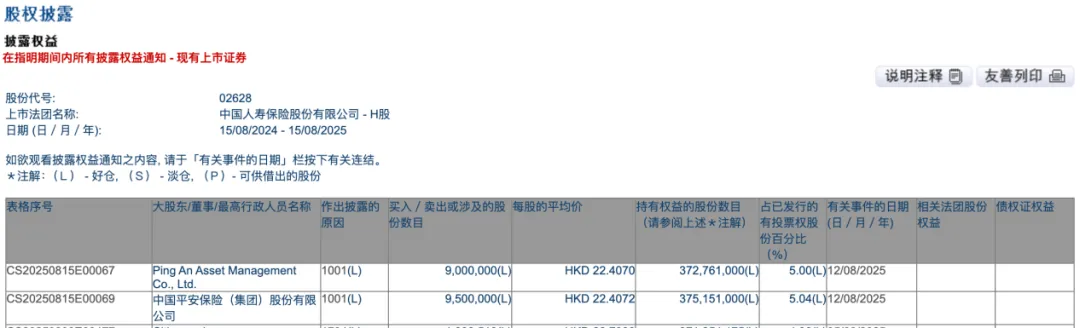
Core Viewpoint - China Ping An has increased its stake in China Life's H-shares to 5.04%, marking a rare occurrence of an insurance company acquiring shares in a peer company, indicating confidence in the insurance sector and financial considerations behind the move [1][3][5]. Group 1: Recent Acquisitions - On August 12, China Ping An purchased 9.5 million shares of China Life at HKD 22.4072 per share, totaling approximately HKD 213 million, raising its total holdings to 375.15 million shares [3][5]. - The day prior, on August 11, China Ping An acquired 174,140 shares of China Pacific Insurance at HKD 32.0655 per share, costing about HKD 55.84 million, increasing its stake to 5.04% [5]. Group 2: Market Context - The recent actions by China Ping An are part of a broader trend where over ten insurance institutions have made significant acquisitions in A-shares and H-shares, surpassing 20 instances this year alone, indicating a shift in investment strategy [9]. - Analysts suggest that the low interest rates and "asset scarcity" environment make high-dividend, low-valuation assets attractive for insurance companies, viewing them as "quasi-fixed income" investments [9]. Group 3: Financial Performance - China Pacific Insurance reported a revenue of CNY 404.09 billion for 2024, a year-on-year increase of 24.7%, with a net profit of CNY 44.96 billion, up 64.9% [9]. - As of August 15, China Pacific's H-shares were priced at HKD 36.64, reflecting a year-to-date increase of 51.76% and a TTM dividend yield of 3.22%, while China Life's H-shares were at HKD 24.36, with a 70.40% increase year-to-date and a TTM yield of 2.92% [10].