储能电站运行效果

Search documents
探秘全球最大电网侧分布式模块化储能电站,CNESA储能媒体行首站启幕!
中关村储能产业技术联盟· 2025-09-19 11:43
Core Viewpoint - The energy storage industry is transitioning from a strong supply-driven model to a market-driven approach, creating significant market opportunities while raising operational performance requirements for energy storage stations [2] Group 1: Industry Trends - The operational effectiveness of energy storage has become a core competitive factor as the industry moves towards large-scale and market-oriented development [3] - Key performance indicators for energy storage stations include online rate, operational efficiency, depth of discharge (DOD), and battery capacity degradation rate [3][4] Group 2: Performance Metrics - Online rate determines how long the system can operate at full power [4] - Operational efficiency reflects the quality of energy utilization [4] - Depth of discharge affects the single output capability of the system [4] - Capacity degradation rate impacts the long-term service life of the energy storage system [4] Group 3: Case Study - The Huayan First Energy Storage Station in Ningxia is the world's largest distributed modular energy storage project, with a capacity of 200MW/400MWh, and has been operational for 21 months since December 2023 [5][6] - The project utilizes a distributed modular smart energy storage system and has consistently ranked high in charging and discharging volumes, playing a crucial role in regional grid regulation [6] Group 4: Media Engagement - The "2025 CNESA Energy Storage Media Tour" aims to explore the successful operational strategies of the Huayan First Energy Storage Station, involving stakeholders such as investors, operators, equipment suppliers, and media [7] - The event will focus on key topics such as policy mechanisms, station operations, technical solutions, and performance factors affecting profitability [7]


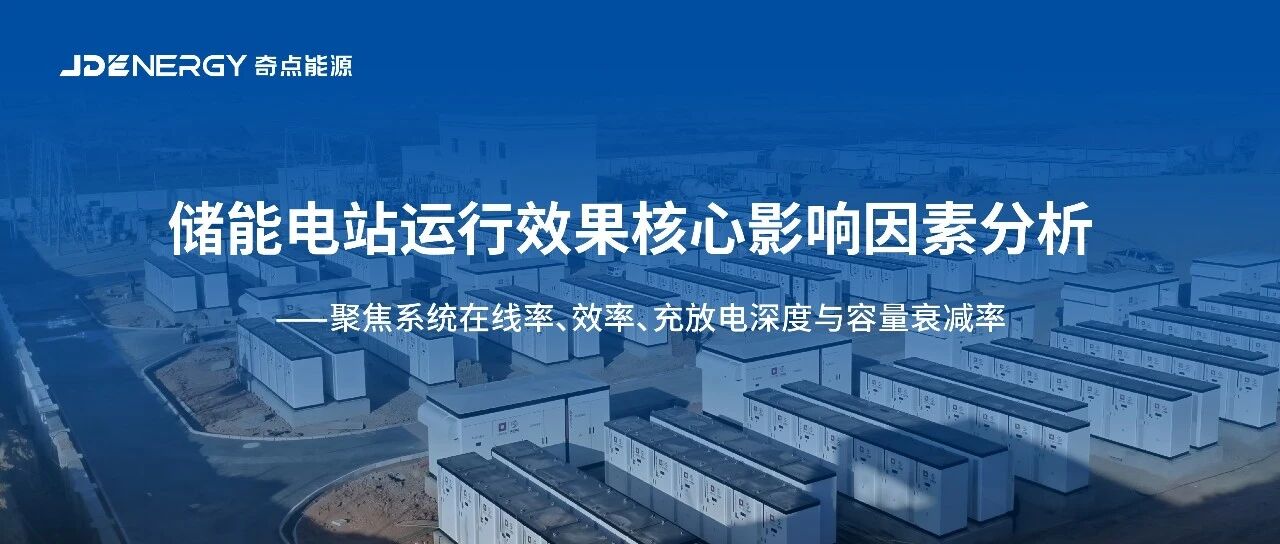
储能电站运行效果核心影响因素分析
中关村储能产业技术联盟· 2025-09-18 11:53
Core Viewpoint - The article emphasizes the importance of four key indicators—equipment online rate, operational efficiency, depth of discharge (DOD), and battery capacity degradation rate—in determining the performance and economic viability of energy storage stations, which are crucial for the new power system construction [2][27]. Group 1: Equipment Online Rate - The equipment online rate is the foundation of the station's "availability," with a 1% decrease leading to an annual discharge loss of up to 1200 MWh for a 200MW/400MWh station [3][6]. - Key factors affecting online rate include equipment stability, maintainability, and flexible redundancy mechanisms [6][8]. - High stability equipment can achieve a 99% online rate, resulting in a revenue loss of only 360,000 yuan annually, compared to 1.8 million yuan for average equipment at 95% [5]. Group 2: Equipment Operational Efficiency - Operational efficiency measures the energy conversion efficiency from charging to discharging, with a 1% increase potentially adding 600,000 yuan in annual revenue for a 200MW/400MWh station [9][10]. - Key factors influencing efficiency include energy conversion, thermal management, and system synergy [9][12]. - The average system efficiency is 85%, while leading solutions can achieve 89%, resulting in an additional 2.4 million yuan in annual revenue [10]. Group 3: Depth of Discharge (DOD) - DOD indicates the ratio of actual discharge capacity to rated capacity, directly affecting the station's peak shaving capability; a reduction from 90% to 80% DOD results in a 40 MWh decrease in discharge for a 400MWh station [15][16]. - Factors affecting DOD include battery characteristics, system topology, and control protection [15][19]. - Advanced string topology can support a DOD of 98%, leading to an additional 3.45 million yuan in revenue compared to a traditional centralized system [16]. Group 4: Battery Capacity Degradation Rate - The degradation rate indicates the percentage loss of battery capacity over cycles, with a 1% reduction in degradation potentially increasing lifecycle revenue by millions [20][24]. - Key factors influencing degradation include operating temperature, cycle count, and cell quality [20][22]. - High temperatures can significantly increase degradation rates, with a 15% degradation observed at 45°C after 1000 cycles [25]. Group 5: Synergistic Optimization of Indicators - The four indicators are interrelated; excessive focus on one may negatively impact others, such as increasing temperature to boost efficiency, which can accelerate capacity degradation [27]. - Achieving optimal performance requires a holistic approach across the entire lifecycle of selection, operation, and maintenance [27].