光伏组件性能验证

Search documents
CGC实证:晶科飞虎组件综合发电增益表现突出,弱光时段优势显著
Xin Lang Cai Jing· 2025-12-12 14:20
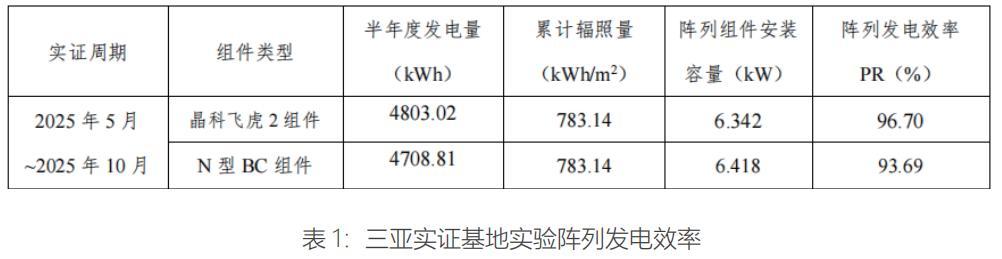
Core Insights - The testing conducted by Beijing Jianheng Certification Center (CGC) in Sanya, Hainan, demonstrated that Jinko's Tiger 2 modules outperformed N-type BC modules in terms of energy generation efficiency and performance under various light conditions [1][26]. Performance Summary - The Jinko Tiger 2 modules exhibited a 3.25% increase in energy generation per watt compared to N-type BC modules during the six-month monitoring period, achieving a performance ratio (PR) of 96.70%, significantly higher than the 93.69% of N-type BC modules [1][14][26]. - In low light conditions, the Jinko Tiger 2 modules showed remarkable advantages, with energy generation gains of 11.87% in the early morning (6:00-7:00) and 12.60% in the evening (18:00-20:00) compared to N-type BC modules [4][16]. - In extremely low irradiance conditions (0-100 W/m²), the Jinko Tiger 2 modules maintained a 5.87% higher energy generation compared to N-type BC modules, demonstrating their effectiveness in cloudy or low-light scenarios [6][17]. Project Background - The testing took place during a challenging tropical maritime climate in Sanya, characterized by high temperatures (average 29.26°C) and humidity (average 88%), with a total irradiance of 783.145 kWh/m², providing a rigorous environment for performance validation [8][21]. - The project aimed to assess the stability of energy generation and weak light response capabilities of solar modules, which are critical factors influencing investment returns and technology selection in the growing photovoltaic market [21]. Project Design - The Sanya testing facility was designed with two photovoltaic arrays, each consisting of 10 identical Jinko Tiger 2 and N-type BC modules, utilizing a dual-sided double-glass structure to ensure controlled testing variables [10][24]. - The experiment employed fixed mounts at approximately 15° facing south, with data continuously collected on energy generation, irradiance, component temperatures, and environmental conditions for comparative analysis [10][25].